

Ney Carter Borges: Does APOC3 Inhibition Translates into Structural Coronary Plaque Modification
Ney Carter Borges, Member Cardiologist of Global Physician Association at Cleveland Clinic Florida, shared a post on LinkedIn:
“APOC3 Inhibition with Olezarsen and Coronary Atherosclerosis
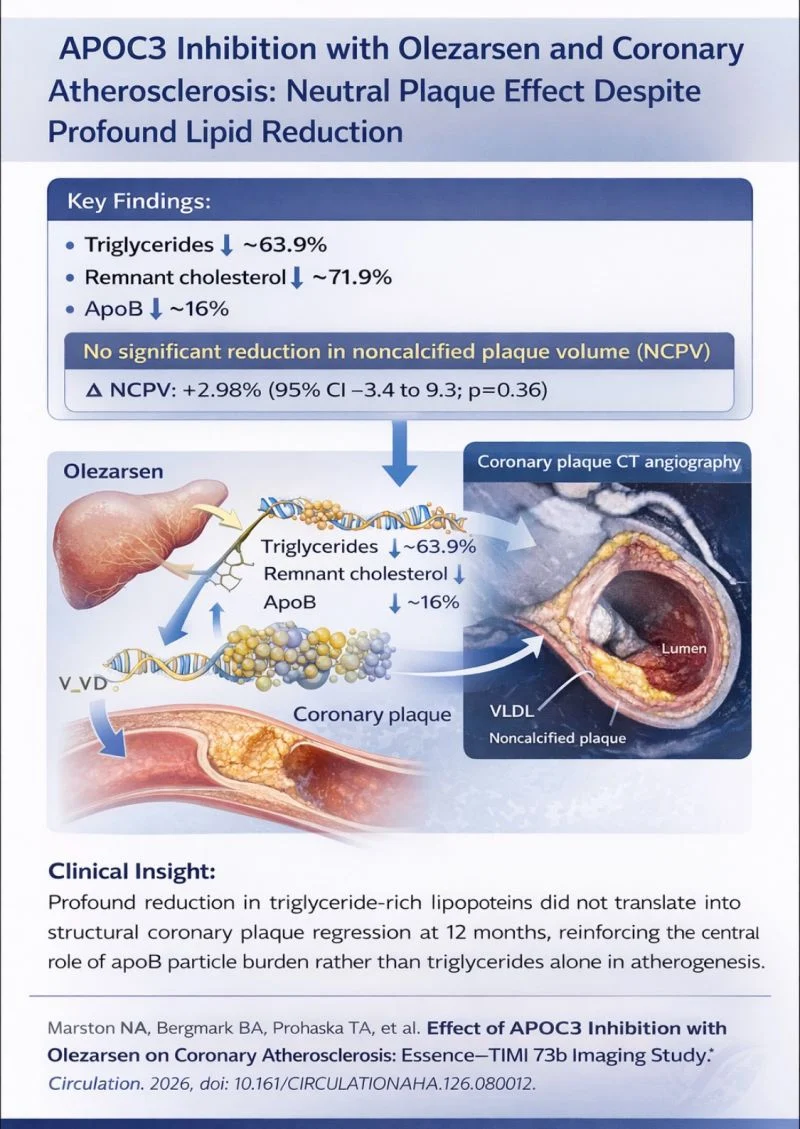
The Essence – TIMI 73b imaging substudy evaluated whether intensive triglyceride-rich lipoprotein reduction with olezarsen translates into structural coronary plaque modification.
In this randomized, placebo – controlled trial, 468 patients with moderate hypertriglyceridemia and established or high cardiovascular risk underwent serial coronary CT angiography over 12 months.
Olezarsen produced profound lipid changes, including a 63.9% reduction in triglycerides, 71.9% reduction in remnant cholesterol, and a 16% decrease in apolipoprotein B (apoB), without affecting LDL cholesterol.
Despite these robust metabolic effects, the primary endpoint – percent change in noncalcified plaque volume (NCPV) – was not significantly different compared with placebo (Δ +2.98%; 95% CI −3.4 to 9.3; p equals 0.36).
Similarly, no meaningful differences were observed across secondary plaque components, including low-attenuation and total plaque volumes.
These findings highlight a critical mechanistic insight:
Substantial triglyceride and remnant cholesterol reduction alone may be insufficient to induce measurable short – term plaque regression, particularly when apoB lowering is modest.
Given that apoB reflects the total burden of atherogenic particles, the results reinforce its central role in atherosclerosis progression.
Longer – term outcome trials are required to determine whether APOC3 inhibition confers clinical cardiovascular benefit despite neutral imaging findings.”
More posts featuring Ney Carter Borges on Hemostasis Today.
-
Oct 9, 2026, 16:23David Boone: Distinguishing Stroke Prevention from Rhythm Control in Atrial Fibrillation
-
Oct 9, 2026, 15:27Mohamed Hegazi: Geostatistical Modelling Maps Global β-Thalassaemia Carrier Prevalence
-
Oct 9, 2026, 15:15Maha Othman: Uncovering the Consensus on TXA in TBI – Call for Collaboration on a Landmark Umbrella Review
-
Oct 9, 2026, 15:07Daniel D. Han: How Inhalation Product Exposure Impairs Cardiac and Platelet Recovery After MI
-
Oct 9, 2026, 14:58William Toole: How Ultrasound-Guided PRP Therapy Relieves Joint and Tendon Pain
-
Oct 9, 2026, 14:50Shayan Mohammadmoradi: In Corpus Christi for the 20th Midwest Platelet Conference
-
Oct 9, 2026, 14:37Tariq Tramboo: High Platelet Concentrate for Osteoarthritis Knee – Recent Meta-Analyses
-
Oct 9, 2026, 14:26Yousma Khan: Hematology Series – Beyond RBCs, WBCs and Platelets
-
Oct 9, 2026, 14:13Jesus Ardila Novoa: Why the WHO’s Historic Essential Medicines List Decision Is Just the Beginning