


Richard Benjamin: RedeS Phase III Trial Reaches Major Milestone in Advancing Pathogen-Reduced RBCs for Transfusion
Richard Benjamin, Chief Medical Officer at Cerus Corporation, shared on LinkedIn about a recent article he and his colleagues co-authored, published in Trials, adding:
”The RedeS study team is happy to celebrate the end of the treatment phase of the RedeS (CLI 00126) trial of INTERCEPT pathogen-reduced Red Blood Cells (RBCs) (ClinicalTrials.gov NCT03037164), the second Phase III study needed for approval of pathogen-reduced RBCs (PR-RBC) for transfusion in the US.
With the demonstration of Zika virus transfusion transmission and congenital birth defects in 2016, the US Food and Drug Agency encouraged Cerus Corporation to make its PR-RBC technology available in Puerto Rico, first in the form of a Phase III clinical study to demonstrate safety and then, if needed, to the general population.
Funded by a contract with the US Department of Health and Human Services, Biomedical Advanced Research and Development Authority (BARDA), the RedeS study enrolled medical and surgical patients at three hospitals but the study was interrupted for prolonged periods by hurricanes Irma and Maria in September 2017, earthquakes in 2019 and 2020, and COVID-19 in 2020.
Enrollment was closed on the island and following consultation with the FDA, clinical sites were opened on the US mainland and Turkey with study expansion to gather data in repeatedly-transfused and red cell exchange subjects.
The study’s objective is to evaluate the safety and efficacy of INTERCEPT RBCs compared to conventional RBCs in patient requiring RBC transfusion support, with a primary efficacy endpoint of hemoglobin increment.
Clinical subject follow-up will continue through July/August and database lock is expected in the September/October timeframe.
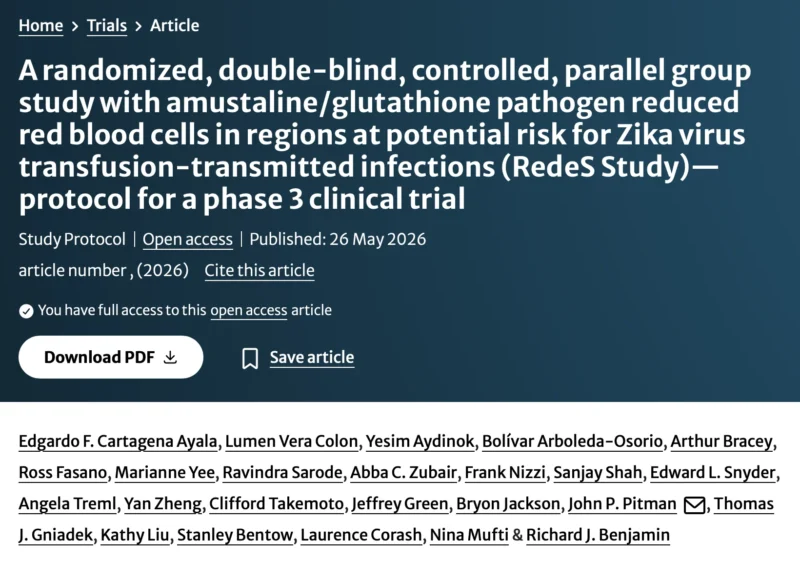
The protocol is published online at Ayala, E., Colon, L., Aydinok, Y. et al. A randomized, double-blind, controlled, parallel group study with amustaline/glutathione pathogen reduced red blood cells in regions at potential risk for Zika virus transfusion-transmitted infections (RedeS Study)—protocol for a phase 3 clinical trial. Trials (2026).”
Title: A randomized, double-blind, controlled, parallel group study with amustaline/glutathione pathogen reduced red blood cells in regions at potential risk for Zika virus transfusion-transmitted infections (RedeS Study)—protocol for a phase 3 clinical trial
Authors: Edgardo F. Cartagena Ayala, Lumen Vera Colon, Yesim Aydinok, Bolívar Arboleda-Osorio, Arthur Bracey, Ross Fasano, Marianne Yee, Ravindra Sarode, Abba C. Zubair, Frank Nizzi, Sanjay Shah, Edward L. Snyder, Angela Treml, Yan Zheng, Clifford Takemoto, Jeffrey Green, Bryon Jackson, John P. Pitman, Thomas J. Gniadek, Kathy Liu, Stanley Bentow, Laurence Corash, Nina Mufti, Richard J. Benjamin
Stay updated on all scientific advances with Hemostasis Today.
-
Oct 9, 2026, 16:23David Boone: Distinguishing Stroke Prevention from Rhythm Control in Atrial Fibrillation
-
Oct 9, 2026, 15:27Mohamed Hegazi: Geostatistical Modelling Maps Global β-Thalassaemia Carrier Prevalence
-
Oct 9, 2026, 15:15Maha Othman: Uncovering the Consensus on TXA in TBI – Call for Collaboration on a Landmark Umbrella Review
-
Oct 9, 2026, 15:07Daniel D. Han: How Inhalation Product Exposure Impairs Cardiac and Platelet Recovery After MI
-
Oct 9, 2026, 14:58William Toole: How Ultrasound-Guided PRP Therapy Relieves Joint and Tendon Pain
-
Oct 9, 2026, 14:50Shayan Mohammadmoradi: In Corpus Christi for the 20th Midwest Platelet Conference
-
Oct 9, 2026, 14:37Tariq Tramboo: High Platelet Concentrate for Osteoarthritis Knee – Recent Meta-Analyses
-
Oct 9, 2026, 14:26Yousma Khan: Hematology Series – Beyond RBCs, WBCs and Platelets
-
Oct 9, 2026, 14:13Jesus Ardila Novoa: Why the WHO’s Historic Essential Medicines List Decision Is Just the Beginning