


Ney Carter Borges: FAVOR III China Demonstrates a 37% Reduction in Myocardial Infarction with QFR Guidance
Ney Carter Borges, Member Cardiologist of Global Physician Association at Cleveland Clinic Florida, shared on LinkedIn about a recent article by Han Zhang et al, published in JACC, adding:
”QFR-Guided PCI Improves 5-Year Outcomes: The FAVOR III China Trial
The FAVOR III China trial provides the longest follow-up to date evaluating an angiography-derived physiological strategy for guiding percutaneous coronary intervention (PCI).
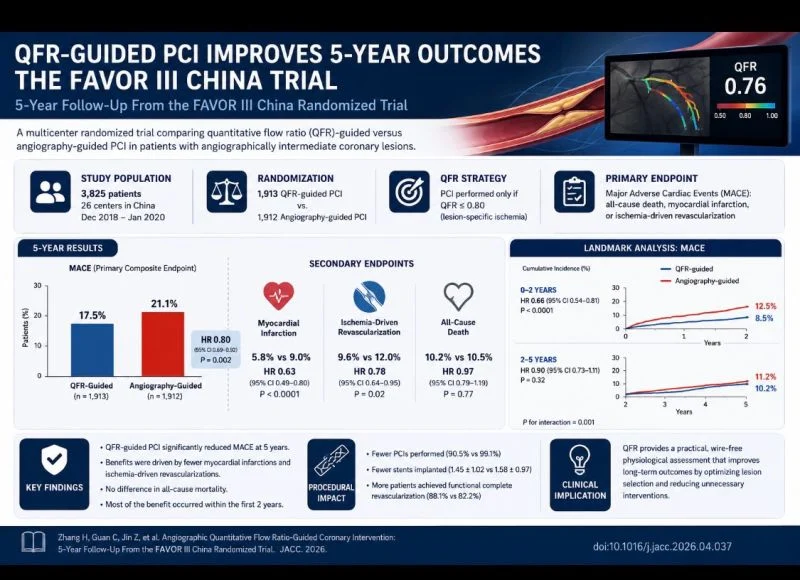
In this multicenter, randomized study involving 3,825 patients with intermediate coronary stenoses, participants were assigned to PCI guided either by Quantitative Flow Ratio (QFR) or by conventional angiography alone.
After 5 years, QFR guidance significantly reduced the incidence of major adverse cardiovascular events (MACE) compared with angiography-guided PCI (17.5% vs 21.1%; HR 0.80; 95% CI 0.69–0.92; p=0.002).
This benefit was primarily driven by a 37% reduction in myocardial infarction (5.8% vs 9.0%; HR 0.63; p<0.0001) and a 22% reduction in ischemia-driven repeat revascularization (9.6% vs 12.0%; HR 0.78; p=0.02).
Overall mortality was similar between groups, confirming that the physiological strategy improves ischemic outcomes without affecting long-term survival.
An important finding is that QFR-guided PCI resulted in fewer procedures and fewer implanted stents, while achieving greater functional completeness of revascularization.
By identifying lesions that truly produced ischemia, QFR avoided unnecessary interventions without compromising safety.
Landmark analysis demonstrated that most of the clinical advantage occurred during the first two years after PCI.
From years 2 to 5, event rates became similar, suggesting that the principal benefit of physiological guidance is the optimization of the initial revascularization strategy rather than continuous divergence over time.
Clinical message: QFR offers a practical, wire-free physiological alternative to FFR, allowing more precise lesion selection while reducing procedural complexity.
These 5-year results reinforce QFR as an effective strategy to improve long-term clinical outcomes, decrease unnecessary stenting, and reduce myocardial infarction and repeat revascularization in patients undergoing PCI.”
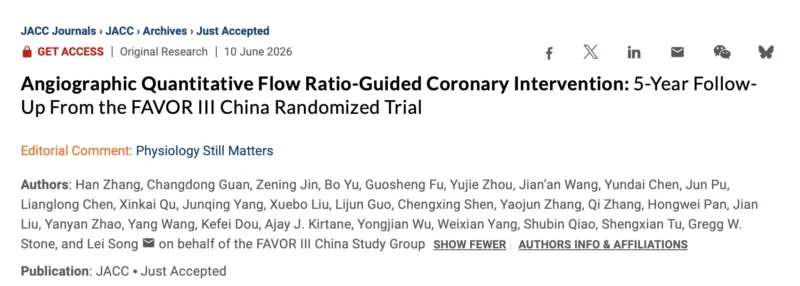
Title: Angiographic Quantitative Flow Ratio-Guided Coronary Intervention: 5-Year Follow-Up From the FAVOR III China Randomized Trial
Authors: Han Zhang, Changdong Guan, Zening Jin, Bo Yu, Guosheng Fu, Yujie Zhou, Jian’an Wang, Yundai Chen, Jun Pu, Lianglong Chen, Xinkai Qu, Junqing Yang, Xuebo Liu, Lijun Guo, Chengxing Shen, Yaojun Zhang, Qi Zhang, Hongwei Pan, Jian Liu, Yanyan Zhao, Yang Wang, Kefei Dou, Ajay J. Kirtane, Yongjian Wu, Weixian Yang, Shubin Qiao, Shengxian Tu, Gregg W. Stone, Lei Song
Stay updated on all scientific advances with Hemostasis Today.
-
Sep 29, 2026, 16:01Stephen Cornelissen: How Joining the Stem Cell Registry Can Save Patients with Blood Cancers
-
Sep 29, 2026, 15:45Alan Nurden: Could Mast Cell aIIb Integrin Play a Key Role in Septic Thrombus Stability?
-
Sep 29, 2026, 15:43Priyadarshani Sharma: Advocacy and Patient Rights Transform Indian Haemoglobinopathies Care
-
Sep 29, 2026, 15:21Kanchan K Banerjee: Rusfertide Earns NCCN Category 1 Recommendation for Polycythemia Vera
-
Sep 29, 2026, 15:06Faizan Khan։ The Worldwide Burden of Venous Thromboembolism
-
Sep 29, 2026, 14:59Global Von Willebrand Disease Diversity Webinar Now Available on EHC YouTube – EHC
-
Sep 29, 2026, 14:43Mary Cushman: Apply to Shape Scientific Publishing as ISTH Associate Editor
-
Sep 29, 2026, 14:32Honoring Women Leaders Advancing Research, Care, and Innovation in Thrombosis and Hemostasis – Seminars in Thrombosis and Hemostasis
-
Sep 29, 2026, 14:20Nathan Connell: Key Takeaways from the 8th Aland Island Meeting on von Willebrand Disease