


Sara Ng: VTE Continues to Plague Modern Oncology
Sara Ng, Clinical and Laboratory Haematologist, Director of Thrombosis and Haemostasis at South Western Sydney Local Health District, reposted from Alok Khorana on LinkedIn:
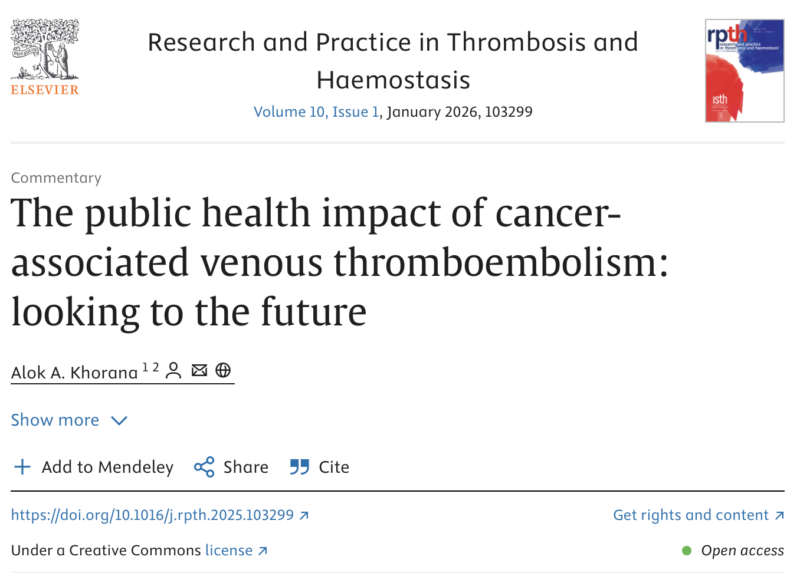
”Despite being a known complication since the 19th century, VTE continues to plague modern oncology. A new commentary by Dr. Alok Khorana in RPTH Journal highlights that even in the era of immunotherapy and targeted agents, the public health burden of cancer-associated VTE remains critically high.
VTE is not fading away with better cancer care –
• The risk of VTE is 9-fold higher in general cancer populations and up to 20-fold higher in advanced cancer compared to non-cancer controls.
• The shift to immune checkpoint inhibitors has not eliminated risk; some targeted therapies, like amivantamab-lazertinib for EGFR-mutated NSCLC, are associated with VTE rates as high as 40%.
• Evaluating 2021 data from Maiocco et al., we see that 8.1% of cancer-related hospitalizations had a VTE co-diagnosis.
• Risk is disproportionately high in gastrointestinal, genitourinary, and gynecologic cancers, and Black patients face a higher risk (aOR 1.29).
Beyond the clinical danger, the economic and operational toll is massive –
• Outcomes: Cancer admissions with VTE have higher all-cause mortality (aOR 1.61) compared to those without.
• Resource Use: These admissions are longer (median 6 vs 4 days) and significantly more expensive ($70,416 vs $55,887).
We need better implementation science and standardized risk assessment to protect our patients from this age-old complication!”
Quoting Alok Khorana‘s post:
”My editorial on the public health impact of cancer-associated VTE is now available RPTH Journal.
This comments on an important paper by Maiocco and colleagues that analyzed the Nationwide Inpatient Database and showed:
– Admissions with cancer and VTE had higher all-cause mortality compared with those with cancer but without VTE (aOR, 1.61).
– The worse the clot, the worse the outcome: aOR for mortality was 1.41 for DVT and 1.88 for pulmonary embolism
– Admissions with cancer and VTE codiagnoses were longer (median of 6 vs 4 days) and much more expensive ($70,416 vs $55,887 per admission; P < .001 for all comparisons) than those for cancer without VTE.
What can we do to overcome this situation?
Better Data: Establishing statewide or national registries, similar to Florida’s new model, to track hospital-acquired VTE as advocated for by the National Blood Clot Alliance.
New Therapies: Investigating safer prevention methods, such as the STAT-CAT trial (testing statins) and upcoming Factor XI inhibitors that may prevent clots with less bleeding risk.
System Changes: redesigning clinical workflows to better identify high-risk patients and implement guidelines.”
Read the full article here.
Article: The public health impact of cancer-associated venous thromboembolism: looking to the future
Authors: Alok Khorana
Stay updated on all scientific advances with Hemostasis Today.
-
Oct 9, 2026, 11:51Sumaiya Dickens: Marginal Zone B Cells in Transfusion Medicine and Hemophilia A Research
-
Oct 9, 2026, 11:44Ayyappan V Nair: PRP and Rehabilitation – Can It Help Athletes with Partial Rotator Cuff Tears?
-
Oct 9, 2026, 11:29Jigesha Dholakia: Supporting the Hemophilia Community Through the Unite Walk
-
Oct 9, 2026, 11:06Nobles Green: How siRNA Therapy Helps the Body Form Stronger Clots
-
Oct 9, 2026, 10:53Switching From Emicizumab to Denecimig in Hemophilia A – Rare Disease Advisor
-
Oct 9, 2026, 10:40What New U.S. Data Reveal About GT – Glanzmann’s Research Foundation
-
Oct 9, 2026, 10:32Anjali Pandey: The Morphologic Clues to MDS With del(5q)
-
Oct 9, 2026, 10:13Reza Shojaei: 5 Leadership Responsibilities for a Sustainable Plasma Ecosystem
-
Oct 9, 2026, 08:38Johannes Gratz: Perioperative Care in Factor VII Deficiency – Treating the Patient, Not the Number