

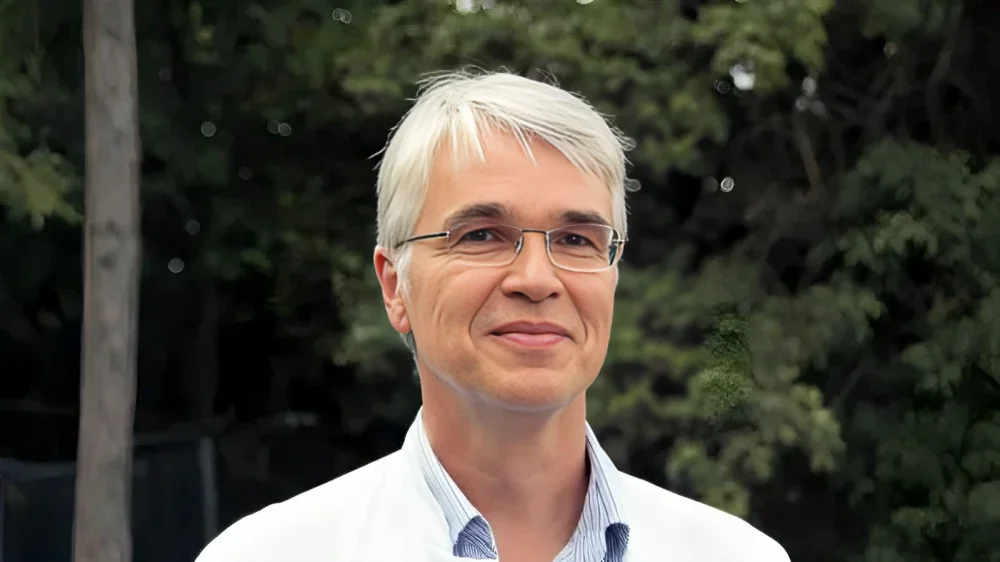
Wolfgang Miesbach: Infections as a Trigger for Stroke in Young Adults
Wolfgang Miesbach, Professor of Medicine at Frankfurt University Hospital, shared a post on LinkedIn about a recent article by Barbara M. Hulsen et al, published in Stroke:
”Infections as a Trigger for Stroke in Young Adults – The role of thromboinflammation.
Just published in Stroke, this multicenter study by Hulsen et al. sheds new light on why young people — without classic cardiovascular risk factors — suffer from cryptogenic ischemic stroke (CIS).
- The question: Can a preceding infection act as a transient trigger for early-onset CIS (ages 18–49), and do coagulation biomarkers explain the mechanism?
- The SECRETO study enrolled 537 matched case-control pairs across 19 European centers (2013–2022), measuring coagulation biomarkers — VWF, FVIII, fibrinogen, antithrombin III, and protein C — at baseline and 3-month follow-up.
What they found:
- Infection in the preceding week – 2.6-fold higher odds of CIS (OR 2.64; 95% CI 1.34–5.20)
- VWF was markedly elevated in CIS patients with recent infection (157 IU/mL) vs. those without (121 IU/mL) — but not in healthy controls, suggesting a heightened thromboinflammatory sensitivity in CIS patients
- Each SD increase in VWF and FVIII was linked to higher stroke odds in those with recent infection or fever
A ‘second hit’ hypothesis:
Importantly, CIS patients already showed higher baseline levels of VWF, FVIII, and fibrinogen compared to healthy controls — even without a recent infection.
Why thromboinflammation can lead to stroke:
The central role of VWF and platelet recruitment under high shear flow conditions in cerebral vessels points specifically to arterial thrombosis.
The paper explicitly cites the VWF–platelet glycoprotein Ib axis as a key thromboinflammatory driver specifically in stroke.”
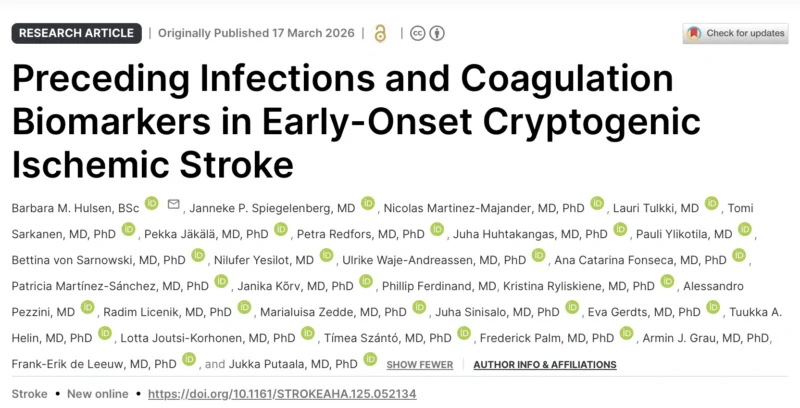
Title: Preceding Infections and Coagulation Biomarkers in Early-Onset Cryptogenic Ischemic Stroke
Authors: Barbara M. Hulsen, Janneke P. Spiegelenberg, Nicolas Martinez-Majander, Lauri Tulkki, Tomi Sarkanen, Pekka Jäkälä, Petra Redfors, Juha Huhtakangas, Pauli Ylikotila, Bettina von Sarnowski, Nilufer Yesilot, Ulrike Waje-Andreassen, Ana Catarina Fonseca, Patricia Martínez-Sánchez, Janika Kõrv, Phillip Ferdinand, Kristina Ryliskiene, Alessandro Pezzini, Radim Licenik, Marialuisa Zedde, Juha Sinisalo, Eva Gerdts, Tuukka A. Helin, Lotta Joutsi-Korhonen, Tímea Szántó, Frederick Palm, Armin J. Grau, Frank-Erik de Leeuw, Jukka Putaala
Read the Full Article on Stroke
Stay updated on all scientific advances with Hemostasis Today.
-
Sep 16, 2026, 16:06Katrina Louise Manalaysay: In Your 20s, You Might be Given the Opportunity to Donate Blood for the First Time
-
Sep 16, 2026, 15:45Matthew Hazell: A Brilliant Explanation of Phenotype vs Genotype Using a LEGO House
-
Sep 16, 2026, 15:23Ahmad Al-Ramahi: Presenting the Military Pharmacists Blood Training Course at the FIP World Congress
-
Sep 16, 2026, 15:21HIT Reimagined: Can 12-Lipoxygenase Inhibition Stop Immune Thrombosis?
-
Sep 16, 2026, 14:42Ruchi Punamia: Beyond the Blood Bank and The Clinical Impact of Apheresis
-
Sep 16, 2026, 14:06Kalyan Roy: Celebrating Apheresis, Advancing Care, Saving Lives
-
Sep 16, 2026, 13:38Andrew Zapfel: Advancing Sickle Cell Disease Care and Research
-
Sep 16, 2026, 13:30Thirunavukkarasu Angappan: Why Plasma-Derived Factor VIII Still Matters for Inhibitor Patients
-
Sep 16, 2026, 13:22Matthew Hazell: New BSH Guidance for Fetal, Neonatal and Paediatric Transfusion