


Jack Shuang Hou: Asundexian Hits Phase 3 Stroke Endpoint Without Increasing Bleeding Risk
Jack Shuang Hou, Scientific Director at Jtests, shared on LinkedIn:
”Bayer Revives FXIa Hopes: Asundexian Hits Phase 3 Stroke Endpoint Without Increasing Bleeding Risk
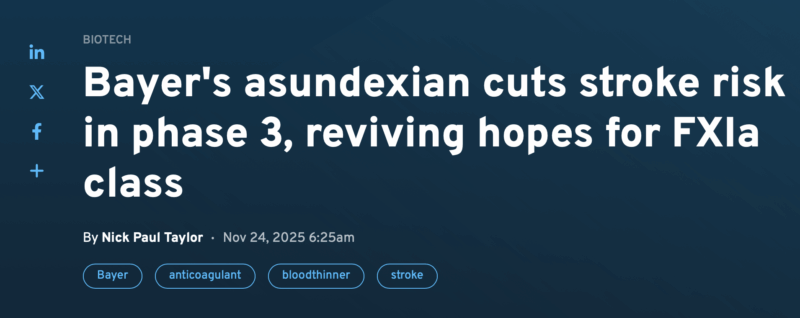
A major turnaround for the Factor XIa class — Bayer has just reported a successful phase 3 readout for asundexian, showing a significant reduction in stroke with no increase in major bleeding in secondary stroke prevention (SSP).
After two years of setbacks across the FXIa landscape, this marks the first late-stage win that could reshape the future of anticoagulation.
Key Insights
FXIa Inhibition Shows Real-World Promise
The SSP trial demonstrated that targeting FXIa may finally deliver the “holy grail” of anticoagulation:
- Prevent clots
- Without elevating bleeding risk
This differentiates FXIa inhibitors from traditional agents like Eliquis and Xarelto, whose bleeding profiles remain a challenge.
A Big Strategic Win for Bayer
After halting its afib trial two years ago, Bayer desperately needed validation of this mechanism.
• Shares jumped 10% on the news
• The result could reignite growth for its pharma division
• It opens a new potential blockbuster path as Xarelto faces LOE pressure
Implications for Competitors (Positive Read-Through)
Analysts at BMO Capital Markets and others suggest this is also a tailwind for Bristol Myers Squibb and Johnson and Johnson, who are pursuing their own FXIa candidate, milvexian.
Even though milvexian recently had a trial halted for futility, renewed confidence in the mechanism may support ongoing SSP and afib studies.
What to Watch Next
While the topline news is strong, the field is waiting for full data:
• How large was the treatment effect?
• How clinically meaningful is the benefit?
• Which patient subgroups respond best?
These will determine how aggressively regulators — and physicians — embrace FXIa therapies.
My Take:
FXIa inhibition might finally be emerging as the next evolution in anticoagulation—addressing an enormous unmet need for safer, long-term therapy.
If confirmed by full data, this could represent one of the most important shifts in cardiovascular medicine in the next decade.”
Read the full article here.
Stay updated with Hemostasis Today.
-
Oct 9, 2026, 16:23David Boone: Distinguishing Stroke Prevention from Rhythm Control in Atrial Fibrillation
-
Oct 9, 2026, 15:27Mohamed Hegazi: Geostatistical Modelling Maps Global β-Thalassaemia Carrier Prevalence
-
Oct 9, 2026, 15:15Maha Othman: Uncovering the Consensus on TXA in TBI – Call for Collaboration on a Landmark Umbrella Review
-
Oct 9, 2026, 15:07Daniel D. Han: How Inhalation Product Exposure Impairs Cardiac and Platelet Recovery After MI
-
Oct 9, 2026, 14:58William Toole: How Ultrasound-Guided PRP Therapy Relieves Joint and Tendon Pain
-
Oct 9, 2026, 14:50Shayan Mohammadmoradi: In Corpus Christi for the 20th Midwest Platelet Conference
-
Oct 9, 2026, 14:37Tariq Tramboo: High Platelet Concentrate for Osteoarthritis Knee – Recent Meta-Analyses
-
Oct 9, 2026, 14:26Yousma Khan: Hematology Series – Beyond RBCs, WBCs and Platelets
-
Oct 9, 2026, 14:13Jesus Ardila Novoa: Why the WHO’s Historic Essential Medicines List Decision Is Just the Beginning