

Abdul Mannan: Why AML inv(16) Isn’t Just “Favourable”
Dr Abdul Mannan, Consultant Haematologist at Betsi Cadwaladr University Health Board, posted on LinkedIn:
“The ‘Harlequin’ Leukemia: Why AML inv(16) Isn’t Just ‘Favourable’
AML with inv(16)(p13.1q22) is one of the most visually striking and biologically distinct subtypes we see. Textbooks call it ‘favourable.’ Clinicians know it’s more complicated.
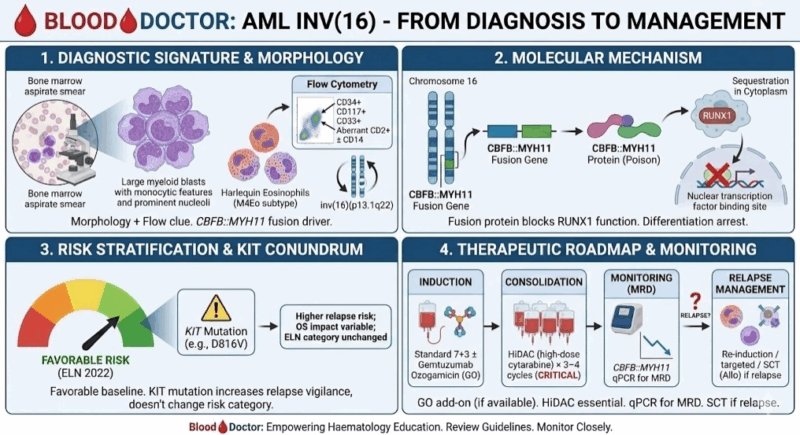
1. Morphology: The Harlequin Clue
- The FAB M4Eo marrow gives it away.
- Those eosinophils with mixed orange and purple granules are almost diagnostic.
- And if the blasts show CD2 positivity, you already know what the karyotype is likely to say.
2. The Engine: CBFB::MYH11
- The fusion traps RUNX1 in the cytoplasm, freezing maturation and driving the disease. Classic CBF biology.
3. The ELN 2022 Twist: KIT Isn’t a Deal-Breaker
- About one-third carry KIT mutations, especially D816V.
- Yes, relapse risk climbs.
- But ELN 2022 keeps CBF-AML in the favourable group regardless because overall survival remains excellent.
Practical point:
- Not a transplant trigger in CR1, but absolutely a reason for closer molecular surveillance.
4. Treatment: Do It Properly or Don’t Call It Favourable
- Induction:
- CD33-high disease → add Gemtuzumab Ozogamicin where possible.
- Consolidation:
- No shortcuts.
- This subtype demands high-dose Cytarabine (HiDAC). Standard-dose consolidation is simply not enough.
5. MRD: Your Early Warning System
- Monitor the CBFB::MYH11 transcript every 3 months for two years.
- A rising log value means molecular relapse long before counts crash.
Bottom Line
- inv(16) isn’t “easy AML.”
- It’s highly curable only when treated with precision: recognise the morphology, respect the molecular modifiers, use GO in induction, and commit to HiDAC consolidation.
How are you using Gemtuzumab in your CBF-AML pathways? And what’s your approach to KIT-mutated cases in CR1? Happy to hear how others are tackling this.”
Follow the latest with Hemostasis Today.
-
Oct 19, 2026, 03:54Jennifer Trowbridge: How Mutant Blood Stem Cells Use Inflammation to Drive Their Own Expansion
-
Oct 19, 2026, 03:39Wyenona Hicks: Catching Up With Old Friends and New Colleagues at AABB 2026
-
Oct 19, 2026, 03:33Developing a Non-Invasive Treatment for Life-Threatening PE – University of Michigan College of Engineering
-
Oct 19, 2026, 03:28Jim Hoffman: How NETs Contribute to Gallstone Formation and Growth
-
Oct 19, 2026, 03:28Nicolas Hubacz: The Organized Chaos of Mitochondria
-
Oct 19, 2026, 03:02Neda Horvacki: Using ROTEM to Refine Transfusion Decisions in Acute Trauma
-
Oct 19, 2026, 02:45Diego Escarraman Martinez: MATTERs Study – When a Cohort Gave Us Major Clues about TXA in Trauma
-
Oct 19, 2026, 02:35Brian O Mahony: Promoting Physical Activity and Sport in Haemophilia Care
-
Oct 19, 2026, 02:35Malusi Mtetwa: Tranexamic Acid – What Does the Evidence Tell Us?