


Wolfgang Miesbach։ Hidden Brain Damage and Progressive Cognitive Decline in iTTP Survivors
Wolfgang Miesbach, Professor of Medicine at Frankfurt University Hospital, shared a post on LinkedIn, about a recent article by Fahad Hannan et al, published in Journal of Thrombosis and Haemostasis:
”Hidden Brain Damage: Advanced Neuroimaging Reveals Progressive Cognitive Decline in iTTP Survivors—Even After Remission.
This Canadian multicenter prospective study (2016-2024) tracked 22 immune-mediated TTP survivors over 12 months using a dual-imaging approach rarely applied in thrombotic microangiopathy research:
Advanced MRI Techniques
Diffusion tensor imaging (DTI) with 64-directional tractography to map white matter integrity across 8 cognitive pathways—assessing fractional anisotropy, radial diffusivity, and microstructural damage
CT-Perfusion Imaging
150-second protocol on 256-slice scanners quantifying cerebral blood flow, cerebral blood volume, and blood-brain barrier permeability through permeability-surface product measurements
Validated Cognitive Testing
Creyos/Cambridge Brain Sciences battery across memory, reasoning, verbal ability, and concentration domains
What They Found:
Despite achieving clinical remission, all patients (100%) exhibited compromised blood-brain barrier integrity at both timepoints. 82% showed structural brain abnormalities at baseline, with progressive deterioration:
- Significant gray and white matter volume loss continued throughout follow-up
- White matter tract damage worsened in pathways critical for memory and verbal processing
- Cognitive impairment persisted significantly below control levels—memory (-0.94 vs -0.25) and verbal domains (-1.05 vs -0.28)
- BBB permeability improved slightly (p=0.04) but remained substantially compromised
The Clinical Challenge:
Brain injury in iTTP extends far beyond the acute phase. Persistent vascular dysfunction drives ongoing neurological decline independent of clinical recovery—yet current care protocols rarely include long-term neurological monitoring.
This research advocates strongly for:
- Standardized longitudinal brain health assessments in iTTP survivors
- Early neuroprotective intervention strategies
- Aggressive relapse prevention
- Reconsideration of treatment accessibility (rituximab, novel agents)
Congratulations to Shih-Han Susan Huang and co authors Journal of Thrombosis and Haemostasis (JTH).”
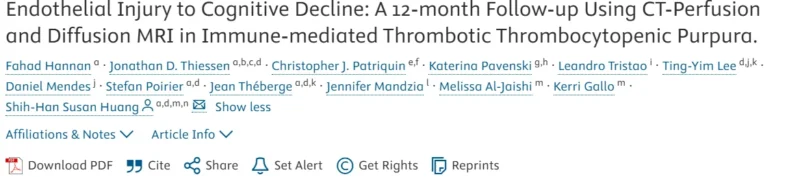
Title: Endothelial Injury to Cognitive Decline: A 12-month Follow-up Using CT-Perfusion and Diffusion MRI in Immune-mediated Thrombotic Thrombocytopenic Purpura
Authors: Fahad Hannana, Jonathan D. Thiessen, Christopher J. Patriquin, Katerina Pavenski, Leandro Tristao, Ting-Yim Lee, Daniel Mendes, Stefan Poirier, Jean Théberge, Jennifer Mandzia, Melissa Al-Jaishi, Kerri Gallo, Shih-Han Susan Huang
Read the Full Article on Journal of Thrombosis and Haemostasis․
Find more posts featuring Wolfgang Miesbach on Hemostasis Today.
-
Sep 25, 2026, 17:13Sam Tsimikas: Lp(a) and Oxidized Phospholipids Link Lipoprotein Biology to Platelet Activation
-
Sep 25, 2026, 16:56Cindy Neunert: The Future of Personalized ITP Care
-
Sep 25, 2026, 16:26Gemma Postil: AI Tools in Modern Health Research
-
Sep 25, 2026, 16:01Mostafa Hammam: When aPTT Correction Is Not the End
-
Sep 25, 2026, 15:50Adam Boruchov: Registration Is Open For The 2026 New England Hematologic Diseases Symposium
-
Sep 25, 2026, 15:23Bringing Hope and Treatment Access to Morocco’s Hemophilia Community – World Federation of Hemophilia
-
Sep 25, 2026, 15:22Alejandro González Veliz: Targeting Atherosclerosis Before the First Event
-
Sep 25, 2026, 15:00Sarah Richardson: Finding Strength Through Bleeding Disorders Advocacy
-
Sep 25, 2026, 14:54James Fildes: Modeling Device Related Thrombosis in Multi Organ Systems