


Martin Haluzík Analyzes the Overall Accuracy of Current Available Smartwatches in Identifying AF
Martin Haluzík, Professor of Medicine at Institute for Clinical and Experimental Medicine, shared on LinkedIn about a recent article by Nelson Barrera et al, published in JACC:
”Accuracy of Smartwatches in the Detection of Atrial Fibrillation: A Systematic Review and Diagnostic Meta-Analysis
Very interesting paper recently published in JACC: Advances by Nelson Barrera and colleagues.
Atrial fibrillation (AF) is the most prevalent arrhythmia and a significant risk factor for stroke and heart disease, making early diagnosis crucial for prevention. Although several smartwatches can detect AF, their accuracy varies, and there is limited information regarding their effectiveness.
The purpose of this study was to analyze the overall accuracy of current available smartwatches in identifying AF.
A comprehensive systematic literature search was performed across major databases for articles published until January 2025.
The specificity, sensitivity, and area under the curve (AUC). Statistical analysis was conducted using R software.
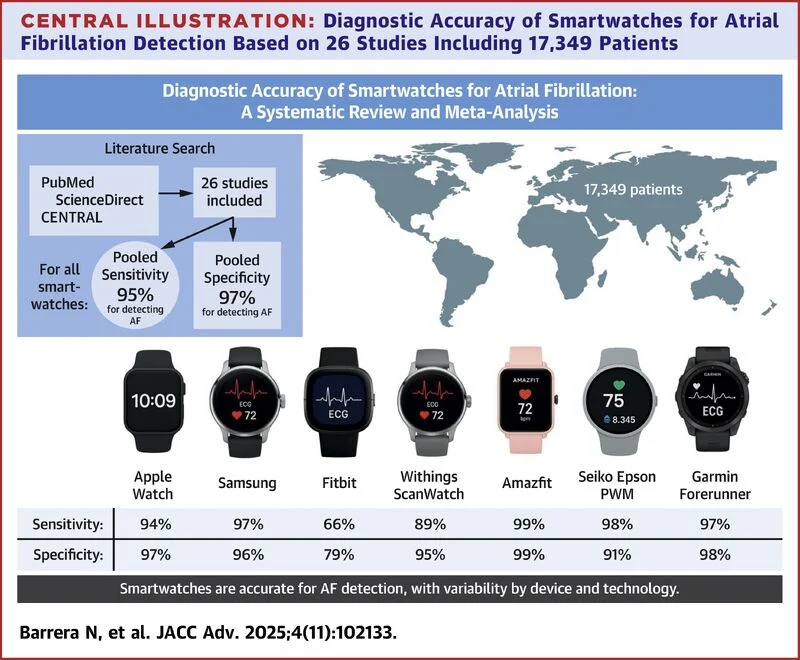
Twenty-six studies were included in the study, including 17,349 patients. Overall sensitivity was 95% (95% CI: 92%-97%; I2 = 95%) and specificity 97% (95% CI: 94%-98%; I2 = 99%), with a pooled AUC of 0.97 (95% CI: 0.96%-0.99%).
Device performance varied, with the Apple Watch achieving 94% sensitivity (95% CI: 89%-96%; I2 = 71%) and 97% specificity (95% CI: 93%-99%; I2 = 87%), Samsung devices yielding 97% sensitivity (95% CI: 92%-99%; I2 = 92%) and 96% specificity (95% CI: 91%-98%; I2 = 92%), and the Withings Scan Watch showing 89% sensitivity (95% CI: 75%-96%; I2 = 94%) and 95% specificity (95% CI: 88%-99%; I2 = 93%).
Accuracy was comparable between photoplethysmography and electrocardiogram-based models.
Smartwatches possess excellent diagnostic accuracy for AF detection and may, therefore, represent a suitable and fitting option for patients.
- Very interesting data
- Overall, impressive specificity and sensitivity.
- Now, the question is, should all patients with high risk of AF wear these devices to detect and treat early?
- I would bet that not only money but also couple of lifes could be saved by this approach
Excellent paper! Congratulations to the authors!”
Title: Accuracy of Smartwatches in the Detection of Atrial Fibrillation: A Systematic Review and Diagnostic Meta-Analysis
Authors: Nelson Barrera, Maria Solorzano, Yomary Jimenez, Yevhen Kushnir, Francisco Gallegos-Koyner, Guilherme Dagostin de Carvalho
Read the Full Article on JACC
Stay updated on all scientific advances with Hemostasis Today.
-
Sep 25, 2026, 09:49Haley Coleman: Volunteering to Support Hemophilia Awareness
-
Sep 25, 2026, 08:55Hitarth Mehta: BHMS Students Gain Practical Exposure to Haemophilia Diagnosis
-
Sep 25, 2026, 07:25Varun Capoor: How Therapeutic Apheresis and Transfusion Medicine Can Complement Clinical Management in SCD
-
Sep 25, 2026, 07:14Manshi Kesharwani: SAK-GQDs Modulate Thrombus Burden and Endothelial Function in Deep Vein Thrombosis
-
Sep 25, 2026, 06:20Farjah Hassan Algahtani: How Can We Better Identify Patients at Risk of Blood Clots after Metabolic and Bariatric Surgery?
-
Sep 25, 2026, 05:59Carla Lewis: Kids Conquering Sickle Disease Joins Nemours Children’s Hospital for 2nd Annual Awareness Event
-
Sep 25, 2026, 05:47Omid Seidizadeh: Evolutionary Constraint and Population Variation Across Coagulation Genes
-
Sep 25, 2026, 05:40Gerald Bertrand: Presenting UMi-NGS Non-Invasive Foetal HPA Genotyping at DGTI 2026
-
Sep 25, 2026, 05:33Urge Congress to support the Sickle Cell Disease Comprehensive Care Act – ASH