


Retheesh Das: Avoiding Unnecessary Transfusions – Why Less Can Be Safer
Retheesh Das, Nursing Officer at Madhya Pradesh Medical Science University (MPMSU), shared a post on LinkedIn:
”Avoiding Unnecessary Transfusions
Blood transfusion isn’t an automatic response – it’s a deliberate treatment.
Mastering the decision of when to hold back is essential in today’s healthcare.
The Importance of Caution
Extra transfusions aren’t harmless. They come with real dangers, such as:
- TRALI: An immune-triggered lung damage causing sudden breathing problems.
- TACO: Overloading the system with fluid, resulting in lung swelling.
- Alloimmunization: Building antibodies that mess up later transfusions or births.
- Infections: Uncommon spread of bugs like viruses or bacteria, even with checks.
- Immunomodulation: Tweaking immunity, raising chances of infections or cancer return.
- Elevated risks: More issues, longer recoveries, and higher death rates in those over-transfused.
Key Idea: Extra blood doesn’t mean superior results. Studies prove that conservative approaches often match or surpass aggressive ones.
Guidelines Backed by Research….
Red Blood Cells
• Below 7 g/dL Hb: Think about transfusing to avoid oxygen shortages.
• 7-8 g/dL Hb: Tailor to the individual’s age, health issues, and signs.
• Above 8 g/dL Hb: Usually skip it—risks typically eclipse benefits.
• Special Cases: Heart attacks, active bleeding, anemia symptoms, or risky operations.
• Reminder: Focus on the person’s condition, not just the lab result.
Plasma (FFP)
• Skip for: Slight INR rises or just needing more fluid.
• Use for: Actual bleeding tied to clotting problems.
• Instances: DIC from sepsis or injury, or huge blood loss scenarios.
Approaches to Blood Conservation (PBM)
• Boost Hb before surgery with checks and fixes like iron or vitamins.
• Cut down on needless blood draws using efficient methods.
• Embrace natural low Hb in steady patients—the body adjusts.
• Method: Give one unit, check progress, add more only if required.
Final Insight….
Holding off isn’t skimping – it’s wise practice. Strive for science-driven, individualized care that balances dangers and gains.”
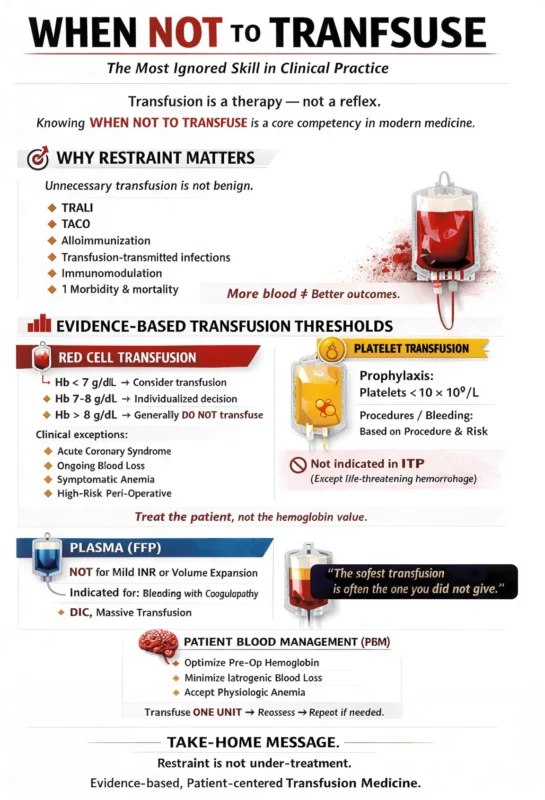
Retheesh Das/LinkedIn
Stay updated with Hemostasis Today.
-
Sep 25, 2026, 07:25Varun Capoor: How Therapeutic Apheresis and Transfusion Medicine Can Complement Clinical Management in SCD
-
Sep 25, 2026, 07:14Manshi Kesharwani: SAK-GQDs Modulate Thrombus Burden and Endothelial Function in Deep Vein Thrombosis
-
Sep 25, 2026, 06:20Farjah Hassan Algahtani: How Can We Better Identify Patients at Risk of Blood Clots after Metabolic and Bariatric Surgery?
-
Sep 25, 2026, 05:59Carla Lewis: Kids Conquering Sickle Disease Joins Nemours Children’s Hospital for 2nd Annual Awareness Event
-
Sep 25, 2026, 05:47Omid Seidizadeh: Evolutionary Constraint and Population Variation Across Coagulation Genes
-
Sep 25, 2026, 05:40Gerald Bertrand: Presenting UMi-NGS Non-Invasive Foetal HPA Genotyping at DGTI 2026
-
Sep 25, 2026, 05:33Urge Congress to support the Sickle Cell Disease Comprehensive Care Act – ASH
-
Sep 25, 2026, 05:24Isabelle Mahé: Reduced-Dose Apixaban in Extended CAT Treatment
-
Sep 25, 2026, 05:15Maria Cherska: High Cholesterol Isn’t Always Diet or Lifestyle – Sometimes It’s Genetic