


Rowan Paul: MSCs Show Strongest Pain Reduction in Regenerative Medicine Approaches
Rowan Paul, Sports Medicine and Interventional Regenerative Orthobiologics Physician at RegenCore, shared on LinkedIn:
”My key takeaway is that MSCs showed the strongest pain reduction. Nice to see this born out in the peer reviewed literature. Happy to be doing Prospective Clinical Trial research.
PRP
Efficacy:
- Best for acute injuries and tendon repair-patellar tendinopathy, knee OA, lateral epicondylitis
- Superior to corticosteroids and HA
- Limited success in chronic conditions:
Limitations
- Hard to generalize across all indications. be precise in formulation of your PRP depending on structure, patient, and goals
- Inconsistent preparation methods
- Optimal: LP- PRP, weekly × 3 weeks
- Requires 10-12 billion cumulative over course:
Mechanism
- VEGF, PDGF, TGF-β release stimulates angiogenesis and matrix synthesis[1]
Mesenchymal Stem Cells (MSCs)
Efficacy:
- Highest pain reduction among all modalities
- Cartilage regeneration in early OA
- Sustained improvements at 12-24 months
Mechanism
- Immunomodulation, reduced inflammation, M2 macrophage polarization
Major Barriers:
- High costs and ethical concerns
- Experimental
- Symptomatic relief insufficient to justify costs on a system level
Peptide-Based Therapies
- Moderate improvements; promising for infection control and wound healing
- Limited evidence (10 studies)
- Needs optimization of dosing, delivery, safety
Biomimetic Materials
- Scaffolds, Autologous Protein Solutions, PRF.
- Lowest efficacy in meta-analysis[1]
Clinical Practice Insights
Standardization Challenges:
- Variable methods and heterogeneous formulations= inconsistent results
- Insufficient reporting limits evidence synthesis
- This is a particular interest of mine and we need more research
Evidence Characterization:
- ‘Symptom-modifying’ vs ‘structure-modifying’—improve pain/function but limited true regeneration
- Short/mid-term results noticeable; long-term stability undetermined
- Need long-term follow-up to see structural changes
Precision Medicine Need:
- Must identify potency markers to match treatments to tissues/pathologies
- Improved mechanistic understanding enables precision approaches
Market Landscape
- 51.5% of publications focus on PRP, 30.8% bone marrow, 15.2% adipose-derived cells. We need more MSC research as well as scaffolding research and this takes investment and funding.”
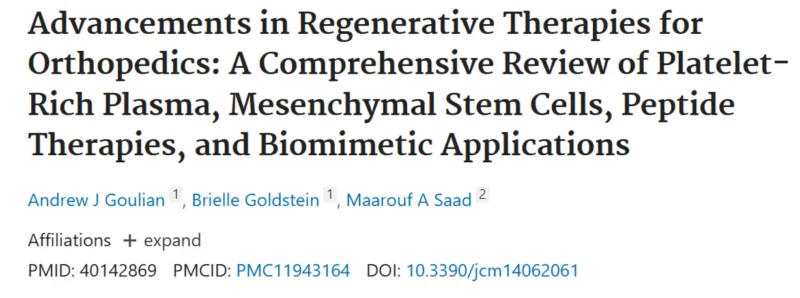
Title: Advancements in Regenerative Therapies for Orthopedics: A Comprehensive Review of Platelet-Rich Plasma, Mesenchymal Stem Cells, Peptide Therapies, and Biomimetic Applications
Authors: Andrew J Goulian, Brielle Goldstein, Maarouf A Saad
Read the Full Article on National Library of Medicine.
Stay updated on all scientific advances with Hemostasis Today.
-
Sep 30, 2026, 01:52Javed Anees: DADA2 – When a Young Stroke Is More Than a Stroke
-
Sep 30, 2026, 01:51How a Venous Thrombus Becomes Revascularized – ISTH
-
Sep 29, 2026, 22:45Victor Agunyego: Paracetamol – The Most Common Drug We Underestimate
-
Sep 29, 2026, 22:42Nova Sinclair: Advancing the Future of Hematology – Meet Our 2027 Organizing Committee
-
Sep 29, 2026, 22:41Lorenz Räber: Intracoronary Imaging in PCI – Why, When, How, and Which Modality?
-
Sep 29, 2026, 22:31Selma Turkovic: Pleased to Deliver the Opening Presentation at Kingston Hospital
-
Sep 29, 2026, 22:31Miguel Teran: Ultrasound and Simulation in Arterial Blood Sampling
-
Sep 29, 2026, 22:28Mohammad Refaei: Navigating Your Career in Hematology From Training to Practice
-
Sep 29, 2026, 22:27Matteo Foschi: 10 Clinical Pearls for Antithrombotic Therapy in Secondary Stroke Prevention