


Jan Sloves։ Pedal Venous Maturation Predicts Limb Salvage in No‑Option CLTI
Jan Sloves, President and Consultant at Vascular Imaging Professionals LLC shared Jill Sommerset’s post on LinkedIn, adding:
”Excellent Manuscript By Jill Sommerset and Colleagues
‘Pedal Venous Maturation (PVM) shows up in most of these no‑option CLTI limbs and it’s time‑dependent, about 86% have it by 6 months, and once it appears, it sticks, even if the conduit closes.’
‘PVM is the signal that matters: every patient who developed PVM healed and kept their limb; every patient who didn’t went on to major amputation.’
‘Conduit patency alone is misleading – two‑thirds of the amputees still had a patent VA, while patients with PVM often did fine even after occlusion because the distal venous bed had already remodeled.’
‘A structured pedal duplex exam lets you actually watch maturation happen: venous PSV/EDV climb, RI stays low, and pedal acceleration time improves in the arteries.’
‘Follow up after VA needs to move away from ‘is the stent open?’ and toward ‘is the foot physiologically matured?’ using PVM and pedal acceleration time as the key duplex endpoints.’ ”
Jill Sommerset, Co-Founder / CSO at Moonrise Medical, shared a post on LinkedIn, about a recent article she and her colleagues co-authored, published in European Journal of Vascular and Endovascular Surgery:
”Pleased to share our work demonstrating how duplex ultrasound and pedal venous maturation can predict outcomes following deep venous arterialization (DVA) in no-option chronic limb-threatening ischemia (CLTI) patients.
These findings reinforce that ultrasound is not simply a post-procedural surveillance tool, but a physiologic guide for assessing hemodynamic success after DVA. The accompanying image illustrates post-DVA positive pedal venous maturation in a previously ‘desert foot,’ where color Doppler demonstrates restoration of flow within the terminal pedal venous system and measurable venous Pedal Acceleration Time (vPAT = 75 ms), reflecting meaningful hemodynamic improvement.
Grateful to my co-authors Miguel Montero Baker, Joseph R. Steele, Jeffrey Hull, Mary Costantino, John Rundback and collaborators.
Proud of the continued role ultrasound plays in advancing limb preservation for this complex patient population…”
Proceed to the video attached to the post.
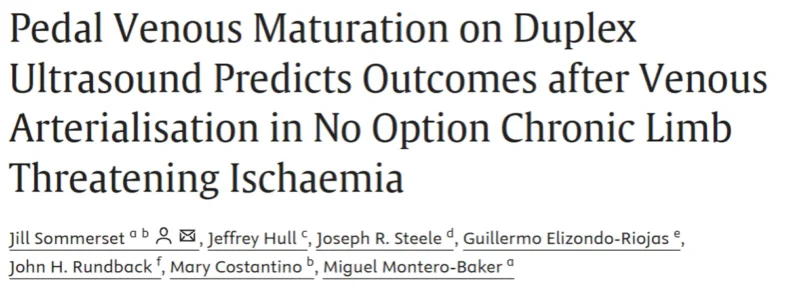
Title: Pedal Venous Maturation on Duplex Ultrasound Predicts Outcomes after Venous Arterialisation in No Option Chronic Limb Threatening Ischaemia
Authors: Jill Sommerset, Jeffrey Hull, Joseph R. Steele, Guillermo Elizondo-Riojas, John H. Rundback, Mary Costantino, Miguel Montero-Baker
Read the Full Article on European Journal of Vascular and Endovascular Surgery.
More posts from Jan Sloves on Hemostasis Today.
-
Sep 30, 2026, 14:13Ashok Choudhury: Portal Vein Thrombosis and Outcomes in Cirrhosis
-
Sep 30, 2026, 13:57Leslye Conde Bazán: When Conventional Imaging Is Not Enough – The Role of IVUS
-
Sep 30, 2026, 13:41Huda Salah Eldin: The Challenge of Balancing Antithrombotic Therapy After PCI
-
Sep 30, 2026, 13:29Abdus Salam: What Can CT Venography Reveal About the Veins?
-
Sep 30, 2026, 13:03Amira Mohy: Diagnostic Flow Cytometry Panels for Hematological Malignancies
-
Sep 30, 2026, 12:52Paul Watton: Could Repetitive Head Impacts Leave a Molecular Memory?
-
Sep 30, 2026, 12:41The Journey to ISTH 2027 Starts in Vancouver
-
Sep 30, 2026, 11:36Basit Ali: A Closer Look at CT Venography
-
Sep 30, 2026, 11:16Christina Pohlman: Could aPL Levels Help Predict Stroke Recurrence?