


Soroush Sohrabi: Foam or Liquid for Spider Veins?
Soroush Sohrabi, Consultant Vascular and Endovascular Surgeon in Dubai, shared a post on LinkedIn:
“Foam or Liquid for Spider Veins? The Evidence Might Surprise You.
We treat telangiectasias every day. We choose between foam and liquid almost instinctively. But when you actually look at the evidence — it’s thinner than you think.
I reviewed approximately 15 publications spanning 1987 to 2024 comparing foam and liquid sclerotherapy for telangiectasias, including the Cochrane systematic review of 10 RCTs involving 484 patients.
Here’s what stands out:
- Only one study within the Cochrane review directly compared foam to liquid for telangiectasias. It had 20 patients. No statistics were performed. It was unblinded.
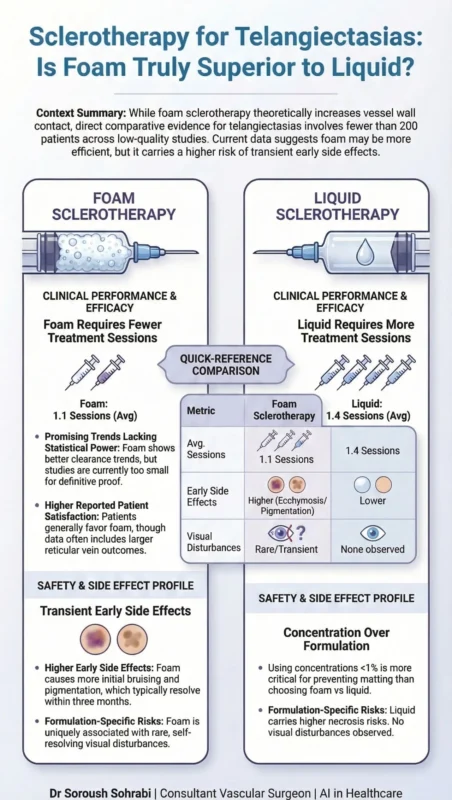
- Foam trends toward better efficacy and fewer sessions — but this has never been confirmed by a well-powered, blinded trial for spider veins specifically.
- Foam causes more early side effects – more pain in the first hours, more ecchymosis, more hyperpigmentation at one week. All resolve by three months.
- Concentration matters more than formulation. Using polidocanol or STS above one percent for veins under 1 mm drives most of the reported complications.
- Polidocanol is consistently less painful than STS regardless of whether you use foam or liquid. POL causes no more pain than placebo injection.
- Transient visual disturbances have been reported exclusively with foam — rare but worth discussing during consent.
- No formal clinical practice guideline makes a direct evidence-graded recommendation comparing foam to liquid for telangiectasias. Existing consensus documents suggest liquid is the preferred approach for C1 disease, with foam acceptable at lower concentrations — but this reflects expert opinion, not high-quality comparative evidence.
The bottom line: we don’t have a definitive answer. The field has invested heavily in comparing foam vs. liquid for truncal veins, but for the most common indication in cosmetic phlebology — spider veins — the comparative evidence is remarkably weak.
I created a poster summarising these findings. Swipe to see the full breakdown.
What’s your preference in practice — foam or liquid for telangiectasias? And why?”
Stay updated with Hemostasis Today.
-
Sep 30, 2026, 10:55Rana Al Hrout: Diagnostic Approach to Hypochromic Microcytic Anemia
-
Sep 30, 2026, 01:52Javed Anees: DADA2 – When a Young Stroke Is More Than a Stroke
-
Sep 30, 2026, 01:51How a Venous Thrombus Becomes Revascularized – ISTH
-
Sep 29, 2026, 22:45Victor Agunyego: Paracetamol – The Most Common Drug We Underestimate
-
Sep 29, 2026, 22:42Nova Sinclair: Advancing the Future of Hematology – Meet Our 2027 Organizing Committee
-
Sep 29, 2026, 22:41Lorenz Räber: Intracoronary Imaging in PCI – Why, When, How, and Which Modality?
-
Sep 29, 2026, 22:31Selma Turkovic: Pleased to Deliver the Opening Presentation at Kingston Hospital
-
Sep 29, 2026, 22:31Miguel Teran: Ultrasound and Simulation in Arterial Blood Sampling
-
Sep 29, 2026, 22:28Mohammad Refaei: Navigating Your Career in Hematology From Training to Practice