


Filippo Cademartiri: Inflammation vs Cholesterol as Driver of Residual ASCVD Risk
Filippo Cademartiri, Consultant Advanced Cardiovascular Imaging at UPMC Salvator Mundi International Hospital, shared on LinkedIn about a recent article by Faizan Mazhar et al, adding:
“Inflammation vs cholesterol: which residual risk matters most in ASCVD?
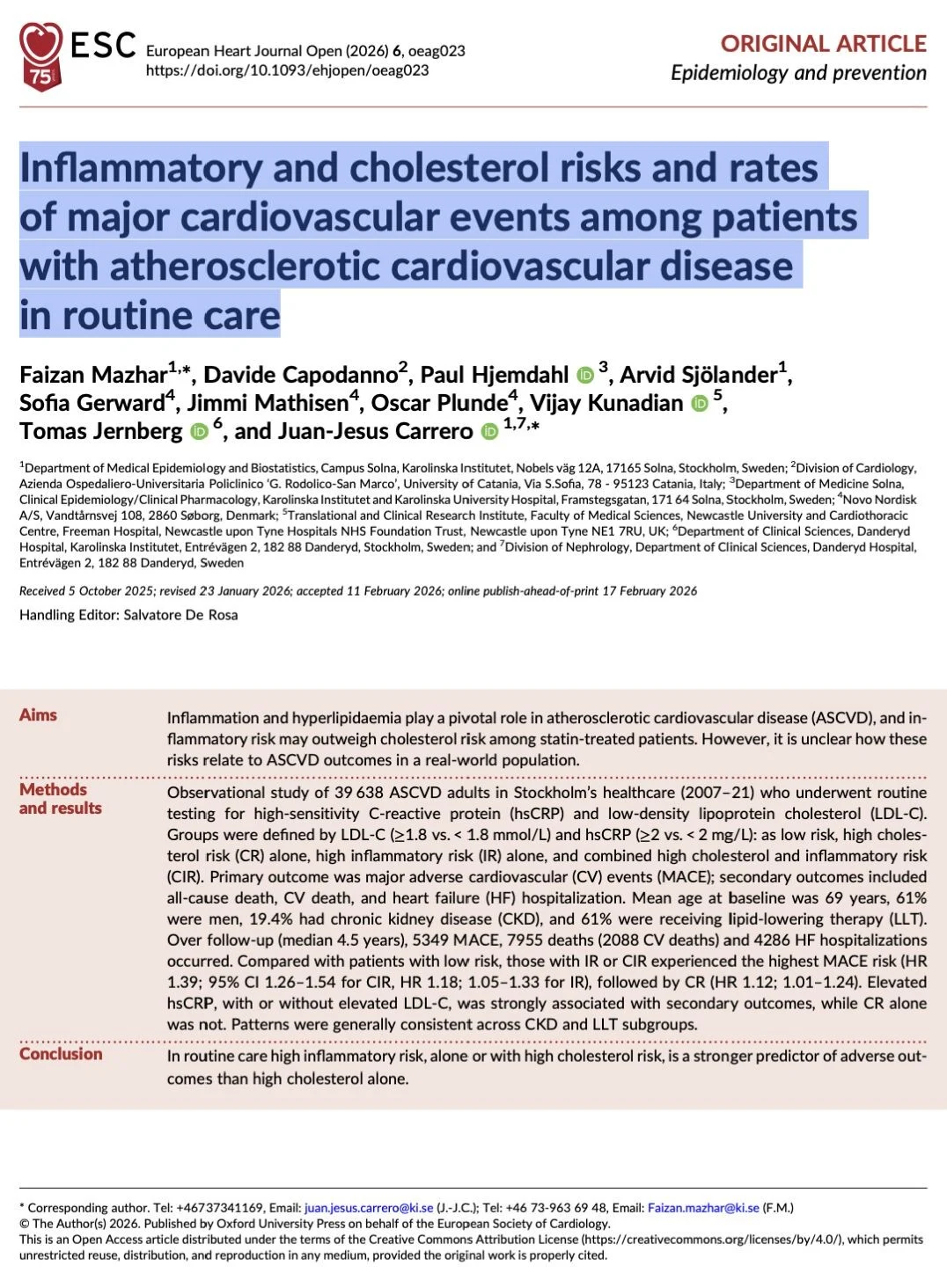
A large real-world study explored how cholesterol risk (LDL-C) and inflammatory risk (hsCRP) relate to cardiovascular outcomes in patients with established atherosclerotic cardiovascular disease (ASCVD).
Researchers analyzed 39,638 patients with ASCVD in routine healthcare in Stockholm between 2007–2021. Patients were stratified into four groups based on LDL-C greater than or equal to 1.8 mmol/L (approximately 70 mg/dL) and hsCRP greater than or equal to 2 mg/L:
- Low risk
- High cholesterol risk
- High inflammatory risk
- Combined high cholesterol plus inflammatory risk
The primary endpoint was major adverse cardiovascular events (MACE), with additional outcomes including cardiovascular mortality, all-cause mortality, and heart failure hospitalization.
Key findings
Inflammatory risk mattered more than cholesterol alone!!!
Patients with high inflammatory risk (hsCRP greater than or equal to 2 mg/L) had significantly higher rates of:
- MACE
- cardiovascular mortality
- all-cause mortality
- heart failure hospitalization
High cholesterol alone was associated with only a modest increase in MACE and was not strongly linked to other adverse outcomes.
Another striking observation: approximately 39% of ASCVD patients were not receiving lipid-lowering therapy, highlighting persistent gaps in secondary prevention in routine care.
Why this matters
The study reinforces a growing concept in cardiometabolic medicine:
Residual inflammatory risk remains a major driver of cardiovascular events even when cholesterol is treated.
This helps explain why therapies targeting inflammation (e.g., colchicine, IL-1 pathways) are increasingly explored alongside lipid-lowering strategies.
Take-home message
ASCVD risk is not just about LDL-C.
In real-world populations, inflammation appears to be an equally important — and often overlooked — driver of recurrent cardiovascular events.
Future prevention strategies will likely need to target both cholesterol and inflammation. ”
Title: Inflammatory and cholesterol risks and rates of major cardiovascular events among patients with atherosclerotic cardiovascular disease in routine care
Authors: Faizan Mazhar, Davide Capodanno, Paul Hjemdahl, Arvid Sjölander, Sofia Gerward, Jimmi Mathisen, Oscar Plunde, Vijay Kunadian, Tomas Jernberg, Juan-Jesus Carrero
Read the Full Article on European Heart Journal Open
Stay updated with Hemostasis Today.
-
Sep 14, 2026, 20:53YoonHwa An: Rusfertide in Polycythemia Vera – From Clinical Benefit to Strategic Value
-
Sep 14, 2026, 20:52Andres Alberto Mercado Pompa: External Validation of Prognostic Risk Scores in Cerebral Venous Thrombosis
-
Sep 14, 2026, 20:50Balaji Kirushnan: Advancing Regional Citrate Anticoagulation in CRRT – From Experience to Implementation
-
Sep 14, 2026, 20:48Valerie Dehondt: Nutritional Anemia Is Associated With Increased Risk of Severe COPD Exacerbations
-
Sep 14, 2026, 20:46Nupur Choudhury: Exploring AI-Based Detection of Anemia Using Eye and Fingernail Images
-
Sep 14, 2026, 20:44Shamee Shastry: Chart Before You Chase – Diagnosing Drug-Induced Hemolytic Anemia
-
Sep 14, 2026, 20:43David Reiner: Blood Tests That Can Reveal Nutrition Clues
-
Sep 14, 2026, 20:40Giuseppe Biondi Zoccai: Balancing Thrombosis and Bleeding in Acute MI With Hemophilia A
-
Sep 14, 2026, 20:39Kemal Karaagac: Kounis Syndrome as a Possible Cause of Very Late Stent Thrombosis