

Heghine Khachatryan: PFO, Cryptogenic Stroke, and Factor V Leiden – Closure or Lifelong Anticoagulation?
Heghine Khachatryan, Editor-in-Chief of Hemostasis Today, Head of Hemophilia and Thrombosis Center at Yeolyan Hematology and Oncology Center, shared a post on LinkedIn:
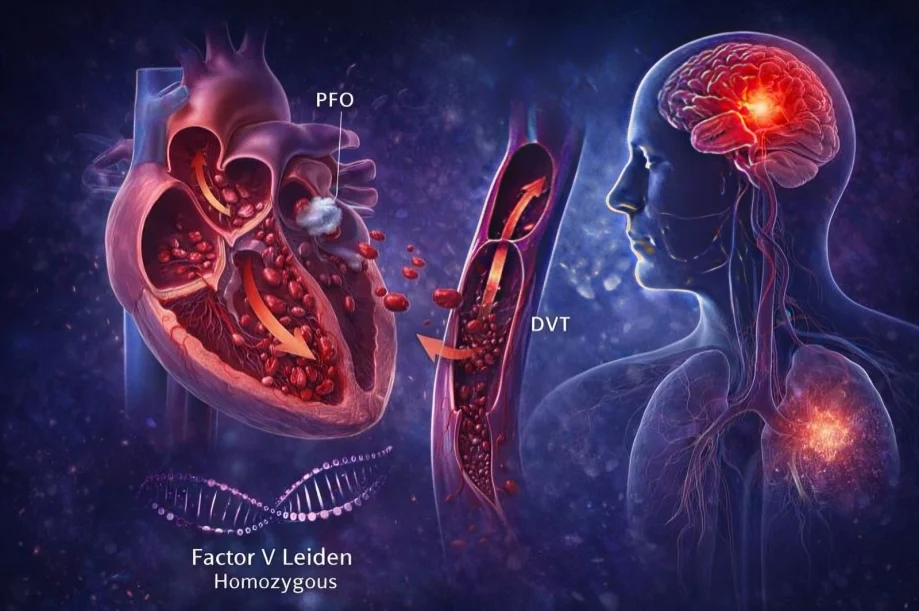
”PFO, Cryptogenic Stroke, and Factor V Leiden: Closure or Lifelong Anticoagulation?
Clinical decision-making becomes particularly complex when a patient presents with cryptogenic stroke, patent foramen ovale (PFO), and homozygous Factor V Leiden thrombophilia.
The key question often raised in practice is:
Should the PFO be closed, or should the patient remain on long-term anticoagulation alone?
Current evidence suggests that the answer is not straightforward and requires careful patient selection.
Several elements must be evaluated before making a decision:
- Age of the patient (particularly <60 years)
- Whether the stroke is truly PFO-associated after a complete diagnostic work-up
- Presence of venous thromboembolism or paradoxical embolism
- High-risk PFO anatomy (large shunt, atrial septal aneurysm)
- Underlying prothrombotic conditions such as Factor V Leiden mutation
In patients with strong evidence suggesting paradoxical embolism, many experts increasingly favor PFO closure combined with antithrombotic therapy, rather than relying on medical therapy alone.
However, Factor V Leiden thrombophilia alone does not necessarily prove that the stroke mechanism is arterial or PFO-mediated, and decisions should always be individualized.
In my view, the optimal strategy often involves multidisciplinary discussion between neurologists, cardiologists, and hematologists.
Personally, in a young patient with cryptogenic stroke, PFO, and homozygous Factor V Leiden, I tend to consider PFO closure plus long-term antithrombotic strategy, rather than leaving the defect open.
But this remains an area where clinical judgment and shared decision-making are critical.
I would be very interested to hear the perspectives of colleagues.
How do you approach patients with PFO, cryptogenic stroke, and inherited thrombophilia?
Do you favor:
- PFO closure
- Lifelong anticoagulation
- A combined strategy?
Your experience and insights would be highly valuable for this discussion.”
Other posts featuring Heghine Khachatryan on Hemostasis Today.
-
Sep 25, 2026, 05:59Carla Lewis: Kids Conquering Sickle Disease Joins Nemours Children’s Hospital for 2nd Annual Awareness Event
-
Sep 25, 2026, 05:47Omid Seidizadeh: Evolutionary Constraint and Population Variation Across Coagulation Genes
-
Sep 25, 2026, 05:40Gerald Bertrand: Presenting UMi-NGS Non-Invasive Foetal HPA Genotyping at DGTI 2026
-
Sep 25, 2026, 05:33Urge Congress to support the Sickle Cell Disease Comprehensive Care Act – ASH
-
Sep 25, 2026, 05:24Isabelle Mahé: Reduced-Dose Apixaban in Extended CAT Treatment
-
Sep 25, 2026, 05:15Maria Cherska: High Cholesterol Isn’t Always Diet or Lifestyle – Sometimes It’s Genetic
-
Sep 25, 2026, 05:07Nancy Braithwaite: BBTS Specialist Certificate in Transfusion Science Practice
-
Sep 24, 2026, 18:43Hugh Nguyen: Honored to Accept the Friend of Singapore Red Cross Award
-
Sep 24, 2026, 18:42Titilope Fasipe: Proud to Support American Society of Hematology’s SCD Initiative