


Simon Senanu: White Blood Cell Differential Count in Clinical Interpretation
Simon Senanu, Medical Laboratory Scientist at Perkins Medical Centre, shared a post on LinkedIn :
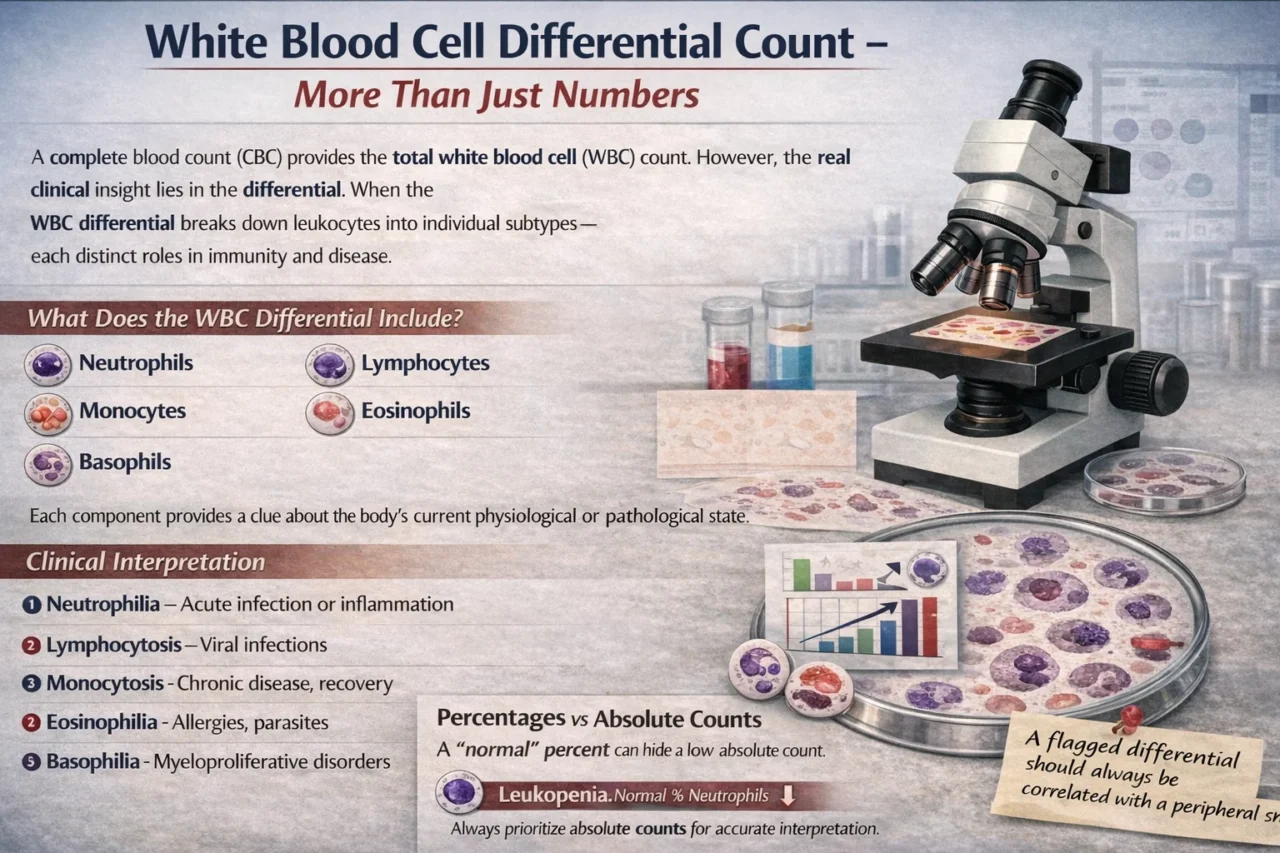
“White Blood Cell Differential Count – More Than Just Numbers
A complete blood count (CBC) provides the total white blood cell (WBC) count.
However, the real clinical insight lies in the differential.
The WBC differential breaks down leukocytes into their individual subtypes – each with distinct roles in immunity and disease.
What Does the WBC Differential Include?
- Neutrophils
- Lymphocytes
- Monocytes
- Eosinophils
- Basophils
Each component provides a clue about the body’s current physiological or pathological state.
Clinical Interpretation
- Neutrophilia indicates acute bacterial infection, inflammation, or physiological stress.
- Lymphocytosis indicates common viral infections (for example, infectious mononucleosis).
- Monocytosis is seen in chronic infections, autoimmune disorders, and recovery phases.
- Eosinophilia is associated with allergic reactions and parasitic infections.
- Basophilia is rare, but may indicate myeloproliferative disorders.
Percentages versus Absolute Counts: A Critical Distinction
One of the most common pitfalls is relying solely on percentages.
A ‘normal’ percentage can mask a clinically significant abnormality in the absolute count.
Example:
A patient with leukopenia may have a normal neutrophil percentage – but a critically low absolute neutrophil count (ANC).
Always prioritize absolute counts for accurate interpretation.
Peripheral Blood Smear – The Missing Link
Automated analyzers provide quantitative data – but morphology provides context.
Smear review can reveal:
- Toxic changes in neutrophils
- Atypical/reactive lymphocytes
- Blast cells (suggestive of leukemia)
- Platelet clumping or artifacts affecting counts
A flagged differential should always be correlated with a peripheral smear.
Laboratory Pitfalls
Even with advanced automation, limitations exist:
- Misclassification of immature or abnormal cells
- Interference from nucleated RBCs
- Cryoglobulins or platelet clumps affecting accuracy
This reinforces the importance of manual differentials in flagged or critical cases.
Takeaway
The WBC differential transforms a routine test into a powerful diagnostic tool.
In hematology, pattern recognition is everything.
When reviewing a differential, what do you prioritize first – the percentage or the absolute count?
Stay updated with Hemostasis Today.
-
Sep 28, 2026, 19:14Aditya Sharma: An Outstanding Start to the Final Day of VSS 2026!
-
Sep 28, 2026, 19:07Dhargam Aljebouri: AIHA Subclassification Research Presented at the 14th Iraqi Society of Hematology Conference
-
Sep 28, 2026, 19:02William Wallace: Your Cholesterol Test is Missing a Particle that May Matter More than the One it Measures
-
Sep 28, 2026, 18:57Indu Thakur: Honoring Sickle Warriors and Advancing Diverse Blood Donation at Sickle Ball 2026
-
Sep 28, 2026, 18:48Orly Leiva: Rethinking JAK Inhibitor Cardiovascular Safety in MPNs
-
Sep 28, 2026, 18:42Wael Saad: Honored to Be Part of Portal and Mesenteric Vein Thrombosis Session at CIRSE 2026
-
Sep 28, 2026, 18:35Alejandro González Veliz: The Unbroken Connection Between Heart and Brain
-
Sep 28, 2026, 16:43Scott Sutton: Community and Connection in Immune Thrombocytopenia
-
Sep 28, 2026, 16:24Pankti Solanki: ISBT Recognized JAMA as the 49th Human Blood Group System