


Marcos Gamboa Chele: Are We Asking for Too Many Thrombophilia Panels?
Marcos Gamboa Chele, Internal Medicine Specialist, shared a post on LinkedIn about a recent article by Jiwon Shin et al, adding:
”Are we asking for too many thrombophilia panels?
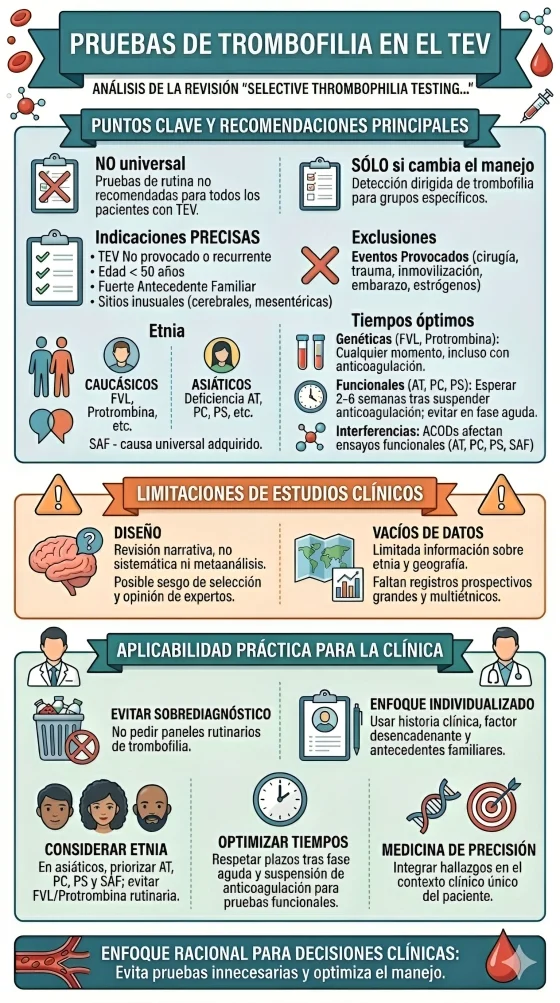
Venous thromboembolism (VTE) affects 1 in 1,000 people worldwide each year. However, the current clinical evidence is clear: universal or routine screening for thrombophilia in all patients with VTE is not recommended.
Based on the recent review ‘Selective Thrombophilia Testing in Venous Thromboembolism’, here is a practical summary of its benefits, limitations, and how to apply it in our daily practice.
Benefits of Selective Testing
In carefully selected patients (unprovoked VTE, younger than 50 years, thrombosis at unusual sites, or strong family history), evaluation offers valuable information for individualized management and prevention of recurrences.
The identification of high-risk conditions, such as Antiphospholipid Syndrome (APS) or Antithrombin deficiency, may alter the choice or duration of anticoagulation, justifying indefinite therapies.
It allows for structured genetic and family counseling when serious hereditary defects are confirmed.
Limitations and Challenges
False positives and negatives: Functional assays are highly sensitive to acute phase reaction and the use of direct oral anticoagulants (DOACs), which can lead to misleading results.
Ethnic variation: Factor V Leiden and Prothrombin G20210A mutations are common in Western populations, but extremely rare in Asians. In contrast, deficiencies of natural anticoagulants are more significant in the latter populations.
Marginal clinical impact: Discovering a mild hereditary defect rarely alters the management of anticoagulation and has not been shown to improve mortality.
Practical Applicability in the Flat or Consultation
Zero tests in provoked VTE: If the event was triggered by surgery, trauma, or estrogen use, the test has limited diagnostic and therapeutic value.
Time is money: Testing for Protein C, Protein S, and Antithrombin should be postponed until the patient is recovered and 2-6 weeks after stopping blood-thinning therapy.
Lean on genetics: Unlike functional testing, genetic (DNA) testing for specific mutations can be performed at any time, as they are not affected by blood thinners or acute illness.”
Title: Selective Thrombophilia Testing in Venous Thromboembolism
Authors: Jiwon Shin, Hyejee Lee, Hyangkyoung Kim
Read the Full Article on Annals of Phlebology

Stay updated on all scientific advances with Hemostasis Today.
-
Sep 25, 2026, 07:25Varun Capoor: How Therapeutic Apheresis and Transfusion Medicine Can Complement Clinical Management in SCD
-
Sep 25, 2026, 07:14Manshi Kesharwani: SAK-GQDs Modulate Thrombus Burden and Endothelial Function in Deep Vein Thrombosis
-
Sep 25, 2026, 06:20Farjah Hassan Algahtani: How Can We Better Identify Patients at Risk of Blood Clots after Metabolic and Bariatric Surgery?
-
Sep 25, 2026, 05:59Carla Lewis: Kids Conquering Sickle Disease Joins Nemours Children’s Hospital for 2nd Annual Awareness Event
-
Sep 25, 2026, 05:47Omid Seidizadeh: Evolutionary Constraint and Population Variation Across Coagulation Genes
-
Sep 25, 2026, 05:40Gerald Bertrand: Presenting UMi-NGS Non-Invasive Foetal HPA Genotyping at DGTI 2026
-
Sep 25, 2026, 05:33Urge Congress to support the Sickle Cell Disease Comprehensive Care Act – ASH
-
Sep 25, 2026, 05:24Isabelle Mahé: Reduced-Dose Apixaban in Extended CAT Treatment
-
Sep 25, 2026, 05:15Maria Cherska: High Cholesterol Isn’t Always Diet or Lifestyle – Sometimes It’s Genetic