


Anu Anna Babu: Which DOAC is Safer for Patients With Acute Venous Thromboembolism?
Anu Anna Babu, Clinical Pharmacist Intern at Believers Church Medical College Hospital, shared a post on LinkedIn: about a recent article by Lana A. Castellucci et al. published in The New England Journal of Medicine (NEJM):
“New Evidence in Anticoagulation- Apixaban Vs. Rivaroxaban for VTE
A landmark study just published in The New England Journal of Medicine (March 11, 2026) sheds critical light on a question clinicians face daily: which DOAC is safer for patients with acute Venous Thromboembolism?
The COBRRA trial– the first ever randomized head-to head comparison between the two most prescribed anticoagulants for acute VTE compared bleeding risk between apixaban and rivaroxaban in 2,760 patients across 32 sites in Canada, Australia, and Ireland over a 90-day follow-up period.
Key Findings
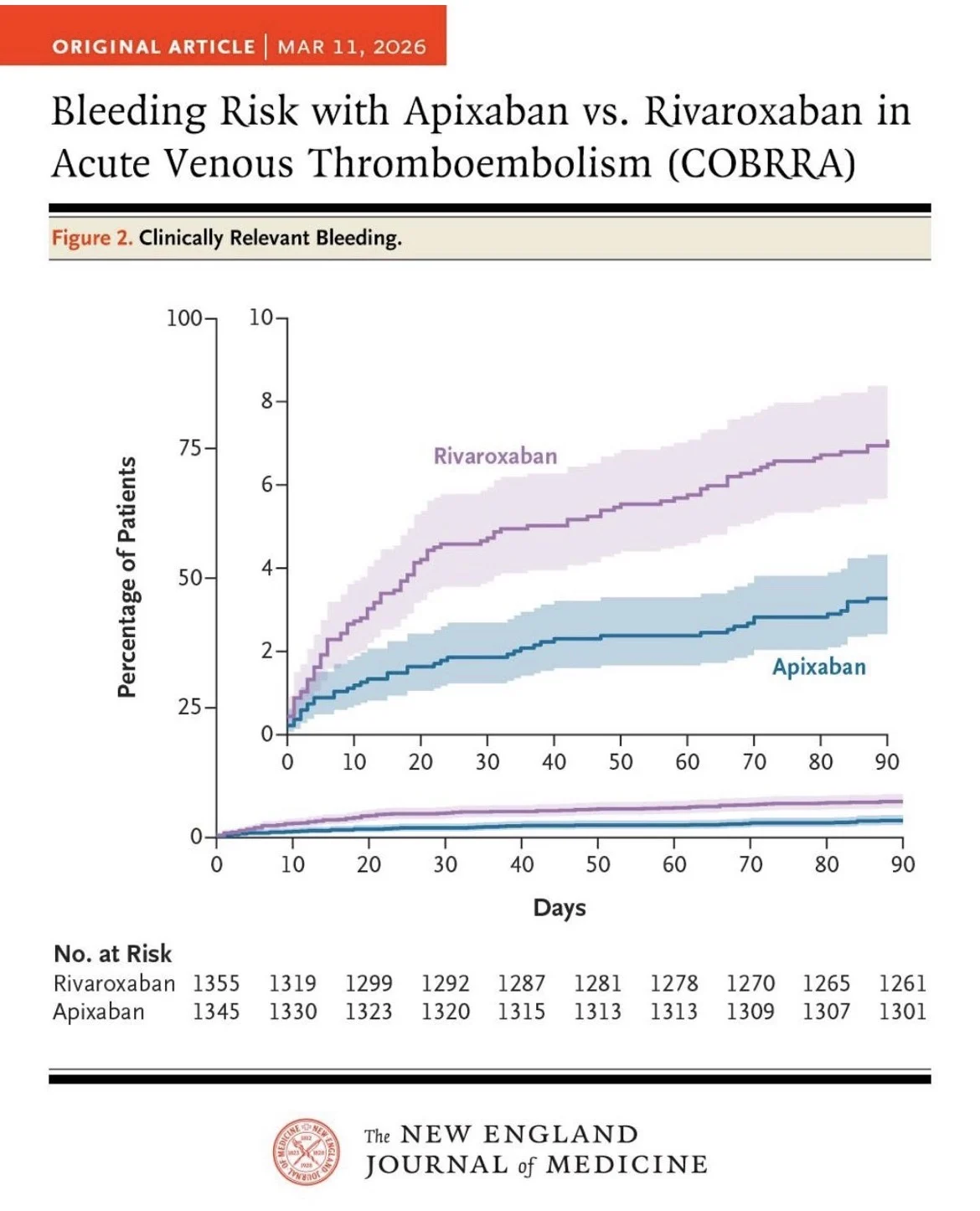
- Rivaroxaban showed a cumulative bleeding rate of 7.1% at 90 days
- Apixaban showed a significantly lower rate of 3.3% at 90 days
- This represents a 54% relative reduction in bleeding risk (P < .001)
- The separation in curves begins early within the first 10-20 days and widens progressively
- Confidence intervals (shaded regions) confirm this is a robust, statistically meaningful difference
Sample size at Day 0:
- Rivaroxaban: 1,355 patients
- Apixaban: 1,345 patients
Both groups remained well-powered throughout the 90-day period, strengthening confidence in these results.
Clinical Takeaway:
When selecting oral anticoagulation therapy for acute VTE, bleeding risk should be a front-and-center consideration. This data suggests apixaban may offer a meaningful safety advantage nearly half the clinically relevant bleeding risk compared to rivaroxaban over 3 months.
Importantly, there was no significant difference in efficacy recurrent clot prevention was comparable between both drugs. So the safety benefit comes without a trade off in effectiveness.
This doesn’t mean one drug is universally superior, patient-specific factors (renal function, dosing adherence, drug interactions, cost) always matter. But this trial adds important real world evidence to guide shared decision making.
Credit: The New England Journal of Medicine NEJM Group, Original Article, March 11, 2026
‘Bleeding Risk with Apixaban vs. Rivaroxaban in Acute Venous Thromboembolism (COBRRA)’
I’m still early in my pharmacy journey would love insights from clinicians and pharmacists who work with these agents daily. What does your practice look like?”
Title: Bleeding Risk with Apixaban vs. Rivaroxaban in Acute Venous Thromboembolism
Authors: Lana A. Castellucci, Vivien M. Chen, Michael J. Kovacs, Alejandro Lazo-Langner, Peter Greenstreet, Susan Kahn, Benoit Côté, Sam Schulman, Kerstin de Wit, James Douketis, Deepa Suryanarayan, Tony Wan, Erik Yeo, Genevieve Le Templier, Huyen A. Tran, Abbey Willcox, Helen J. Crowther, Ritam Prasad, Sudeep Shivakumar, Etimbuk Umana, Fionnuala Ni Ainle, Tobias Tritschler, Stefano Barco, Jean-Philippe Galanaud, Marc Blondon, Lisa Baumann Kreuziger, Susan Solymoss, Clive Kearon, Erin Thomas, Tim Ramsay, Gregoire Le Gal, Marc Rodger
Read the Full Article on The New England Journal of Medicine
Stay updated on all scientific advances Hemostasis Today.
-
Sep 25, 2026, 10:49Shefina S: From Presenting to Hosting at TRANSCON 2026
-
Sep 25, 2026, 10:37Michelle Leona Cecil: Hemophilia Advocacy and the Power of Community
-
Sep 25, 2026, 10:13Michael Baria: Platelet Concentration and PRP Outcomes in Partial Rotator Cuff Tears
-
Sep 25, 2026, 09:49Haley Coleman: Volunteering to Support Hemophilia Awareness
-
Sep 25, 2026, 08:55Hitarth Mehta: BHMS Students Gain Practical Exposure to Haemophilia Diagnosis
-
Sep 25, 2026, 07:25Varun Capoor: How Therapeutic Apheresis and Transfusion Medicine Can Complement Clinical Management in SCD
-
Sep 25, 2026, 07:14Manshi Kesharwani: SAK-GQDs Modulate Thrombus Burden and Endothelial Function in Deep Vein Thrombosis
-
Sep 25, 2026, 06:20Farjah Hassan Algahtani: How Can We Better Identify Patients at Risk of Blood Clots after Metabolic and Bariatric Surgery?
-
Sep 25, 2026, 05:59Carla Lewis: Kids Conquering Sickle Disease Joins Nemours Children’s Hospital for 2nd Annual Awareness Event