


Brecca Gaffney: The Role of Hemophilia Severity on Movement Patterns
Brecca Gaffney, Assistant Professor at University of Colorado Denver Anschutz Medical Campus, reposted from RPTH Journal on LinkedIn:
”New pub alert
Strong work led by postdoc Danielle Siegel, PhD demonstrating the role of hemophilia severity on movement patterns.
Fun collaboration and exciting to see biomechanics being applied in yet another novel clinical population to help inform different types of rehab aimed at preserving long-term joint health.
More to come!!”
Quoting RPTH Journal‘s post:
”Hemophilia and joint health: when does arthropathy start limiting movement?
Recurrent joint bleeds are a hallmark of hemophilia, leading over time to hemophilic arthropathy, chronic joint damage that affects mobility and quality of life.
But how well do standard clinical scores capture real-world functional limitations?
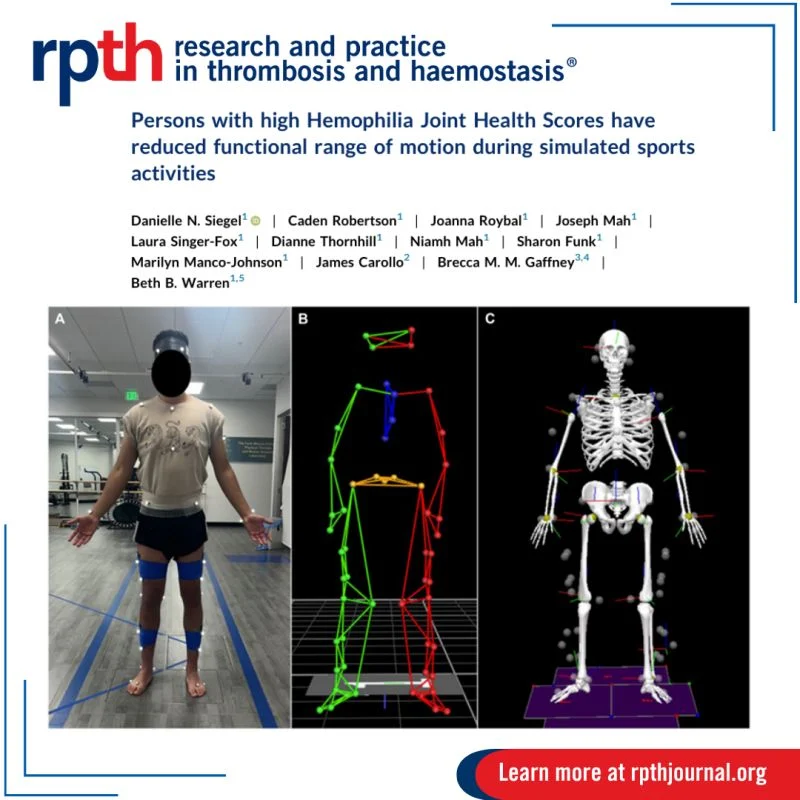
A new study used motion capture analysis to assess functional range of motion (ROM) during simulated sports activities in 86 persons with hemophilia A or B, compared to 33 healthy controls.
Key findings:
- Persons with a 6-joint Hemophilia Joint Health Score (HJHS) ≥25 showed significantly reduced ROM, particularly at the ankle, with reductions in 8 out of 10 activities
- Those with HJHS <25 had functional ROM comparable to healthy controls
- A HJHS threshold of 25 may represent a tipping point for clinically meaningful mobility loss
Findings make a strong case for early prophylaxis and targeted rehabilitation to preserve joint function before that threshold is reached.”
Title: Persons with high Hemophilia Joint Health Scores have reduced functional range of motion during simulated sports activities
Authors: Danielle N. Siegel, Caden Robertson, Joanna Roybal, Joseph Mah, Laura Singer-Fox, Dianne Thornhill, Niamh Mah, Sharon Funk, Marilyn Manco-Johnson, James Carollo, Brecca M.M. Gaffney, Beth B. Warren
Read the Full Article on RPTH Journal
Stay updated on all scientific advances with Hemostasis Today.
-
Nov 18, 2026, 14:41Factor V Deficiency: Diagnostic Challenges and the Role of Combined Factor V and VIII Deficiency
-
Nov 18, 2026, 14:29Maxime Dely: When Patient Encounters Become Life Lessons
-
Nov 18, 2026, 14:23Basanta Khatiwada: Advancing Haematology Through Research and Innovation at HAEMATOCON 2026
-
Nov 18, 2026, 14:13Alvin Katumba: Sickle Cell Disease Research Recognised With a 2026 ASH Abstract Achievement Award
-
Nov 18, 2026, 13:34Vincenzo De Angelis: Strengthening Plasma Management and Quality Control in Eastern Europe
-
Nov 18, 2026, 13:34Standardizing Bleeding Outcome Assessment in Hemophilia Clinical Trials – JTH
-
Nov 18, 2026, 13:34Nicolas Gendron: Towards Sustainable Anticoagulation
-
Nov 18, 2026, 13:33Breaking the Silence on Women and Girls with Bleeding Disorders – EHC
-
Nov 18, 2026, 13:32Maria Elisa Mancuso: Next-Generation Protein Therapies in Hemophilia