


Simon Senanu: A Stepwise Laboratory Approach for aPTT Prolongation
Simon Senanu, Medical Laboratory Scientist at Perkins Medical Centre, shared a post on LinkedIn:
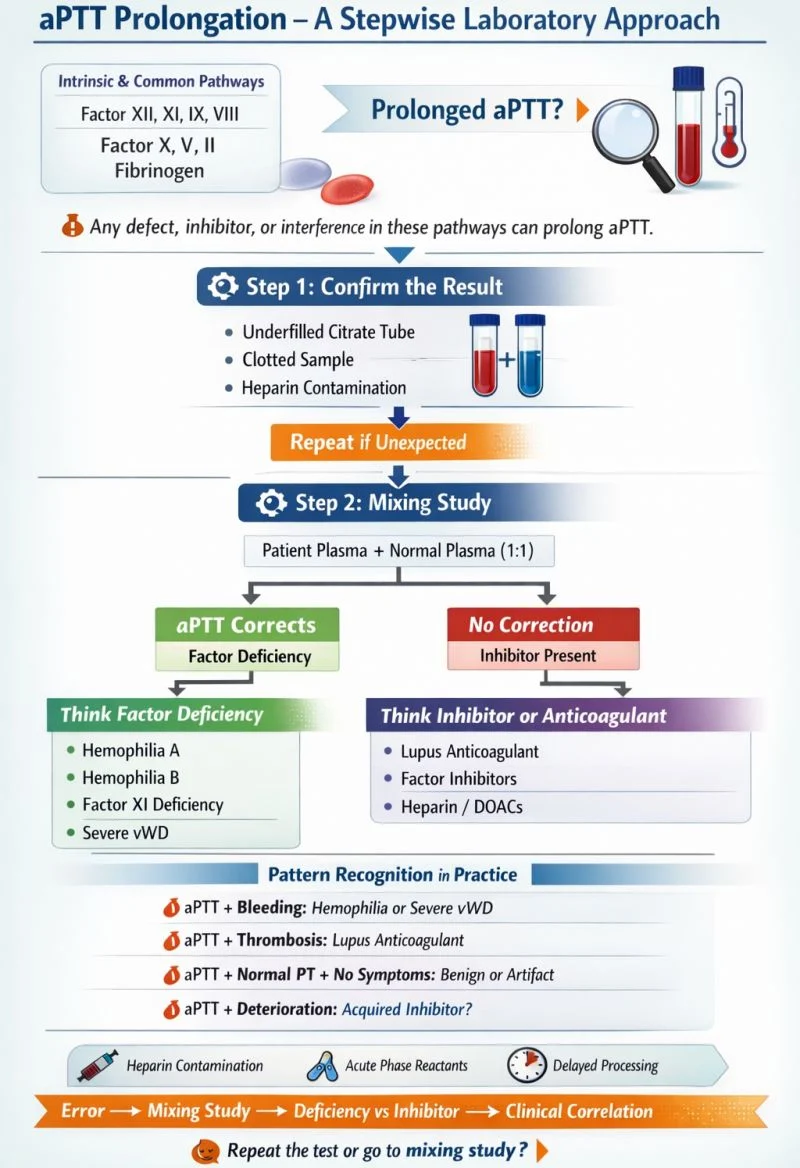
“aPTT Prolongation – A Stepwise Laboratory Approach
A prolonged activated partial thromboplastin time (aPTT) is a common laboratory finding.
But not all prolongations indicate a bleeding disorder.
The key lies in a structured interpretation.
What Does aPTT Assess?
aPTT evaluates the intrinsic and common pathways:
- Factor XII, XI, IX, VIII
- Factor X, V, II (prothrombin), fibrinogen
Any defect, inhibitor, or interference in these pathways can prolong aPTT.
Step 1: Confirm the Result
Before interpretation, rule out pre-analytical errors:
- Underfilled citrate tube (incorrect blood-to-anticoagulant ratio)
- Clotted sample
- Heparin contamination (e.g., line draws)
Always repeat if the result is unexpected.
Step 2: Perform a Mixing Study
Mix patient plasma with normal plasma (1:1):
- Correction of aPTT – Suggests factor deficiency
- No correction – Suggests circulating inhibitor
This is the most critical step in narrowing the cause.
If It Corrects – Think Factor Deficiency
Common etiologies:
- Hemophilia A (Factor VIII deficiency)
- Hemophilia B (Factor IX deficiency)
- Factor XI deficiency
- Severe von Willebrand disease (via reduced Factor VIII)
Factor XII deficiency can prolong aPTT but does not cause bleeding – a key diagnostic trap.
If It Does Not Correct – Think Inhibitor or Anticoagulant
Key causes:
- Lupus anticoagulant (LA)
- Specific factor inhibitors (e.g., acquired Factor VIII inhibitor)
- Heparin or direct anticoagulants
Lupus anticoagulant prolongs phospholipid – dependent assays but is associated with thrombosis.
Pattern Recognition in Practice
- Isolated prolonged aPTT plus bleeding – Hemophilia or severe vWD
- Isolated prolonged aPTT plus thrombosis – Lupus anticoagulant
- Prolonged aPTT plus normal PT plus no symptoms – Likely benign cause or artifact
- Prolonged aPTT plus clinical deterioration – Consider acquired inhibitor
Laboratory Pitfalls
- Heparin contamination mimicking inhibitor patterns
- Acute phase reactions altering factor levels
- Delayed testing affecting labile factors (especially Factor VIII)
Always integrate clinical plus laboratory data.
Clinical Significance
A prolonged aPTT can indicate:
- Inherited bleeding disorders
- Acquired inhibitors
- Antiphospholipid syndrome
- Anticoagulant therapy effects
Misinterpretation can lead to inappropriate management.
Laboratory Takeaway
aPTT prolongation is not a diagnosis – it is a starting point.
Think systematically:
Error – Mixing study – Deficiency vs inhibitor – Clinical correlation
When you see a prolonged aPTT, what’s your immediate instinct – repeat the test or proceed directly to a mixing study?”
Other posts featuring Simon Senanu on Hemostasis Today.
-
Oct 4, 2026, 15:06Vasiliki Gkalea: Journal of Clinical Medicine Launches Special Issue on Hematologic Thrombosis and Bleeding
-
Oct 4, 2026, 14:55Quentin Brebant: What Defines a High-Quality Red Blood Cell Concentrate?
-
Oct 4, 2026, 14:47Rana Al-Hrout: Recognizing Non-Anemic Iron Deficiency – Why Iron Matters Beyond Hemoglobin
-
Oct 4, 2026, 14:41David McIntosh: International Plasma Awareness Week 2026 – Closing the Global Plasma Gap
-
Oct 4, 2026, 14:33Pete Stibbs: CleanerVac Real-World Study Presented at VIVA and The VEINS 2026
-
Oct 4, 2026, 13:56Maria Elisa Mancuso: EHC 2026 Highlights the Unmet Needs of Women with Bleeding Disorders
-
Oct 4, 2026, 13:53Nirmal Shaji George: Individualizing Anticoagulation in Complex APS and Thrombocytopenia
-
Oct 4, 2026, 13:5210 Posts Not to Miss This Week
-
Oct 4, 2026, 13:45Suswapna Singh Rawat: The Clinical Significance of Coronary Plaque Stability