


Francisco Chacón-Lozsán: Bleeding on Anticoagulation Is Not a Complication, It’s a Turning Point
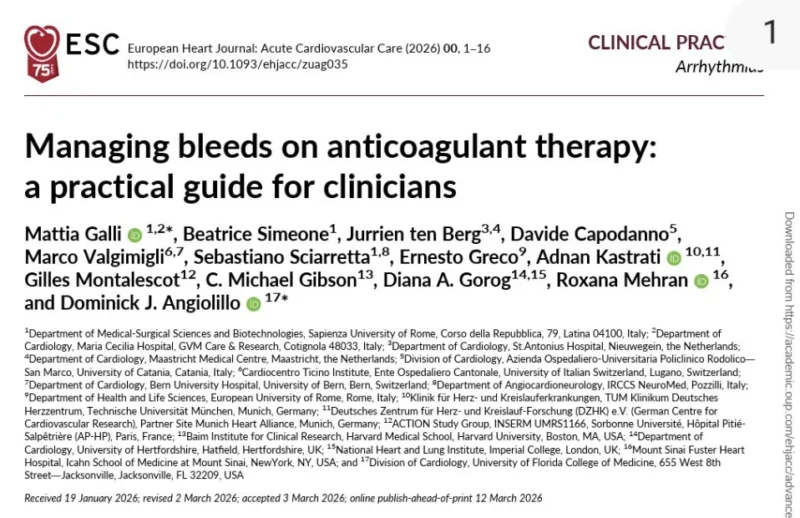
Francisco Chacón-Lozsán, Fellow at World Extreme Medicine, Member of European Society of Intensive Care Medicine (ESICM) and American College of Cardiology, shared on LinkedIn about a recent article by Mattia Galli et al, published in European Heart Journal:
”Bleeding on anticoagulation is NOT a complication… it’s a turning point
The problem
We prescribe anticoagulants to prevent:
- Stroke
- MI
- VTE
But the most frequent complication is: Bleeding
And here’s the uncomfortable truth: Bleeding often determines prognosis more than thrombosis
Why this matters
Bleeding is NOT just an event.
It triggers:
- Treatment interruption
- Fear-driven underdosing
- Permanent discontinuation
Leading to higher prevalence of stroke, MI and mortality
Key clinical reality
Major bleeding:
- approximately 1-3% per year
- 30-day mortality >15%
- 1-year mortality >25%
That’s NOT benign
The real battlefield
Every anticoagulated patient lives here: Thrombosis vs Bleeding
And we often focus on only one side.
What experts are telling us (ESC)
This is the new paradigm
1. Risk is dynamic
Bleeding risk is highest:
- Early after starting anticoagulation
- In elderly / multimorbid patients
Reassess continuously, not once
2.Not all bleeding is equal
Critical sites equal high mortality:
- Intracranial
- GI
- Retroperitoneal
- Pericardial
Even small volumes can kill
3.Combination therapy is dangerous
OAC plus antiplatelet equals 2–3 times higher risk for bleeding
- De-escalate EARLY
- Avoid triple therapy when possible
4.Prevention is powerful
Simple interventions:
- PPI for GI protection
- Avoid NSAIDs / SSRIs when possible
- Correct dosing (DOAC underdosing equals worse outcomes)
Most bleeding is preventable.
When bleeding happens
Think in 3 steps:
1. Stabilize
- Stop anticoagulant
- Airway, oxygen, access
- Fluids plus transfusion
2. Reverse (if needed)
- VKA: PCC plus Vitamin K
- Dabigatran: Idarucizumab
- FXa inhibitors: PCC (± Andexanet)
3. Find and control the source
- Endoscopy
- IR embolization
- Surgery
The biggest mistake: ‘Let’s stop anticoagulation and never restart’
The evidence says:
NOT restarting = higher risk for stroke plus death
- Restart early when safe
- Individualize timing plus dose
The future
We are moving toward:
- Personalized anticoagulation
- Dose tailoring
- Drug selection based on bleeding profile
Take-home message
Anticoagulation is NOT binary.
It is:
- A continuous balance
- A dynamic decision
- A personalized therapy
Final thought: The goal is not to avoid bleeding. The goal is to survive both bleeding AND thrombosis.
Reference: Galli, M., Simeone, B., ten Berg, J., et al. (2026). European Heart Journal: Acute Cardiovascular Care.”
Title: Managing bleeds on anticoagulant therapy: a practical guide for clinicians
Authors: Mattia Galli, Beatrice Simeone, Jurrien ten Berg, Davide Capodanno, Marco Valgimigli, Sebastiano Sciarretta, Ernesto Greco, Adnan Kastrati, Gilles Montalescot, C Michael Gibson, Diana A Gorog, Roxana Mehran, Dominick J Angiolillo
Read the Full Article on European Heart Journal
Stay updated on all scientific advances with Hemostasis Today.
-
Oct 7, 2026, 16:44Amor Salah: 2026 NCS/SCCM Guidelines for Managing Antithrombotic-Associated ICH
-
Oct 7, 2026, 16:04NETs in Thrombosis: From Mechanism to Therapeutic Target
-
Oct 7, 2026, 15:28Amir Samimi: Prognostic Value of Platelet Count in Resected HNSCC
-
Oct 7, 2026, 15:21Eloïse Laouenan: Bridging Immunity and Thrombosis in MVTE
-
Oct 7, 2026, 15:10Uthra Sundaram: Honouring Donors During International Plasma Awareness Week
-
Oct 7, 2026, 15:04Daniel Victor Ortigoza: Should Frail Older Patients With AF Switch From VKA to DOACs?
-
Oct 7, 2026, 14:53Susan Noone: Donor Turned Recipient Shares Lifesaving Transfusion Story
-
Oct 7, 2026, 14:49Aimee Burtenshaw: The Impact of the Infected Blood Inquiry on Hospital Transfusion Laboratories
-
Oct 7, 2026, 14:41Vikash Jaiswal: Does Timing Matter for Calcium in Pre-Eclampsia Prevention?