


Sara Moscatelli: Apixaban in Children is Not Just Safe, But Biologically Active
Sara Moscatelli, Research Fellow at UCL, shared a post on LinkedIn about a recent article by Ghada A. Aborkhees, published in Journal of the American Heart Association, adding:
“Apixaban in children: not just safe – biologically active
We now have more than clinical outcomes.
We have mechanistic data.
What did this study actually do?
- Substudy of SAXOPHONE trial
- 182 children with heart disease
- Apixaban vs standard of care (VKA and LMWH)
- Serial hemostatic biomarkers with thrombin generation assays
Not just ‘does it work’ but how it works
Key finding
- Apixaban reduces hypercoagulability
- Decreased D-dimer
- Increased Lag time and time to peak
- Decreased Peak thrombin
- A clear shift toward less thrombin generation
But here’s the nuance (and it matters)
Apixaban does not suppress everything
Preserves endogenous thrombin potential (ETP)
No major effect on protein C and protein S
- Not a ‘blunt anticoagulant’
- More like a modulator of coagulation dynamics
Mechanistic insight
Factor Xa inhibition leads to:
- Slower thrombin initiation
- Delayed amplification
- But ongoing, controlled thrombin generation
A shift in timing, not just magnitude
The hidden variable:
- Prior VKA exposure
- Strong carryover effect at baseline
- Suppressed d-dimer and thrombin parameters
Interpretation without this leads to wrong conclusions
Clinical pearl
Transitioning from VKA to apixaban:
- Stable d-dimer levels
- No rebound hypercoagulability
- Supports safe switching strategy
What’s really important here
This is pediatric haemostasis— not adult haemostasis.
- Developmental coagulation system
- Variable protein levels
- Complex congenital heart disease physiology
And yet:
Apixaban shows predictable, consistent effects across ages
Take-home
Apixaban is not just ‘easier to use’ in children.
It produces a controlled, physiologically coherent anticoagulation profile
Not suppression.
Regulation.”
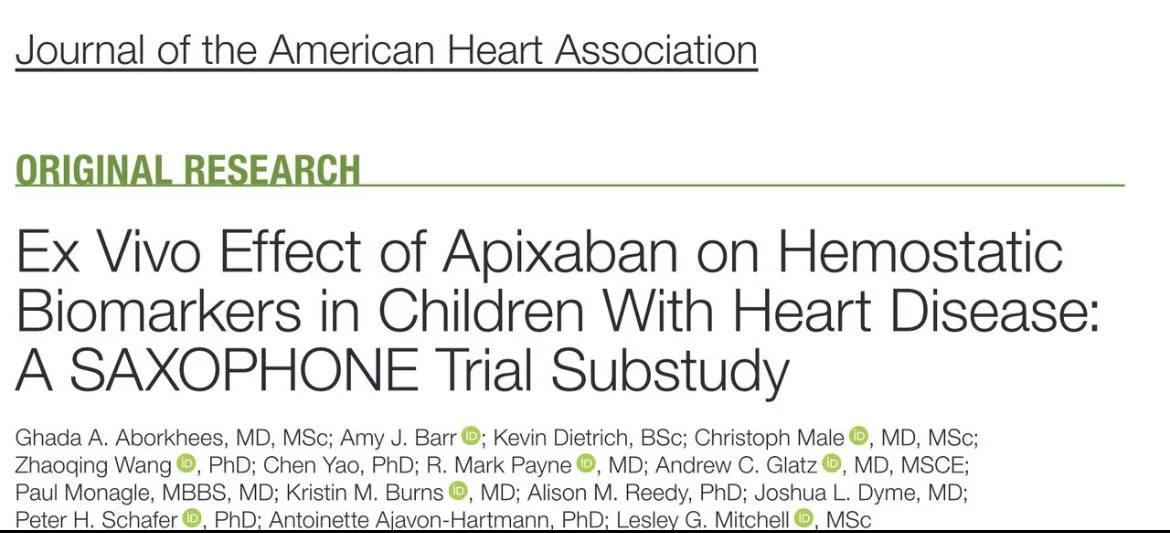
Title: Ex Vivo Effect of Apixaban on Hemostatic Biomarkers in Children With Heart Disease: A SAXOPHONE Trial Substudy
Authors: Ghada A. Aborkhees, Amy J. Barr, Kevin Dietrich, Christoph Male, Zhaoqing Wang, Chen Yao, R. Mark Payne, Andrew C. Glatz, Paul Monagle, Kristin M. Burns, Alison M. Reedy, Joshua L. Dyme, Peter H. Schafer, Antoinette Ajavon-Hartmann, Lesley G. Mitchell
Stay updated on all scientific advances with Hemostasis Today.
-
Sep 21, 2026, 15:56Anita Zaidi: Why Only 2% of Health Research and Development Goes to Women’s Conditions
-
Sep 21, 2026, 15:49Omid Khalafi: Gating Strategy and How Do We Decide Which Cells to Analyze
-
Sep 21, 2026, 15:44Levacetylleucine: A New Therapeutic Approach to Ataxia Telangiectasia
-
Sep 21, 2026, 15:40Andreas Tridimas: The Diagnostic Traps of Lipaemic Blood – Why a Normal Amylase Can Mislead You
-
Sep 21, 2026, 15:33Arsene Mekinian: Exploring Cardiac Involvement in Behçet’s Disease
-
Sep 21, 2026, 15:23Anis Mahjoubi: MRI Findings of Krukenberg Tumors
-
Sep 21, 2026, 15:08Fikreab Tesfaye Tefera: 10 Practical Take-Home Points for Diagnosing Iron Deficiency Anemia
-
Sep 21, 2026, 14:10Aswin K Mohan: Lessons from TRANSCON 2026 – Building Resilient Blood Supply Systems Before Crisis Hits
-
Sep 21, 2026, 14:00Vincent Lu: Beyond PT and aPTT – How Hemostasis Evolves Across a Lifetime