

Could Moon Dust Help Stop Bleeding in Space? – RPTH Journal
RPTH Journal shared a post on LinkedIn about a recent article by Nabil Ali-Mohamad et al, adding:
”Could moon dust help stop bleeding in space?
When astronauts venture beyond low Earth orbit on long-duration missions, emergency medicine becomes a critical challenge.
Payload constraints mean that traditional medical supplies may simply not be available, so what if the answer lies in the ground beneath their feet?
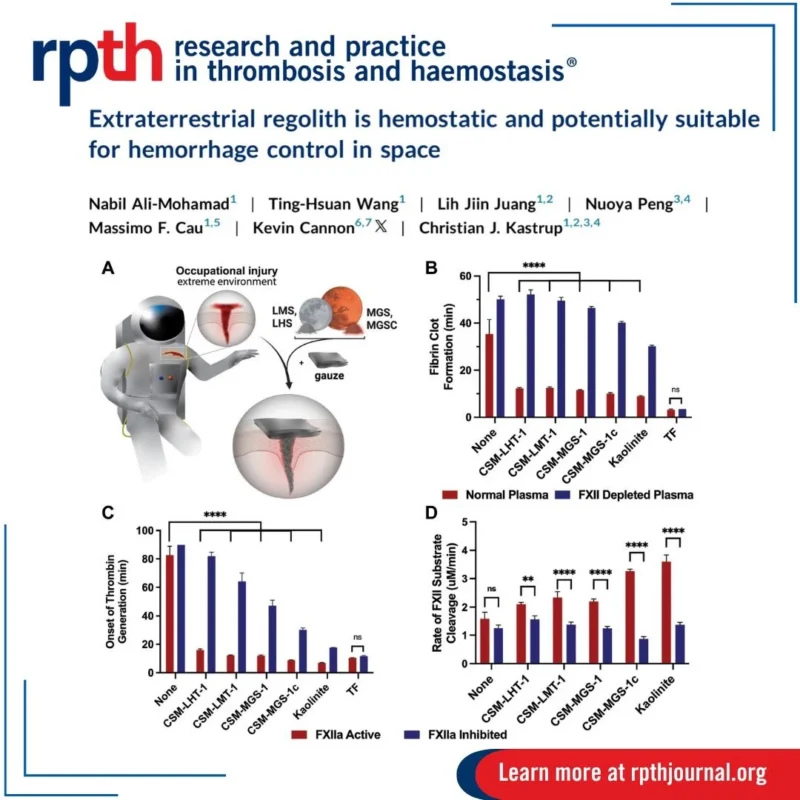
A new study in RPTH Journal investigated whether extraterrestrial regolith, the rocky and dusty material found on the Moon, Mars, and asteroids, could serve as a haemostatic agent in space trauma care.
Key findings:
- Lunar and Martian regolith simulants, as well as meteorite samples, accelerated clotting, thrombin generation, and FXII activation in human plasma. Procoagulant activity was reduced in FXII-depleted or FXII-inhibited plasma, confirming an FXII-dependent mechanism
- Phyllosilicates showed greater procoagulant activity than framework silicates. In a porcine model of penetrating haemorrhage, wounds treated with regolith remained clotted longer and lost less blood than those treated with gauze alone
Watch the RPTH Research Recap video with Michael Makris.”
Title: Extraterrestrial regolith is hemostatic and potentially suitable for hemorrhage control in space
Authors: Nabil Ali-Mohamad, Ting-Hsuan Wang, Lih Jiin Juang, Nuoya Peng, Massimo F. Cau, Kevin Cannon, Christian J. Kastrup
Stay updated on all scientific advances with Hemostasis Today.
-
Sep 25, 2026, 07:25Varun Capoor: How Therapeutic Apheresis and Transfusion Medicine Can Complement Clinical Management in SCD
-
Sep 25, 2026, 07:14Manshi Kesharwani: SAK-GQDs Modulate Thrombus Burden and Endothelial Function in Deep Vein Thrombosis
-
Sep 25, 2026, 06:20Farjah Hassan Algahtani: How Can We Better Identify Patients at Risk of Blood Clots after Metabolic and Bariatric Surgery?
-
Sep 25, 2026, 05:59Carla Lewis: Kids Conquering Sickle Disease Joins Nemours Children’s Hospital for 2nd Annual Awareness Event
-
Sep 25, 2026, 05:47Omid Seidizadeh: Evolutionary Constraint and Population Variation Across Coagulation Genes
-
Sep 25, 2026, 05:40Gerald Bertrand: Presenting UMi-NGS Non-Invasive Foetal HPA Genotyping at DGTI 2026
-
Sep 25, 2026, 05:33Urge Congress to support the Sickle Cell Disease Comprehensive Care Act – ASH
-
Sep 25, 2026, 05:24Isabelle Mahé: Reduced-Dose Apixaban in Extended CAT Treatment
-
Sep 25, 2026, 05:15Maria Cherska: High Cholesterol Isn’t Always Diet or Lifestyle – Sometimes It’s Genetic