

Anu Thomas: Understanding the ABO Blood Group System and Its Formation
Anu Thomas, Assistant Professor at Government Medical College, Kozhikode, shared a post on LinkedIn:
“Understanding the ABO Blood Group System and Its Formation
The ABO blood group system is one of the most important classifications in transfusion medicine.
It plays a critical role in ensuring safe blood transfusions and organ transplants.
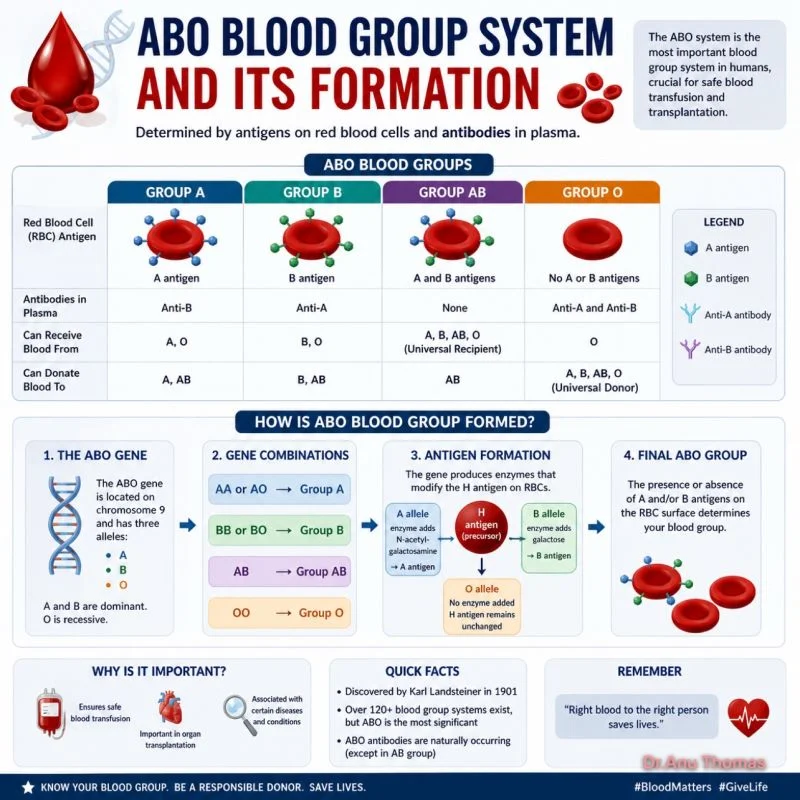
This system is based on the presence or absence of specific antigens – A and B antigens – on the surface of red blood cells:
- Group A – Has A antigen and anti-B antibodies
- Group B – Has B antigen and anti-A antibodies
- Group AB – Has both A and B antigens and no antibodies
- Group O – Has no antigens but both anti-A and anti-B antibodies
How is it formed?
The ABO blood group is genetically determined and inherited from parents.
It is controlled by the ABO gene, which exists in three forms (alleles): A, B, and O.
- The A and B alleles are co-dominant, meaning both are expressed if present together.
- The O allele is recessive, meaning it only appears when both inherited alleles are O.
These genes influence the production of enzymes that modify the surface of red blood cells, leading to the formation of A or B antigens – or neither in the case of group O.
Why is it important?
Compatibility in the ABO system is crucial. Mismatched transfusions can lead to serious, even life-threatening reactions due to immune responses.
Understanding this system is fundamental in clinical practice, blood banking, and patient safety.”
Stay updated with Hemostasis Today.
-
Sep 25, 2026, 15:23Bringing Hope and Treatment Access to Morocco’s Hemophilia Community – World Federation of Hemophilia
-
Sep 25, 2026, 15:22Alejandro González Veliz: Targeting Atherosclerosis Before the First Event
-
Sep 25, 2026, 15:00Sarah Richardson: Finding Strength Through Bleeding Disorders Advocacy
-
Sep 25, 2026, 14:54James Fildes: Modeling Device Related Thrombosis in Multi Organ Systems
-
Sep 25, 2026, 14:51Platelet Metabolic Reprogramming: How Cellular Energy Drives Thrombosis
-
Sep 25, 2026, 14:46Thomas Maxwell: From Hemophilia Shame to Strength – Walking for Bleeding Disorders
-
Sep 25, 2026, 14:35Sarita Rani Jaiswal: Sharing Basic Science Insights at EBMT HWP 2026
-
Sep 25, 2026, 14:12Managing Breakthrough Bleeds in Hemophilia – National Bleeding Disorders Foundation
-
Sep 25, 2026, 13:50Alejandro González Veliz: Beyond the Golden Hour in Stroke Care