


Ifeanyichukwu Ifechidere: Why INR Can Be Dangerously Misleading
Ifeanyichukwu Ifechidere, Specialist Biomedical Scientist at Sheffield Teaching Hospitals NHS Foundation Trust, shared a post on LinkedIn:
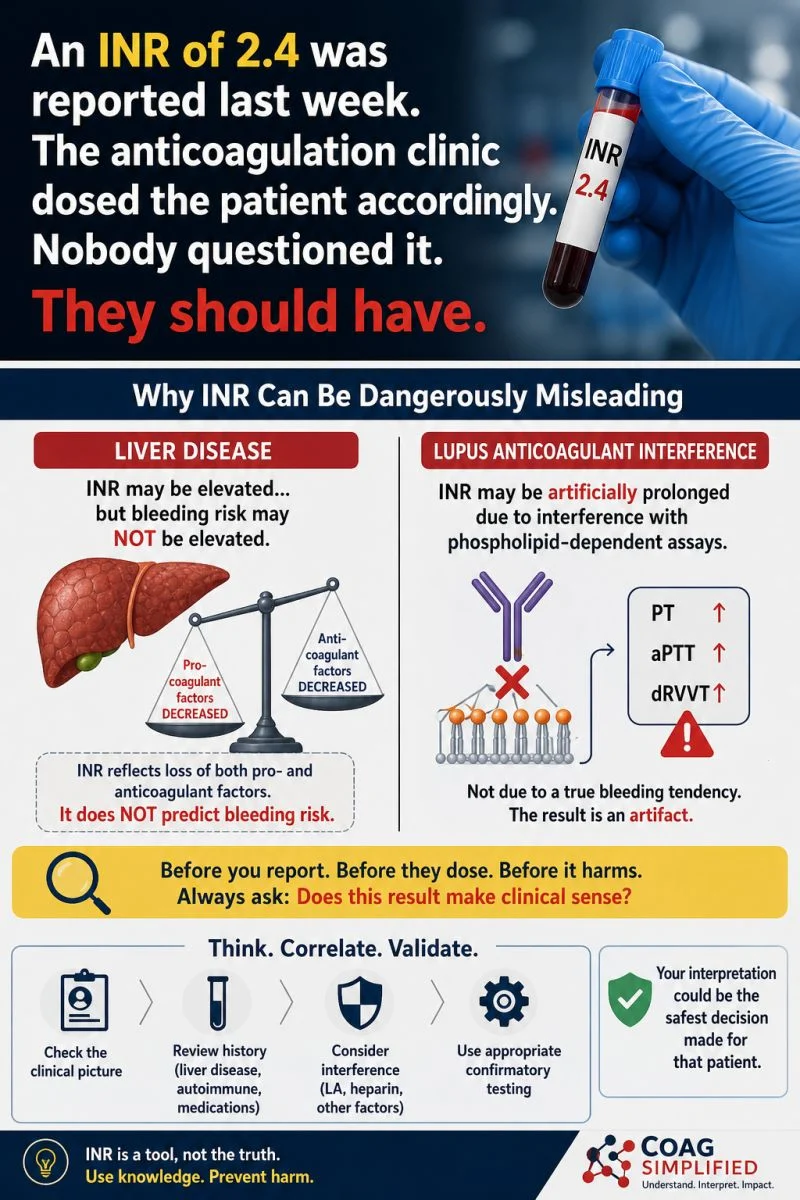
“I reported an INR of 2.4 last week. The clinic dosed accordingly.
Nobody questioned it.
They should have. Because that INR was lying.
I’m a Biomedical Scientist specialising in Coagulation and Haemostasis. I’ve processed thousands of coagulation screens. And the most dangerous assumption I see repeatedly is this:
‘The INR tells us how anticoagulated the patient is.’
Sometimes it does. Often, it doesn’t.
Two scenarios that should concern every haematology professional.
Scenario 1: The Cirrhotic Patient
INR is 2.8. The team labels them ‘auto-anticoagulated’ and pulls back on VTE prophylaxis.
Here’s what the INR isn’t telling you.
The liver manufactures all clotting factors — but also Protein C, Protein S, and antithrombin. In liver failure, both sides of the haemostatic balance collapse simultaneously. The INR only captures the procoagulant deficiency. It is completely blind to the anticoagulant protein loss happening in parallel.
These patients are frequently in a rebalanced haemostatic state. Some are actually prothrombotic.
That elevated INR is not permission to withhold thromboprophylaxis. It is a measurement of synthetic dysfunction — nothing more.
Scenario 2: The Lupus Anticoagulant
INR returns at 1.6. The team assumes subtherapeutic anticoagulation or mild factor deficiency.
What they may not know:
Lupus anticoagulants are phospholipid-dependent antibodies. In the laboratory, they prolong clotting times. In the patient, they are associated with a prothrombotic state — antiphospholipid syndrome.
Depending on the thromboplastin used, LA interference can artificially elevate the INR. The ISI calibration assumes factor deficiency – not phospholipid inhibition. If a clinician interprets INR 1.6 as mild coagulopathy in an undiagnosed LA patient, the downstream consequences can be catastrophic.
The correct pathway? Mixing studies. Phospholipid neutralisation. DRVVT and silica clotting time.
Not a repeat INR.
What this means practically:
- Liver disease – interpret INR alongside thrombin generation, fibrinogen, and platelet count. Never in isolation.
- Suspected LA – flag the sample. Communicate with haematology. The INR is unreliable standalone.
- Always ask: what is this reagent actually measuring – and what is it missing?
Laboratory science only protects patients when its limitations are understood as clearly as its capabilities.
The INR is one of our most requested tests. It is not infallible. It was designed and validated in a specific clinical context — and that context matters enormously.
If you’re a fellow BMS: your clinical commentary matters. Add it to the report. Make the call. You may be the only person in the pathway who truly understands what that number can and cannot tell us.
What’s the most significant INR misinterpretation you’ve encountered?”
Other posts featuring Ifeanyichukwu Ifechidere on Hemostasis Today.
-
Sep 25, 2026, 09:49Haley Coleman: Volunteering to Support Hemophilia Awareness
-
Sep 25, 2026, 08:55Hitarth Mehta: BHMS Students Gain Practical Exposure to Haemophilia Diagnosis
-
Sep 25, 2026, 07:25Varun Capoor: How Therapeutic Apheresis and Transfusion Medicine Can Complement Clinical Management in SCD
-
Sep 25, 2026, 07:14Manshi Kesharwani: SAK-GQDs Modulate Thrombus Burden and Endothelial Function in Deep Vein Thrombosis
-
Sep 25, 2026, 06:20Farjah Hassan Algahtani: How Can We Better Identify Patients at Risk of Blood Clots after Metabolic and Bariatric Surgery?
-
Sep 25, 2026, 05:59Carla Lewis: Kids Conquering Sickle Disease Joins Nemours Children’s Hospital for 2nd Annual Awareness Event
-
Sep 25, 2026, 05:47Omid Seidizadeh: Evolutionary Constraint and Population Variation Across Coagulation Genes
-
Sep 25, 2026, 05:40Gerald Bertrand: Presenting UMi-NGS Non-Invasive Foetal HPA Genotyping at DGTI 2026
-
Sep 25, 2026, 05:33Urge Congress to support the Sickle Cell Disease Comprehensive Care Act – ASH