

Masoabi Sefojane: In Africa 88% of Hemophilia Remains Undiagnosed
Masoabi Sefojane, Geographic Expansion Lead, Africa and Asia Pacific at MicroHealth , shared a post on LinkedIn:
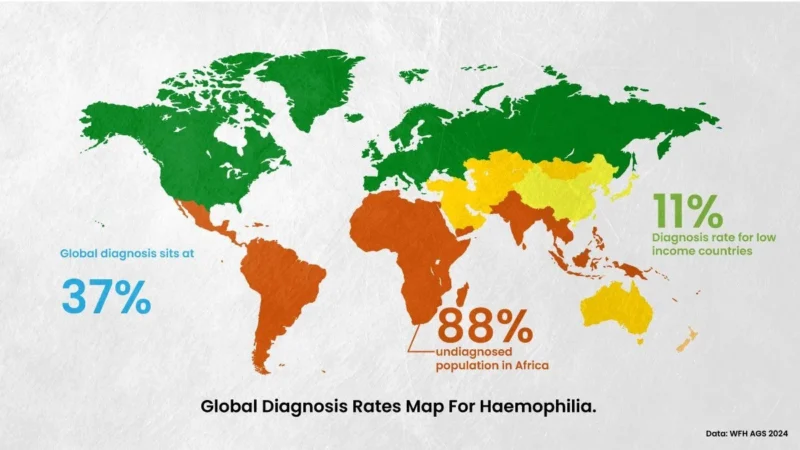
”The World Federation of Haemophilia identifies 37% of people with haemophilia globally.
In low-income countries? 11%.
In Africa? An estimated 88% remain undiagnosed.
Let me be direct: these numbers represent invisibility by design.
Not because diagnosis is impossible.
But because the systems to find people were built for certain geographies and certain people.
When my brother was 6 years old in Phuthaditjhaba, South Africa, He didn’t exist in any global haemophilia dataset.
He was bleeding, my family was desperate, but he was invisible. No screening protocol would find him.
No registry would record him. No system knew he existed. This could have been my story if it wasn’t for my brothers.
Ask any bleeding disorder patient in the global south and you will hear similar stories and a pattern will also emerge.
Meanwhile, a child born with the same severe haemophilia A in Amsterdam? Known by age 1. Registered. Part of the data that shapes global priorities.
Same disease. Different visibility.
Here’s what the data shows: Africa, with 18% of the world’s population, represents less than 3% of identified haemophilia patients globally.
That’s not because haemophilia is rare in Africa. It’s because the systems designed to find haemophilia were never designed to reach Africa.
The invisibility isn’t accidental. It’s structural.
When a patient is invisible, they don’t exist in clinical trials. They’re not counted in epidemiology.
They don’t influence treatment guidelines. Their outcomes don’t matter because nobody’s measuring them.
The question we need to ask: Are we actually looking for these patients?
Or have we built systems that only find the ones in certain places?
Because that’s the real diagnosis gap.”
Stay updated with Hemostasis Today.
-
Sep 28, 2026, 19:14Aditya Sharma: An Outstanding Start to the Final Day of VSS 2026!
-
Sep 28, 2026, 19:07Dhargam Aljebouri: AIHA Subclassification Research Presented at the 14th Iraqi Society of Hematology Conference
-
Sep 28, 2026, 19:02William Wallace: Your Cholesterol Test is Missing a Particle that May Matter More than the One it Measures
-
Sep 28, 2026, 18:57Indu Thakur: Honoring Sickle Warriors and Advancing Diverse Blood Donation at Sickle Ball 2026
-
Sep 28, 2026, 18:48Orly Leiva: Rethinking JAK Inhibitor Cardiovascular Safety in MPNs
-
Sep 28, 2026, 18:42Wael Saad: Honored to Be Part of Portal and Mesenteric Vein Thrombosis Session at CIRSE 2026
-
Sep 28, 2026, 18:35Alejandro González Veliz: The Unbroken Connection Between Heart and Brain
-
Sep 28, 2026, 16:43Scott Sutton: Community and Connection in Immune Thrombocytopenia
-
Sep 28, 2026, 16:24Pankti Solanki: ISBT Recognized JAMA as the 49th Human Blood Group System