

Tareq Abadl: The Hidden Danger in a Blood Bag – When a Unit Looks ‘Wrong’
Tareq Abadl, Medical Lab Specialist, shared a post on LinkedIn:
“The Hidden Danger in a Blood Bag: When a Unit Looks ‘Wrong’
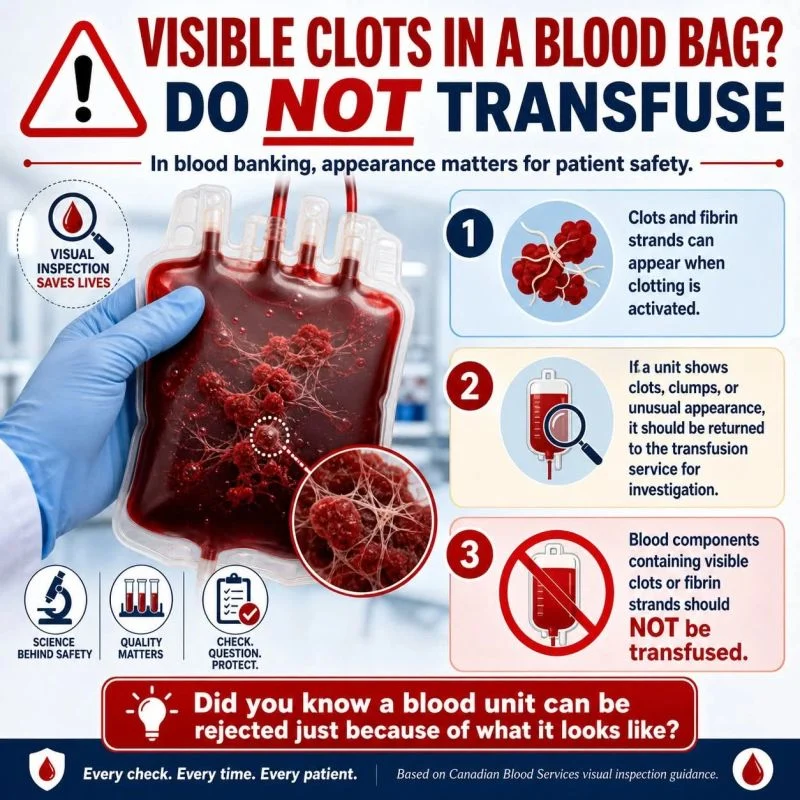
Did you know that if a blood bag contains visible clots or fibrin strands, it should not be transfused?
Many people think transfusion safety is only about ABO, Rh, and antibody testing — but sometimes the warning sign is something you can actually see with the naked eye.
Blood components are collected into bags containing anticoagulants to prevent clotting. However, clotting activation can still occasionally occur, leading to the formation of:
- Clots
- Fibrin strands
- Clumps or aggregates
- Abnormal discoloration or appearance
Why is this important?
Because visible clots or fibrin strands may indicate:
- Activation of the coagulation process
- Product quality deterioration
- Improper storage or handling
- Potential risk to the patient if transfused
That is why blood-bank personnel and transfusion services perform careful visual inspection before releasing blood products.
A unit may be rejected even if:
- The blood type is correct
- Compatibility testing is acceptable
- The label appears normal
If unusual findings are seen, the component should be:
- Returned to the transfusion service
- Investigated further
- Withheld from transfusion until deemed safe
Another important laboratory point:
Different blood components can show different abnormal appearances.
For example:
- RBC units can show clots, hemolysis, dark discoloration
- Plasma can show unusual turbidity or color change
- Platelets can show clumping or loss of the normal swirling appearance
This is one of the most fascinating parts of medical laboratory science in transfusion medicine:
Blood-bank safety is not only about compatibility testing — it also includes visual inspection, storage monitoring, quality control, and product release safety.”
Other posts featuring Tareq Abadl on Hemostasis Today.
-
Sep 25, 2026, 12:53Bastu Odoka: What Happened to Blood Donation?
-
Sep 25, 2026, 12:43Thomas Dayspring: Reshaping the Biology of Atherosclerotic Plaques with New Therapies
-
Sep 25, 2026, 12:14Garima Sharma: Community Clinical Linkages for Better Postpartum Cardiovascular Care
-
Sep 25, 2026, 10:49Shefina S: From Presenting to Hosting at TRANSCON 2026
-
Sep 25, 2026, 10:37Michelle Leona Cecil: Hemophilia Advocacy and the Power of Community
-
Sep 25, 2026, 10:13Michael Baria: Platelet Concentration and PRP Outcomes in Partial Rotator Cuff Tears
-
Sep 25, 2026, 09:49Haley Coleman: Volunteering to Support Hemophilia Awareness
-
Sep 25, 2026, 08:55Hitarth Mehta: BHMS Students Gain Practical Exposure to Haemophilia Diagnosis
-
Sep 25, 2026, 07:25Varun Capoor: How Therapeutic Apheresis and Transfusion Medicine Can Complement Clinical Management in SCD