


Athma Dias: Limitations of PT and APTT in Predicting Thrombotic Risk
Athma Dias, Medical Laboratory Scientist at Teaching Hospital Ratnapura, shared a post on LinkedIn:
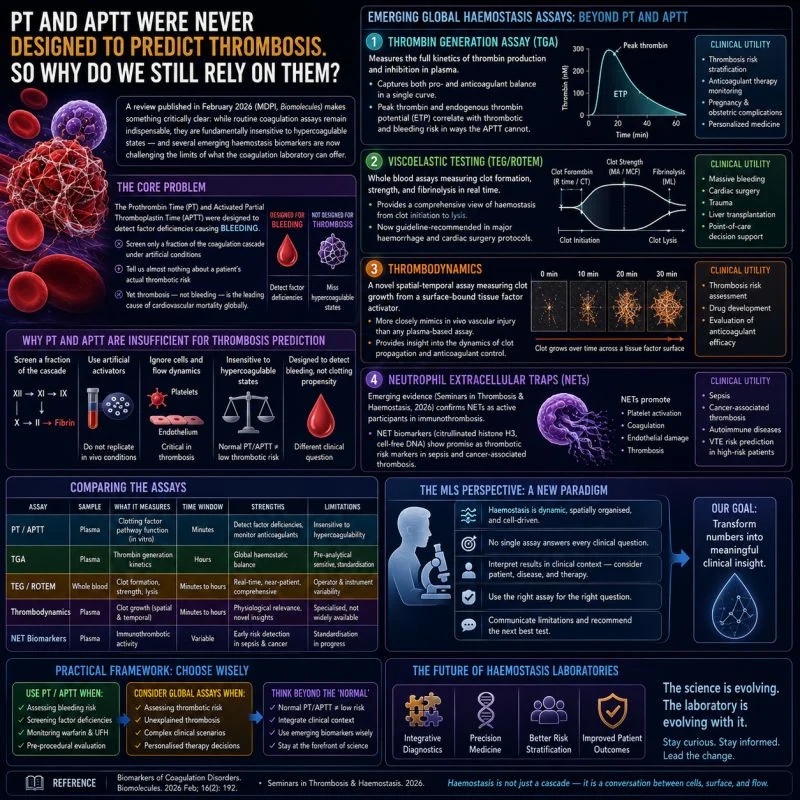
“The PT and APTT were never designed to predict thrombosis.
So why do we still rely on them as if they were?
A review published in February 2026 (MDPI, Biomolecules) makes something critically clear: while routine coagulation assays remain indispensable, they are fundamentally insensitive to hypercoagulable states and several emerging haemostasis biomarkers are now challenging the limits of what the coagulation laboratory can offer.
The core problem:
The Prothrombin Time (PT) and Activated Partial Thromboplastin Time (APTT) were designed to detect factor deficiencies causing Bleeding.
They screen only a fraction of the coagulation cascade under artificial conditions.
They tell us almost nothing about a patient’s actual thrombotic risk.
Yet thrombosis not bleeding is the leading cause of cardiovascular mortality globally.
Emerging global haemostasis assays are addressing this gap:
- Thrombin Generation Assay (TGA) measures the full kinetics of thrombin production and inhibition in plasma, capturing both pro- and anticoagulant balance in a single curve. Peak thrombin and endogenous thrombin potential (ETP) correlate with thrombotic and bleeding risk in ways the APTT cannot.
- Viscoelastic Testing (TEG/ROTEM) whole blood assays measuring clot formation, strength, and fibrinolysis in real time. Now guideline-recommended in major haemorrhage and cardiac surgery protocols.
- Thrombodynamics a novel spatial-temporal assay measuring clot growth from a surface-bound tissue factor activator, more closely mimicking in vivo vascular injury than any plasma-based assay.
- Neutrophil Extracellular Traps (NETs) emerging evidence published in Seminars in Thrombosis and Haemostasis (2026) confirms NETs as active participants in immunothrombosis, with NET biomarkers (citrullinated histone H3, cell-free DNA) showing promise as thrombotic risk markers in sepsis and cancer-associated thrombosis.
For the MLS in haemostasis, this evolution demands more than technical competency on the coagulation analyser.
It demands understanding haemostasis as a dynamic, spatially organised, cell-driven biological process not simply a cascade of clotting factors on a reagent strip.
Reference: Biomarkers of Coagulation Disorders MDPI Biomolecules, February 2026.
Is your laboratory using any global haemostasis assays beyond routine coagulation screening?”
Stay updated with Hemostasis Today.
-
Sep 25, 2026, 09:49Haley Coleman: Volunteering to Support Hemophilia Awareness
-
Sep 25, 2026, 08:55Hitarth Mehta: BHMS Students Gain Practical Exposure to Haemophilia Diagnosis
-
Sep 25, 2026, 07:25Varun Capoor: How Therapeutic Apheresis and Transfusion Medicine Can Complement Clinical Management in SCD
-
Sep 25, 2026, 07:14Manshi Kesharwani: SAK-GQDs Modulate Thrombus Burden and Endothelial Function in Deep Vein Thrombosis
-
Sep 25, 2026, 06:20Farjah Hassan Algahtani: How Can We Better Identify Patients at Risk of Blood Clots after Metabolic and Bariatric Surgery?
-
Sep 25, 2026, 05:59Carla Lewis: Kids Conquering Sickle Disease Joins Nemours Children’s Hospital for 2nd Annual Awareness Event
-
Sep 25, 2026, 05:47Omid Seidizadeh: Evolutionary Constraint and Population Variation Across Coagulation Genes
-
Sep 25, 2026, 05:40Gerald Bertrand: Presenting UMi-NGS Non-Invasive Foetal HPA Genotyping at DGTI 2026
-
Sep 25, 2026, 05:33Urge Congress to support the Sickle Cell Disease Comprehensive Care Act – ASH