

Tagreed Alkaltham: How Does an Apheresis Machine Actually Work?
Tagreed Alkaltham, Transfusion Medicine Lab Supervisor at KSMC, shared a post on LinkedIn:
“How Does an Apheresis Machine Actually Work?
Many people see the apheresis machine but few understand what is happening inside the system.
At first glance, it may look complicated.
In reality, the core principle is surprisingly logical:
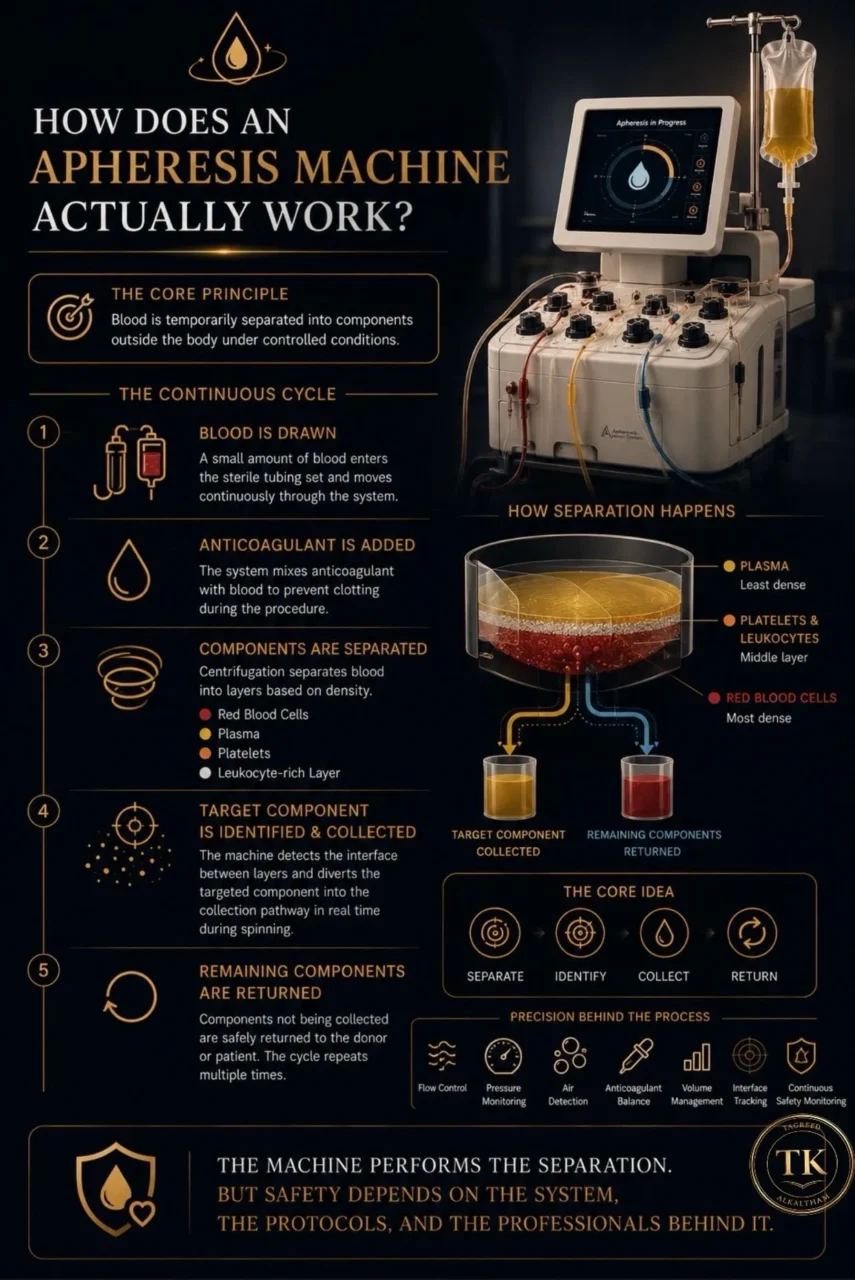
Blood is temporarily separated into components outside the body under controlled conditions.
That is why the procedure is called:
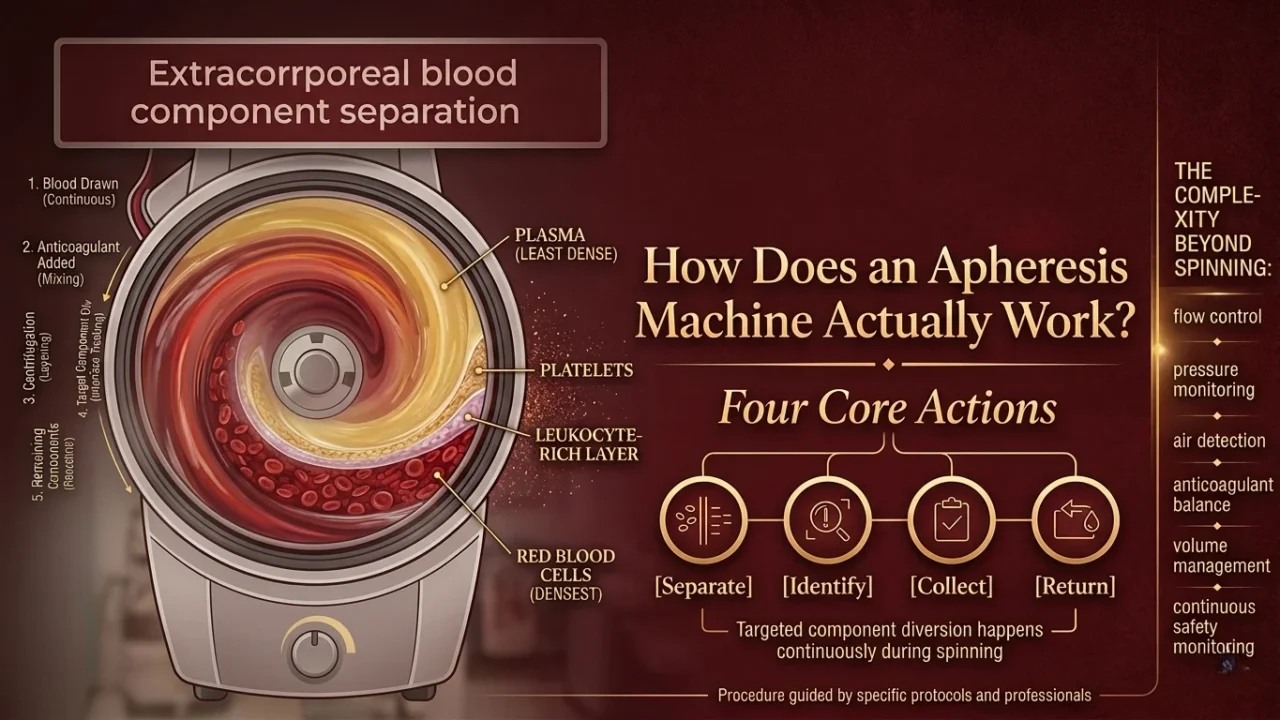
‘Extracorporeal blood component separation.’
So what actually happens during apheresis?
The process usually follows a continuous cycle:
1.Blood is drawn from the donor or patient:
A small amount of blood enters a sterile disposable tubing set connected to the machine.
The blood moves continuously through the extracorporeal circuit in controlled volumes throughout the procedure.
2.Anticoagulant is added:
The system mixes the blood with anticoagulant solution to prevent clotting while blood circulates through the extracorporeal circuit.
3.The machine separates blood components:
Most apheresis systems use centrifugation based separation.
Inside the centrifuge chamber, blood spins at controlled speed.
Because blood components have different densities, they separate into layers:
- Red blood cells
- Plasma
- Platelets
- Leukocyte-rich layer
4.The target component is identified and collected:
The machine continuously detects the interface between blood layers and selectively diverts the targeted component into a collection pathway while the remaining components continue through the return pathway.
This process happens continuously in real time during spinning, not after centrifugation stops.
5.The remaining blood components are returned:
The components that are not being collected are safely returned to the donor or patient through the return line.
This collection and return cycle may repeat multiple times during the session.
So despite how advanced the machine appears, the principle is built around four core actions:
- separate
- identify
- collect
- return
But the real complexity is not the spinning chamber alone.
It is the precision behind the process:
- flow control
- pressure monitoring
- air detection
- anticoagulant balance
- volume management
- interface tracking
- continuous safety monitoring
Because apheresis is not simply ‘blood spinning in a machine.’
It is a highly controlled extracorporeal procedure designed to achieve a specific therapeutic or donation goal while maintaining donor and patient safety throughout the process.
The machine performs the separation.
But safety depends on the system, the protocols, and the professionals behind it.”
Other posts featuring Tagreed Alkaltham on Hemostasis Today.
-
Sep 25, 2026, 12:43Thomas Dayspring: Reshaping the Biology of Atherosclerotic Plaques with New Therapies
-
Sep 25, 2026, 12:14Garima Sharma: Community Clinical Linkages for Better Postpartum Cardiovascular Care
-
Sep 25, 2026, 10:49Shefina S: From Presenting to Hosting at TRANSCON 2026
-
Sep 25, 2026, 10:37Michelle Leona Cecil: Hemophilia Advocacy and the Power of Community
-
Sep 25, 2026, 10:13Michael Baria: Platelet Concentration and PRP Outcomes in Partial Rotator Cuff Tears
-
Sep 25, 2026, 09:49Haley Coleman: Volunteering to Support Hemophilia Awareness
-
Sep 25, 2026, 08:55Hitarth Mehta: BHMS Students Gain Practical Exposure to Haemophilia Diagnosis
-
Sep 25, 2026, 07:25Varun Capoor: How Therapeutic Apheresis and Transfusion Medicine Can Complement Clinical Management in SCD
-
Sep 25, 2026, 07:14Manshi Kesharwani: SAK-GQDs Modulate Thrombus Burden and Endothelial Function in Deep Vein Thrombosis