


Muhammad Asim: The Clinical Value of Cord Blood in Neonatal Practice
Muhammad Asim, Pediatrics Resident at Qassim Health Cluster, shared a post on LinkedIn:
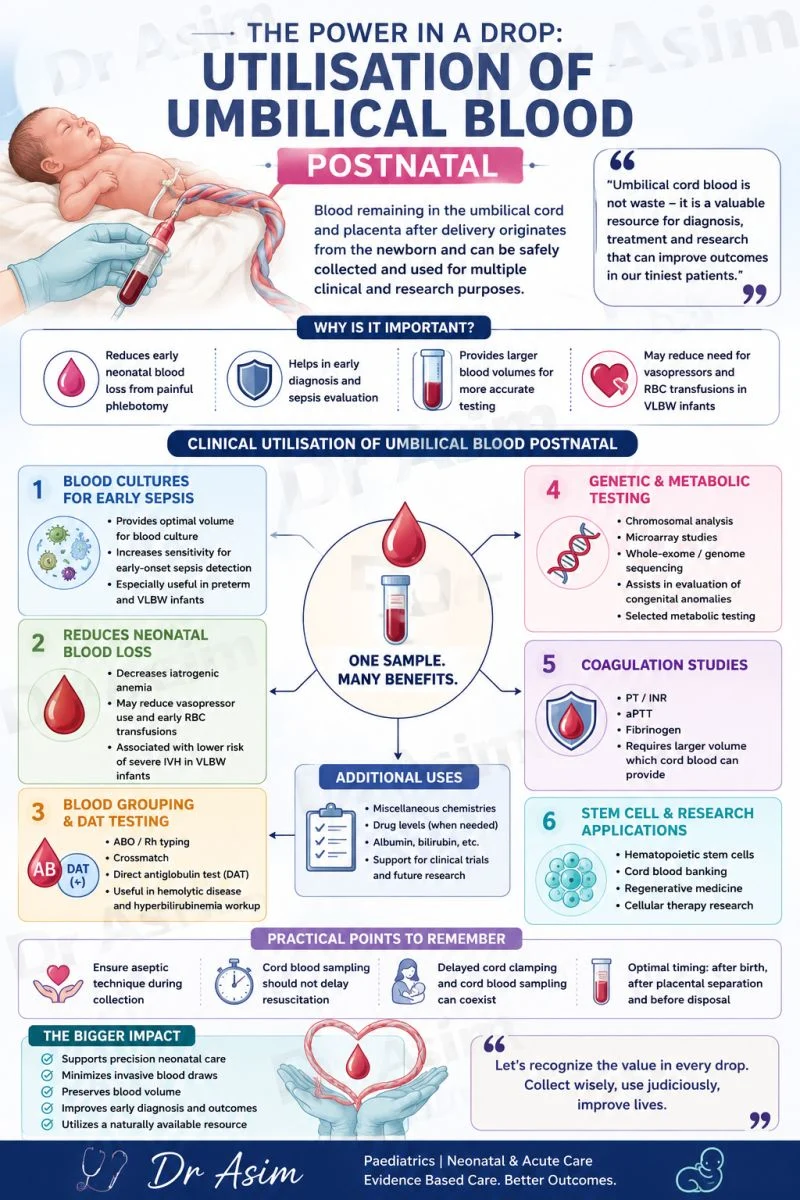
“Uses of Cord Blood After Delivery: More Than Just a Discarded Sample.
Umbilical cord blood has traditionally been viewed as a biological byproduct.
However, growing evidence shows that cord blood is a valuable clinical resource with important diagnostic, therapeutic, and research applications in neonatal medicine.
Why is cord blood important?
The blood remaining in the umbilical cord and placenta after delivery originates primarily from the newborn.
Cord blood can often be used for early investigations immediately after birth.
This is particularly important in:
- Preterm infants
- Very low birth weight (VLBW) neonates
- Babies requiring NICU admission
- Infants needing early sepsis evaluation
Major Clinical Uses of Cord Blood
1. Blood Cultures for Early-Onset Sepsis
Cord blood can be used for:
- Blood cultures
- CBC with differential
- CRP and selected chemistries
2. Reducing Neonatal Blood Loss
Repeated phlebotomy in NICU infants contributes significantly to:
- Iatrogenic anemia
- Need for transfusions
- Hemodynamic instability
Using cord blood decreases early neonatal blood loss and may reduce:
- Vasopressor requirement
- Early RBC transfusions
- Severe intraventricular hemorrhage in VLBW infants.
This is especially relevant during the critical transition period after birth.
3. Blood Grouping and DAT Testing
Cord blood is widely used for:
- ABO/Rh typing
- Crossmatch
- Direct antiglobulin testing (DAT)
- Hyperbilirubinemia workup
4. Genetic and Metabolic Testing
Cord blood may assist in:
- Chromosomal analysis
- Microarray studies
- Whole-exome/genome sequencing
- Investigation of congenital anomalies
It can also support selected newborn metabolic screening when clinically indicated.
5. Coagulation Studies
Cord blood can reliably be used for:
- PT/INR
- aPTT
- Fibrinogen
This is valuable because coagulation studies often require larger sample volumes in neonates.
6. Stem Cell and Research Applications
Cord blood banking and stem cell preservation continue to expand in:
- Hematologic disorders
- Regenerative medicine
- Cellular therapy research
Additionally, cord blood collected after delayed cord clamping may still be usable for selected research and banking purposes.
Important Practical Points
- Cord blood sampling should be performed aseptically.
- Delayed cord clamping and cord blood sampling can coexist with proper planning.
- Cord blood should not delay urgent neonatal resuscitation.
- In VLBW infants, PCBS may offer substantial benefits by minimizing painful phlebotomy procedures.
Cord blood is no longer merely discarded tissue — it has become a valuable extension of neonatal diagnostics and precision care.
Inspired by AAP neonatal guidance and current literature.”
Stay updated with Hemostasis Today.
-
Sep 25, 2026, 12:43Thomas Dayspring: Reshaping the Biology of Atherosclerotic Plaques with New Therapies
-
Sep 25, 2026, 12:14Garima Sharma: Community Clinical Linkages for Better Postpartum Cardiovascular Care
-
Sep 25, 2026, 10:49Shefina S: From Presenting to Hosting at TRANSCON 2026
-
Sep 25, 2026, 10:37Michelle Leona Cecil: Hemophilia Advocacy and the Power of Community
-
Sep 25, 2026, 10:13Michael Baria: Platelet Concentration and PRP Outcomes in Partial Rotator Cuff Tears
-
Sep 25, 2026, 09:49Haley Coleman: Volunteering to Support Hemophilia Awareness
-
Sep 25, 2026, 08:55Hitarth Mehta: BHMS Students Gain Practical Exposure to Haemophilia Diagnosis
-
Sep 25, 2026, 07:25Varun Capoor: How Therapeutic Apheresis and Transfusion Medicine Can Complement Clinical Management in SCD
-
Sep 25, 2026, 07:14Manshi Kesharwani: SAK-GQDs Modulate Thrombus Burden and Endothelial Function in Deep Vein Thrombosis