

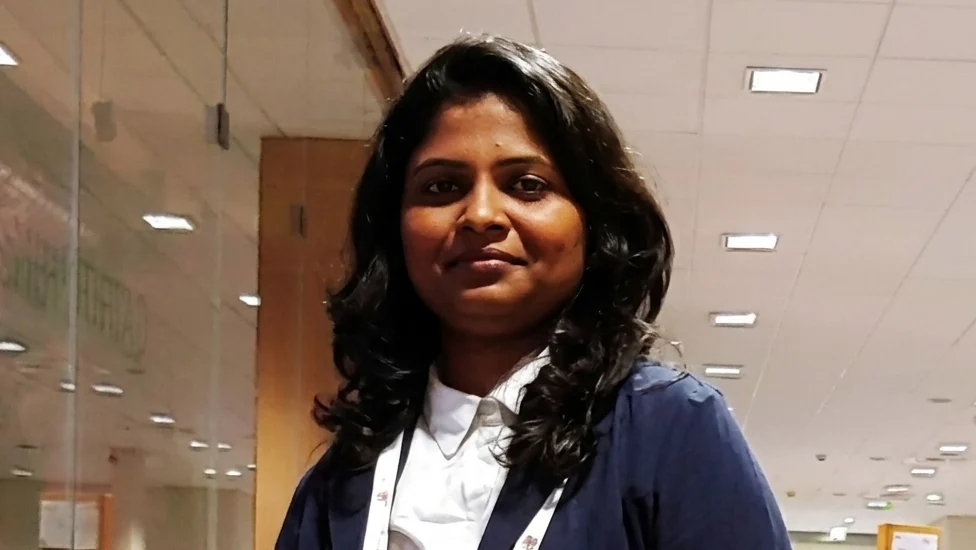
Priyanka Kasatkar: How One Research Idea Became a Diagnostic Innovation in Hemostasis
Priyanka Kasatkar, Biomedical researcher in Molecular Biology, Hemostasis and thrombosis, shared a post on LinkedIn:
“An idea written in a PDF project proposal in 2014… became an innovation, then a technology, then diagnostic kits used in the market – and today, a granted patent!
During my PhD, I witnessed patients with bleeding disorders travelling from different parts of India to Mumbai just for diagnosis.
At that time, only a few specialized coagulation centres were available in the country, and many bleeders with Hemophilia A and von Willebrand Disease (VWD) remained undiagnosed or experienced long delays in diagnosis and treatment.
Hemophilia A and VWD were the primary focus of this work because they are among the most common inherited bleeding disorders worldwide.
Lack of awareness and paucity of diagnostic facilities were among the major reasons behind the large number of undiagnosed cases globally.
Seeing the struggles of patients and their families stayed with me deeply.
Somewhere during those years, a simple thought kept coming back to me – ‘What if bleeding disorder patients who urgently need rapid point-of-care (POC) diagnosis could receive faster, simpler, and more accessible testing?’
That thought slowly turned into an idea… and that idea became this innovation.
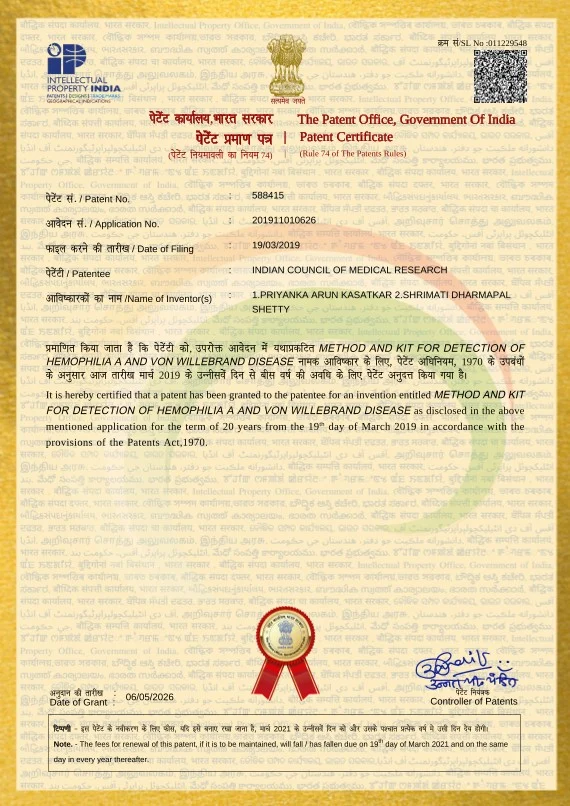
Today, I am happy to share that our patent has been officially granted in India (Patent No. 588415) by the Indian Patent Office under Indian Council of Medical Research!!
Grateful to ICMR for supporting translational healthcare innovation.
What makes this milestone especially meaningful to me is that this innovation did not remain just a ‘paper patent.’
The diagnostic kits based on this technology have already been in the market for the past 3 years, helping clinicians and contributing toward real-world patient care.
The technology has also received granted patents in India and South Africa.
This journey had everything – years of research, long hours in the lab, experiments, clinical validation, persistence, patience, technology transfer, commercialization, and the continuous effort to translate an idea into something that could genuinely help patients.
Grateful to all those who helped and supported me throughout this journey.
For me, the true purpose of science is not just publications or patents – it is creating solutions that can genuinely improve lives.”
Stay updated with Hemostasis Today.
-
Sep 29, 2026, 22:45Victor Agunyego: Paracetamol – The Most Common Drug We Underestimate
-
Sep 29, 2026, 22:42Nova Sinclair: Advancing the Future of Hematology – Meet Our 2027 Organizing Committee
-
Sep 29, 2026, 22:41Lorenz Räber: Intracoronary Imaging in PCI – Why, When, How, and Which Modality?
-
Sep 29, 2026, 22:31Selma Turkovic: Pleased to Deliver the Opening Presentation at Kingston Hospital
-
Sep 29, 2026, 22:31Miguel Teran: Ultrasound and Simulation in Arterial Blood Sampling
-
Sep 29, 2026, 21:47Javed Anees: DADA2 – When a Young Stroke Is More Than a Stroke
-
Sep 29, 2026, 22:28Mohammad Refaei: Navigating Your Career in Hematology From Training to Practice
-
Sep 29, 2026, 22:27Matteo Foschi: 10 Clinical Pearls for Antithrombotic Therapy in Secondary Stroke Prevention
-
Sep 29, 2026, 22:26A Global Call for Action on Cardiovascular Health on World Heart Day – ISTH