


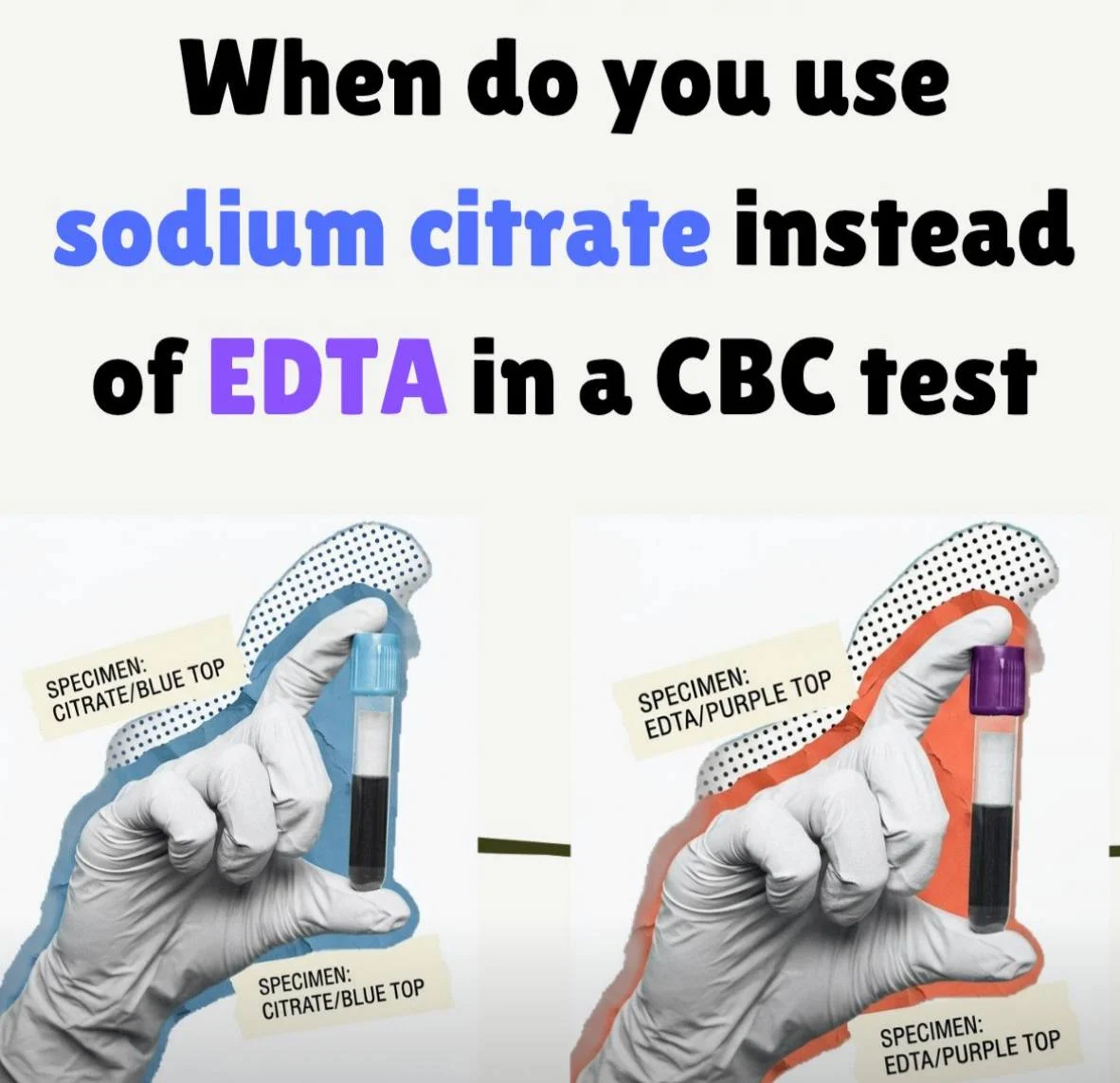
Razan Suliman: When do we use sodium citrate instead of EDTA for a CBC?
Razan Suliman, Medical Laboratory Specialists at Qater medical lab, shared a post on LinkedIn:
”A patient’s platelet count comes back extremely low.
The clinician is concerned. The patient has no signs of bleeding. The result doesn’t match the clinical picture.
So, what’s going on?
Could the platelet count be wrong?
Before diagnosing thrombocytopenia, laboratory professionals should ask an important question:
Is EDTA the problem?
Although EDTA is the anticoagulant of choice for routine CBC testing, there are situations where it can cause platelet clumping in vitro. As a result, the analyzer may report a falsely low platelet count, a phenomenon known as EDTA-dependent pseudothrombocytopenia.
In such cases, the solution may be surprisingly simple:
Collect a new sample in a sodium citrate tube.Sodium citrate can prevent the platelet clumping seen with EDTA, helping us obtain a more accurate platelet count and avoid unnecessary investigations or treatments.
When do we use sodium citrate instead of EDTA for a CBC?
- When platelet clumping is observed on the blood film.
- When the platelet count is unexpectedly low and does not correlate with the patient’s condition.
- When EDTA-dependent pseudothrombocytopenia is suspected.
Remember: Not every low platelet count is a true thrombocytopenia.
Question for laboratory professionals: Have you ever encountered EDTA-induced platelet clumping in your practice? How was it identified and resolved?”
Stay updated with Hemostasis Today.
-
Sep 22, 2026, 09:18Shamee Shastry: How Transfusion Medicine Research Is Evolving in India
-
Sep 22, 2026, 09:11Tarique Shahzad Chachar: Why Warfarin Remains the Gold Standard for Mechanical Heart Valves
-
Sep 22, 2026, 09:04Bianca Rocca: Thromboinflammatory Injury in Ischemic Limb Necrosis During Severe Shock
-
Sep 22, 2026, 09:01Ash Paul: Comparing Left Atrial Appendage Occlusion and Oral Anticoagulation
-
Sep 22, 2026, 08:50Emily Horner: Lipoprotein(a) Links Oxidized Phospholipids to Platelet Hyperactivity
-
Sep 22, 2026, 08:42Sally Mandour: Bone Marrow Needle Gauge Explained
-
Sep 22, 2026, 08:39Alessandro Sionis: Navigating Anticoagulation in Mechanical Circulatory Support
-
Sep 22, 2026, 08:28Raghavendra Rao: The Latest Research on Varicose Veins
-
Sep 22, 2026, 08:23Aravind Palraj: Three Essential Tests in Antiphospholipid Syndrome