


Abdelrahman Essam: Why Early Hemorrhage Control Is Critical in Pelvic Fractures
Abdelrahman Essam, General Surgery and Trauma Doctor Specialist at Suez Medical Complex, shared a post on LinkedIn:
“A pelvic fracture doesn’t usually kill because of the broken bone.
It kills because of the bleeding you cannot see.
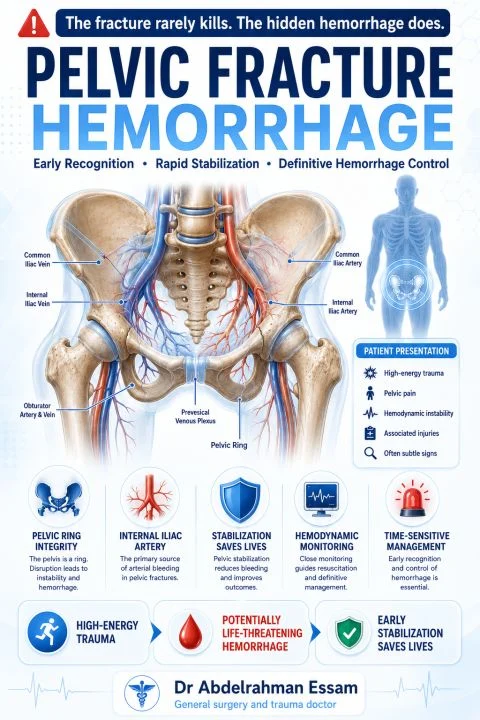
Pelvic fracture hemorrhage remains one of the most life-threatening emergencies in trauma surgery.
Although pelvic fractures account for a relatively small percentage of traumatic injuries, they are associated with some of the highest mortality rates when accompanied by massive hemorrhage.
The pelvis acts as a large potential space.
When disrupted by high-energy trauma, it can accommodate a significant volume of blood before obvious clinical signs appear.
By the time hypotension develops, the patient may have already lost a substantial amount of circulating blood.
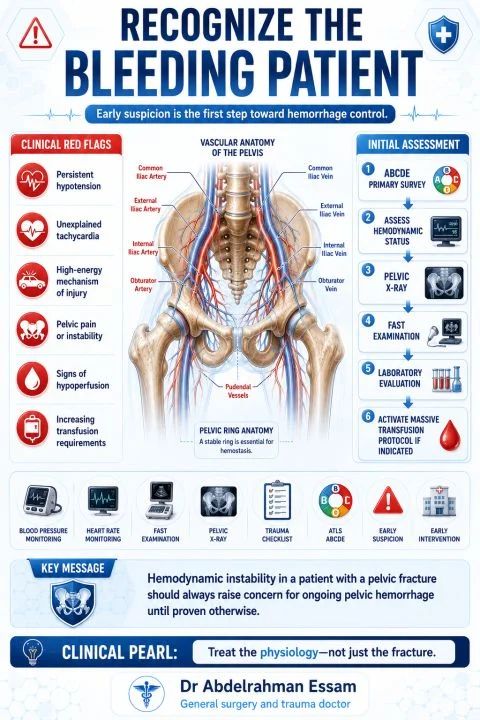
The first priority is not identifying the exact fracture pattern.
The first priority is recognizing the patient who is bleeding.
- Patients should immediately be assessed for:
- Hemodynamic instability
- High-energy mechanism of injury
- Signs of ongoing shock
- Pelvic instability when appropriate to assess
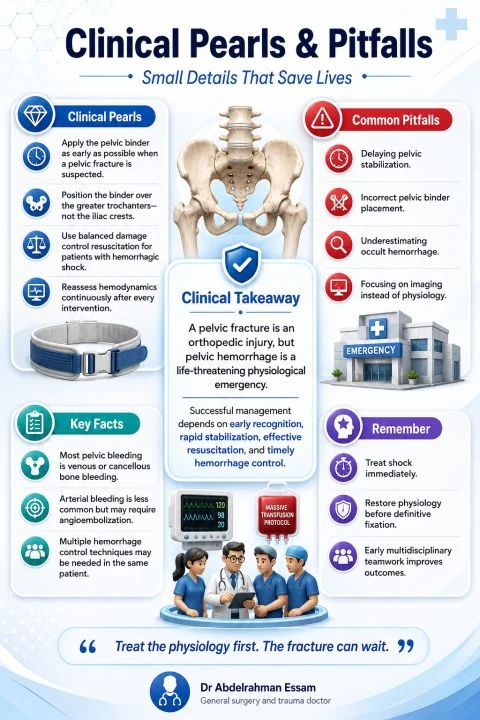
The majority of pelvic hemorrhage originates from venous bleeding and fractured cancellous bone surfaces, while a smaller proportion results from arterial injury.
This distinction is important because management strategies differ.
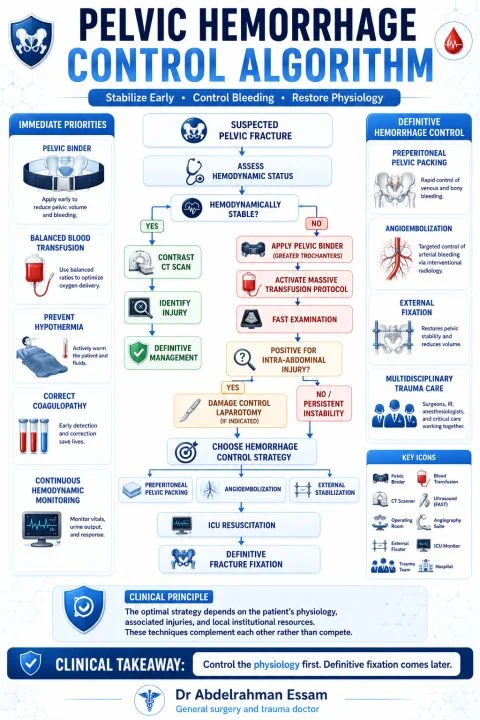
Early management follows a simple principle:
Reduce pelvic volume.
Restore physiology.
Control the bleeding.
Applying a pelvic binder at the level of the greater trochanters is one of the fastest and most effective initial interventions.
Proper application stabilizes the pelvic ring, reduces pelvic volume, and may significantly decrease ongoing hemorrhage.
At the same time, balanced damage control resuscitation should begin immediately, including activation of a Massive Transfusion Protocol when indicated.
Definitive hemorrhage control depends on the patient’s physiology and available resources.
Options may include:
- Preperitoneal Pelvic Packing
- Angioembolization
- External pelvic fixation
These techniques are complementary—not competitive—and should be selected according to the clinical scenario.
Perhaps the greatest mistake is focusing solely on the fracture.
The fracture is only the injury.
Hemorrhage is the disease.
Clinical Takeaway
In pelvic trauma, don’t ask first, ‘How bad is the fracture?’
Ask instead,
‘Is this patient bleeding to death?’
That question saves lives.”
Stay updated with Hemostasis Today.
-
Oct 12, 2026, 21:51Sam Botchey: Orthobiologics Are Advancing but the Evidence Must Keep Pace
-
Oct 12, 2026, 21:50Serum Vitamin D, Platelet Function, and Bleeding in Primary ITP – Platelets Journal
-
Oct 12, 2026, 21:30Nika Samadzadeh Tabrizi: Looking Forward to the PACeS Trial on Anticoagulation for POAF
-
Oct 12, 2026, 21:28Michael Megaly: Does Coronary Ectasia Affect Outcomes in Acute Coronary Syndromes?
-
Oct 12, 2026, 21:25Vitor Borin P. de Souza: Think Twice Before Anticoagulating an Isolated Subsegmental PE
-
Oct 12, 2026, 20:43Jazlyn A Selvasingh: Excited to Share Our Research at AAO-HNSF 2026 in Los Angeles
-
Oct 12, 2026, 20:31Natalia Kovtun: Higher Ferritin Cutoffs Now Define Iron Deficiency
-
Oct 12, 2026, 19:39Edward Loftus: Using Low-Dose Aspirin in Pregnant Women With IBD
-
Oct 12, 2026, 19:32Shruti Sachdeva: Strengthening the Fight against Anemia