


Linda Hayes Bennett: Redefining Ferroptosis in Aging and Neurodegenerative Conditions
Linda Hayes Bennett, Cognitive-Behavioral Neuroscientist, shared Tatiana Zaneva‘s post on LinkedIn, adding:
“Fascinating perspective on ferroptosis and the role of iron in cellular aging.
One question keeps coming to mind as I read this emerging literature:
What determines whether a cell ever reaches this point?
Ferroptosis is increasingly recognized as an important mechanism of iron-dependent cell death. But from a preventive health perspective, I find myself asking what shapes cellular resilience years before ferroptosis becomes possible.
Perhaps the conversation should extend beyond iron itself to the broader physiological terrain in which mitochondria operate.
From an evolutionary and systems biology perspective, that terrain includes:
- Oxygenation — the primary constraint on mitochondrial energy production and redox balance.
- Hydration — the medium that supports diffusion, circulation, and cellular communication.
- Transition metal regulation — iron, manganese, copper, and zinc working together to maintain mitochondrial function rather than being viewed in isolation.
- Rhythm and oscillation — breathing, movement, sleep, heart rate variability, and circadian biology continuously regulating physiology.
- Mitochondria — not simply powerhouses, but environmental sensors that continuously respond to oxygen availability, inflammatory signaling, nutrient status, and metabolic demand.
- Developmental timing — recognizing that embryogenesis, organogenesis, and early neurodevelopment may represent uniquely sensitive windows for establishing lifelong physiological resilience.
- Life-course physiological drift — the gradual accumulation of hypoxia, chronic stress, circadian disruption, sedentary behavior, and metabolic imbalance that may slowly reshape mitochondrial performance over decades.
For me, this is where longevity science becomes especially exciting.
Perhaps the future is not simply preventing ferroptosis.
Perhaps it is understanding—and preserving—the physiological conditions that make ferroptosis less likely to occur in the first place.
Health is not about forcing the body.
It is about restoring the conditions that allow it to function as designed.”
Tatiana Zaneva, Founder and CEO at VAIA Longevity, shared a post on LinkedIn:
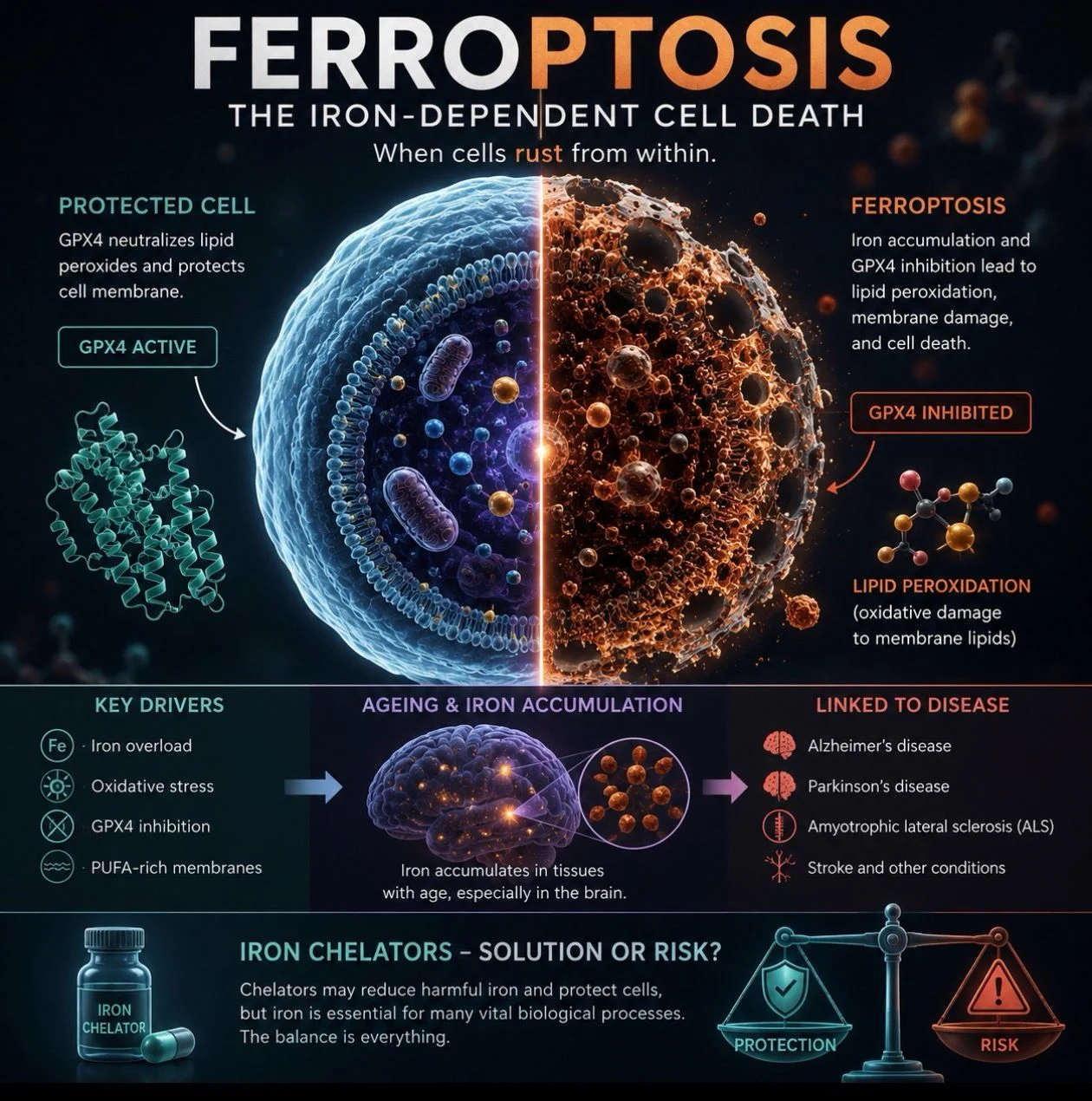
“Ferroptosis: When Cells Don’t Die by Suicide… They Rust from Within.
We often hear about apoptosis, the body’s carefully controlled process of programmed cell death.
Ferroptosis is different.
It is a distinct form of regulated cell death driven by iron and uncontrolled lipid peroxidation of the cell membrane.
Think of it as the cell losing its ability to protect its own membrane from oxidative damage.
At the centre of this defence system is an enzyme called glutathione peroxidase 4 (GPX4).
GPX4 repairs oxidised membrane lipids before they accumulate.
As long as GPX4 is functioning, the cell can maintain membrane integrity despite continuous oxidative stress.
When GPX4 activity is lost or overwhelmed, lipid peroxides rapidly accumulate.
Iron then accelerates these oxidative reactions, causing catastrophic membrane damage and ultimately ferroptotic cell death.
Unlike apoptosis, ferroptosis is not characterised by DNA fragmentation or cellular ‘self-destruction.’
Its defining hallmark is iron-dependent lipid peroxidation.
Why does this matter for ageing?
Ageing is associated with progressive disturbances in iron homeostasis.
Several studies have shown increased iron accumulation in tissues, particularly in regions of the ageing brain.
Growing evidence also links ferroptosis with Alzheimer’s disease, Parkinson’s disease, amyotrophic lateral sclerosis, stroke, and other neurodegenerative conditions.
Researchers are now investigating whether preventing ferroptosis could help preserve vulnerable neurons.
One possible strategy involves iron chelators, drugs that bind excess iron and reduce its availability for harmful oxidative reactions.
Yet iron is also essential for oxygen transport, mitochondrial function, DNA synthesis, and normal immune activity.
Removing too much iron could create new problems.
The question is no longer whether ferroptosis exists.
The real question is:
Can we selectively control ferroptosis without disrupting the essential biological functions of iron?
That answer could shape the future of neurodegenerative disease research and healthy ageing.
What do you think?
Could targeting ferroptosis become one of the next major directions in longevity medicine, or does interfering with iron metabolism carry too much risk?”
Stay updated with Hemostasis Today.
-
Oct 5, 2026, 22:55Steve Humphreys: A Big Thank You to BSHT for Providing Me With a Recent Skills Exchange Award
-
Oct 5, 2026, 22:52William McKeown: Great to Be in Istanbul for the Opening of the EHC 2026
-
Oct 5, 2026, 22:48Laura Quintas Lorenzo: A New Approach to Healthcare for von Willebrand Disease at EHC 2026
-
Oct 5, 2026, 22:46Anas Zayad: Pleased to Share Our New Review on Thrombosis in SCD and Beta Thalassemia
-
Oct 5, 2026, 22:44Cihan Ay: Honouring Eric Kandel and Eugene Braunwald at the Medical University of Vienna
-
Oct 5, 2026, 22:42Heather L. Gornik: Testing for Aortic and Arterial Thrombosis at VSS 2026
-
Oct 5, 2026, 22:34Hasan Abbas Zaheer: Honoured to Have Co-Authored One of the Four Reviews in The Lancet Thalassemia Series
-
Oct 5, 2026, 22:34Kamyar Shameli: Understanding the Coagulation Cascade – How Anticoagulants Prevent Blood Clots
-
Oct 5, 2026, 22:31Risika Samanta: Pediatric ITP in a 12-year-old – An Atypical Presentation without a Viral Prodrome