


Akinchan Bhardwaj: The Real Silent Shift in the 2026 ACC/AHA Dyslipidemia Guideline
Akinchan Bhardwaj, Consultant Interventional Cardiologist at Kauvery Hospital, shared a post on LinkedIn:
“Everyone is talking about LDL targets in the new 2026 ACC/AHA Dyslipidemia guideline.
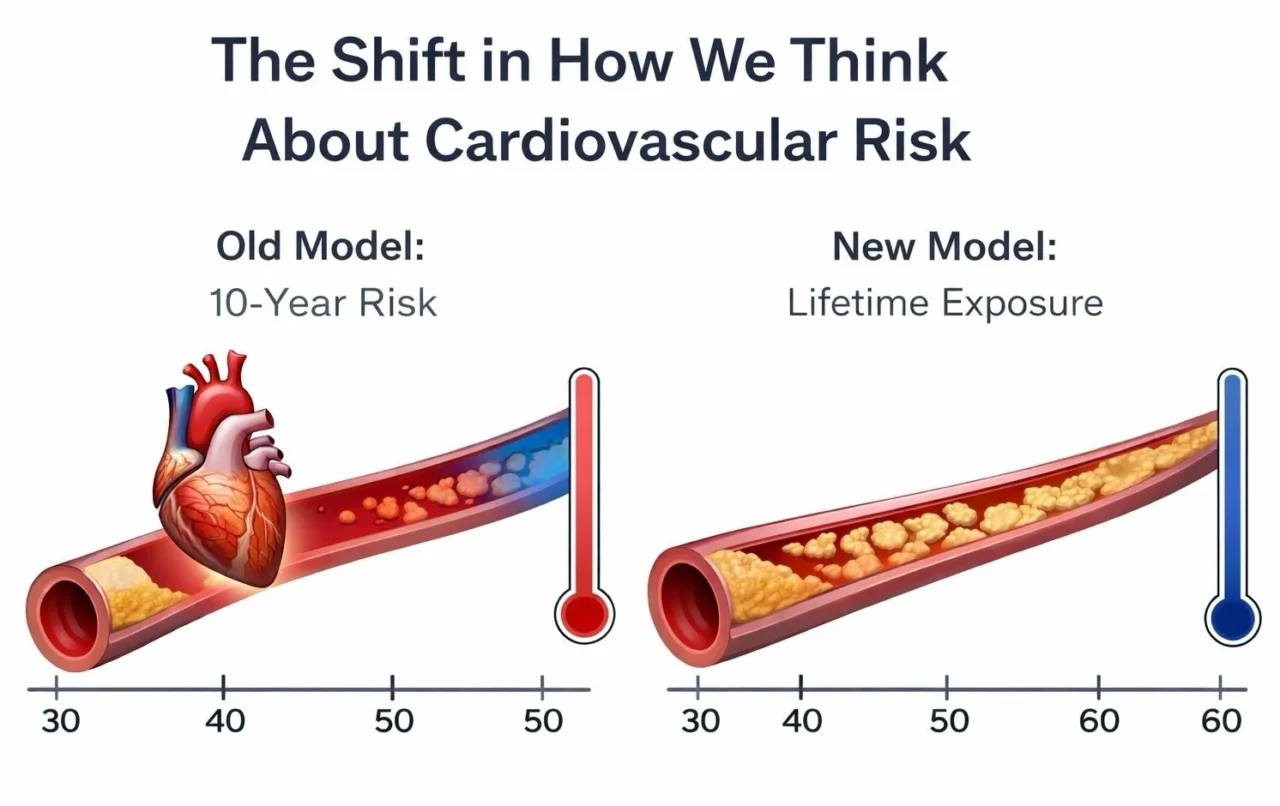
The bigger story is that the guideline changes how we think about risk.
For years, much of lipid decision-making in primary prevention was dominated by a 10-year risk frame.
Now the conversation is clearly moving toward something more biologically honest: atherosclerosis is not just about short-term event prediction.
It is about cumulative exposure to atherogenic particles over time.
That shift shows up in several places in the new ACC guideline:
- stronger emphasis on treating dyslipidemia earlier to reduce lifelong exposure burden
- use of the PREVENT equations instead of the older pooled cohort equations for 10- and 30-year risk assessment in adults 30 to 79 years
- explicit attention to young adults with LDL-C more than/equal 160 mg/dL or a strong family history of premature ASCVD
- and yes, the return of LDL-C and non-HDL-C treatment goals alongside percentage reduction
That is an update beyond just a technical update.
- Because many patients do not become ‘high risk’ suddenly at age 55.
- They spend years, sometimes decades, accumulating risk quietly.
- By the time the 10-year risk estimate becomes impressive, the biology may have been active for a long time.
That is why I think this guideline matters beyond the headline changes.
It nudges us to think less like emergency responders to future events and more like clinicians managing lifetime plaque exposure.
Interestingly, the ESC guidelines update (2025) was already very much aligned with a goal-based, intensive lipid-lowering mindset, with emphasis on LDL-C lowering strategies, Lp(a), hypertriglyceridaemia and special populations.
In that sense, ACC now feels closer to the biology-first direction Europe has been pushing.
For me, the practical message is simple:
we should stop thinking only in terms of ‘Who is high risk today?’ and start thinking more often in terms of ‘Who is accumulating vascular injury already?’
That is where earlier prevention becomes more meaningful.
And that may be the real silent shift in this guideline.”
Other posts featuring Akinchan Bhardwaj on Hemostasis Today.
-
Sep 21, 2026, 20:56George Touma: ApoB Should Be Central to All Lipid Guidlines
-
Sep 21, 2026, 20:55Christopher Robinson: Obstetric Risks Are Seen at the Extremes of Birthweight
-
Sep 21, 2026, 20:54Emicizumab for Refractory GI Bleeding in Myeloma-Associated Acquired VWD – JTH
-
Sep 21, 2026, 20:52Ross Baker: ASH 2026 Guidelines on Iron Deficiency in HMB and Bleeding Disorders
-
Sep 21, 2026, 20:50Rainer Kaiser: Genes and Signalling Pathways Implicated in Procoagulant Platelet Generation
-
Sep 21, 2026, 20:49Natalia Dovlatova: Celebrating Stan Heptinstall and His Legacy in Platelet Science
-
Sep 21, 2026, 20:48Norm Roulet: The Interaction of Pb and SARS-CoV-2 and Its Impact on the Cardiovascular System
-
Sep 21, 2026, 20:45Felix Scholkmann: The Spleen Plays a Key Role in Regulating Platelet Activity
-
Sep 21, 2026, 20:43Claire Pomeroy: Celebrating the 2026 Lasker Awards and Why Medical Research Matters