


Annie Bauzon: How to Properly Make a Peripheral Blood Smear
Annie Bauzon, Medical Laboratory Assistant Technician at Med Health Laboratories, shared a post on LinkedIn:
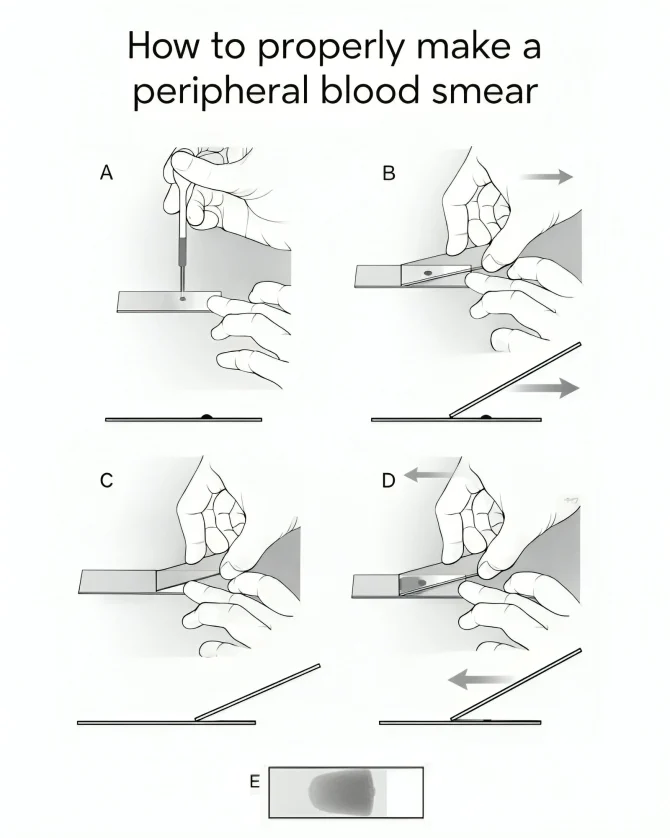
”How to properly make a peripheral blood smear
It may look like a simple lab step, but creating a proper peripheral blood smear is a critical skill that directly impacts patient diagnosis and care.
Every accurate hematology result begins with a well-prepared slide. A poorly made smear can lead to misinterpretation of cell morphology, missed abnormalities, or even incorrect diagnoses. That’s why technique matters just as much as technology in the laboratory.
Key steps in making a good smear:
- Place a small drop of blood near one end of a clean slide
- Use a spreader slide at a 30–45° angle
- Allow the blood to spread along the edge of the spreader
- Push the spreader smoothly and quickly to create a thin film
What makes a quality smear?
- A smooth transition from thick to thin (gradient)
- A well-defined ‘feathered edge’ where cells are evenly distributed
- No streaks, ridges, or clumps
- Cells that are not distorted or overlapping
This is where red blood cells, white blood cells, and platelets can be clearly evaluated helping detect conditions like anemia, infections, leukemia, and other blood disorders.
Remember: Even the most advanced analyzers rely on manual verification. When results don’t add up, the microscope and a properly made smear—becomes the gold standard.
Behind every slide is a Medical Laboratory Scientist applying skill, precision, and attention to detail because one well-made smear can reveal what machines might miss.”
Stay updated with Hemostasis Today.
-
Oct 10, 2026, 02:38Brianne D.: Sex Differences in RIPK1 Signaling Following Intracerebral Hemorrhage
-
Oct 10, 2026, 02:17Dino Mehic: Managing Heavy Menstrual Bleeding in Patients with BDUC
-
Oct 10, 2026, 00:34Raphaëlle Dodart: Discussing the Mechanisms of Menstrual Hemostasis
-
Oct 10, 2026, 00:26Barbara Adams Krolak: Discussing the Growing Need for Blood Clot Prevention in Asia
-
Oct 9, 2026, 23:59Ana Pedrero Gil: Is Coagulopathy with Fibrinolysis Present in All Obstetric Hemorrhages?
-
Oct 9, 2026, 23:57Exploring the Psychosocial Needs of People with Bleeding Disorders in Kyrgyzstan – EAHAD
-
Oct 9, 2026, 23:53Bernard Slater Jr.: Serving on the Advisory Council for the NBDF West Virginia Chapter
-
Oct 9, 2026, 23:53Aurelio Maggio: Thalassemia Reports Real-Time Impact Factor Rises to 1.760
-
Oct 9, 2026, 23:52Stronger Connections, Stronger Organizations – World Federation of Hemophilia