


Aryabhatta Sadhu: Sickle Cell Crisis – When Diagnostics Should Change Therapy
Aryabhatta Sadhu, Attending Consultant and Head of Transfusion Medicine at Fortis Hospital Shalimar Bagh, New Delhi, shared a post on LinkedIn:
“The Dangerous Turn in Sickle Cell Crisis: Detect Early, Exchange Fast
Sickle cell crisis is not one clinical event.
It is a spectrum – from uncomplicated vaso-occlusive pain to acute chest syndrome, stroke, fat embolism syndrome, and multiorgan failure.
The real decision point is identifying when diagnostics should change therapy.
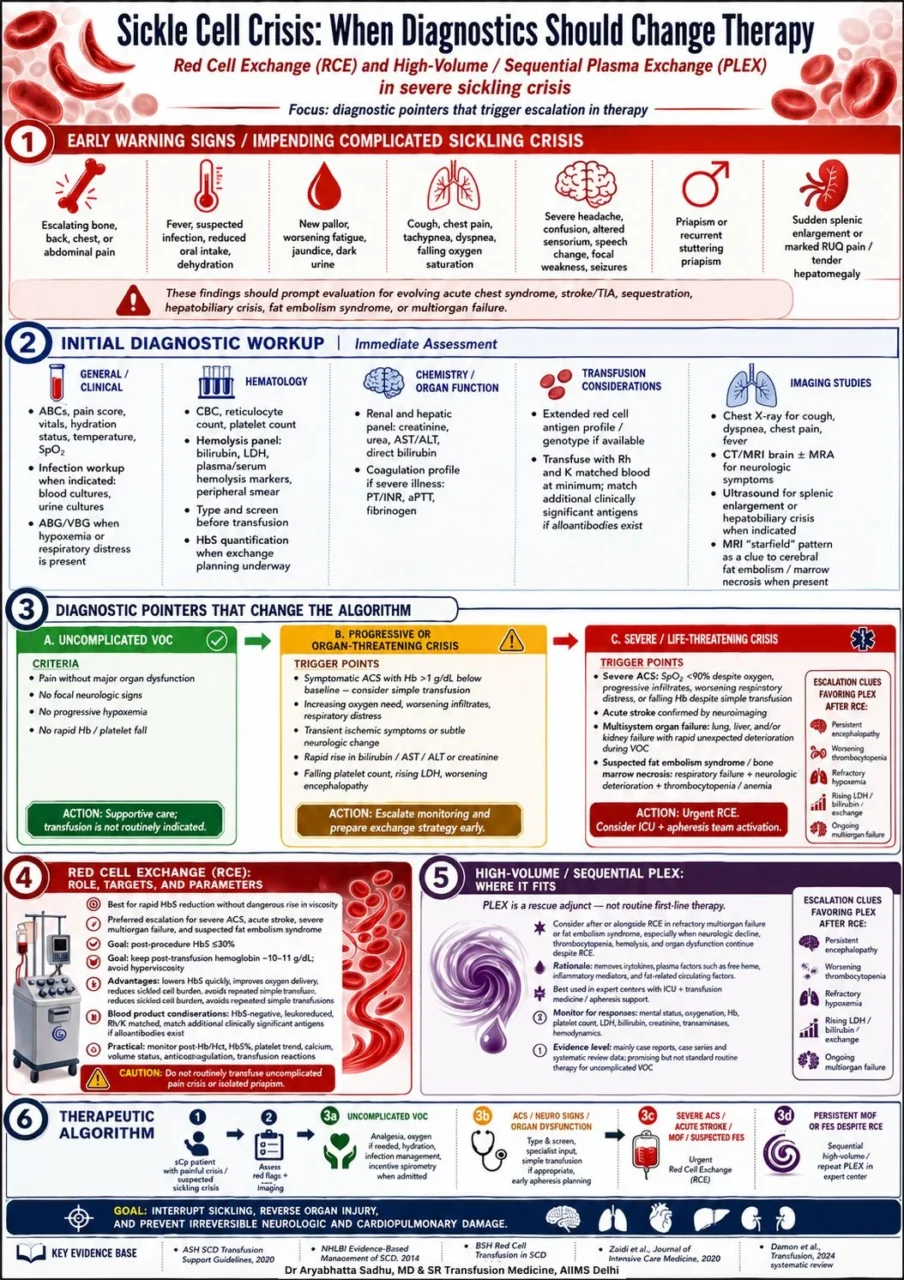
This infographic maps a practical escalation pathway for severe sickling crisis, focusing on:
- Early warning signs of impending complicated crisis
- Diagnostic triggers separating uncomplicated VOC from organ-threatening disease
- When simple transfusion may be sufficient
- When urgent red cell exchange is required
- Where high-volume / sequential plasma exchange may fit as rescue adjunct therapy in refractory multiorgan failure or fat embolism syndrome
Hard decision points for HbS% tracking:
- In uncomplicated VOC, HbS% alone should not trigger transfusion. Clinical deterioration matters more.
- In ACS, neurologic symptoms, falling SpO₂, progressive infiltrates, organ dysfunction, or suspected fat embolism syndrome – send HbS% early and activate transfusion/apheresis planning.
- In severe ACS, acute stroke, multiorgan failure, or suspected FES – do not wait for HbS% to return if the patient is clinically deteriorating. Start urgent red cell exchange planning.
- Post-RCE target: HbS less than or equal to 30%, with hemoglobin generally kept around 10–11 g/dL to avoid hyperviscosity.
- Persistent HbS more than 30% after RCE, or rebound HbS with worsening hypoxemia, encephalopathy, thrombocytopenia, rising LDH/bilirubin/creatinine, should trigger repeat clinical review, repeat HbS quantification, and consideration of further exchange or adjunct PLEX in expert settings.
The key point is simple:
Do not transfuse reflexively for uncomplicated pain crisis.
Do not delay exchange when hypoxemia, neurologic decline, organ failure, or fat embolism physiology appears.”
Other posts featuring Aryabhatta Sadhu with Hemsotasis Today.
-
Oct 11, 2026, 16:57Shiny K. Kajal: Japan Advances Artificial Blood via Haemoglobin Vesicles Trials
-
Oct 11, 2026, 16:45Luca Scarcia: Rescue Stenting Superior When Posterior Circulation Thrombectomy Fails
-
Oct 11, 2026, 16:27Giuseppe Bellelli: Reevaluating Anticoagulation Net Benefit in Frail Older Adults
-
Oct 11, 2026, 16:17Johnathan Whetstine: How Does MYC Go From 2 Copies to an Amplified Oncogene?
-
Oct 11, 2026, 16:03Parth Parmar: Practical Guidelines for Managing Venous Thromboembolism
-
Oct 11, 2026, 15:31Muhammad Alvi: CASPR Study Explores Treatment Response Across ESUS Phenotypes
-
Oct 11, 2026, 15:15Thalassaemia International Federation Joins ASCAT 2026 to Advance Sickle Cell and Thalassaemia Care
-
Oct 11, 2026, 15:14Challenges and Perspectives on Gene Therapy in Hemophilia A – Seminars in Thrombosis and Hemostasis
-
Oct 11, 2026, 15:07Neysa Rahardjo: Platelet Estimation Pitfalls and Discrepancy Resolution