

Caitlin Raymond: Understanding Risks in Rare Group A Subtypes with Anti-A1 Antibodies in Transfusion Medicine
Caitlin Raymond, Assistant Professor of Pathology and Transfusion Medicine at the University of Wisconsin-Madison, shared a post on LinkedIn:
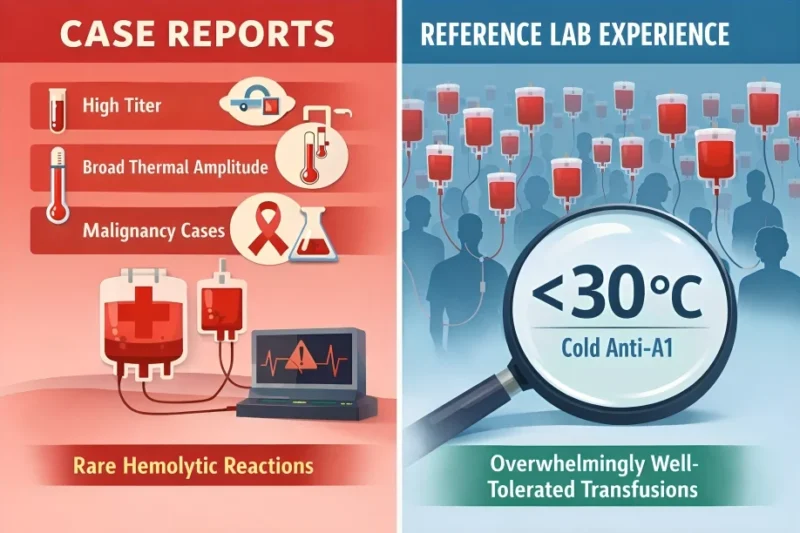
”In transfusion medicine, some risks feel larger than they actually are — not because they’re common, but because the evidence we have is skewed toward worst-case scenarios.
I recently wrote a follow-up blog post on rare group A subtypes with anti-A1 antibodies, prompted by a real case and a conversation with a reference laboratory.
Case reports tell us what can go wrong. Reference labs see what actually does go wrong — and how often.
This post walks through:
- When cold reacting anti-A1 actually becomes dangerous
- Why malignancy-associated cases don’t generalize
- When to choose group O blood for rare group A subtypes
If you’ve ever felt uneasy making decisions where the literature offers warnings but no denominator, this one’s for you.”
Stay updated with Hemostasis Today.
-
Sep 21, 2026, 04:06Allison Lewin: How Gender Shapes the Way We Receive Medical Care
-
Sep 21, 2026, 03:49Jessica Lee: Walking Together for a Stronger Bleeding Disorders Community
-
Sep 21, 2026, 03:36Syed Asif Ali Shah: From Pakistan to Australia – A Clinical Haematology Milestone
-
Sep 21, 2026, 03:22Katie Baca-Motes: Estradiol Fluctuations May Help Explain Menstrual Migraine
-
Sep 21, 2026, 03:00Family History Can Reveal Hidden Risk of Aortic Dissection – The Marfan Foundation
-
Sep 21, 2026, 02:47Transitioning from Paediatric to Adult Haemophilia Care – Haemophilia Foundation Australia
-
Sep 21, 2026, 02:29Diana Castro Paupério: A New Era for Patient Blood Management
-
Sep 21, 2026, 00:29Iheanyichukwu Ike: Childhood Anaemia in Nigeria Through an Analysis of the 2018 NDHS
-
Sep 21, 2026, 00:27Nicole De Vita: The Global Burden of Iron Deficiency and Anemia in Women at SABM