


Edward Lee Carter: What If Better Stroke Prevention Didn’t Require More Bleeding?
Edward Lee Carter, Clinical Pharmacist Practitioner at U.S. Department of Veterans Affairs, shared a post on LinkedIn:
”What if better stroke prevention didn’t require more bleeding?
For decades, antithrombotic therapy has relied on a familiar tradeoff:
- Prevent more thrombosis
- Accept more bleeding
The Phase III OCEANIC-STROKE trial suggests that assumption may deserve another look.
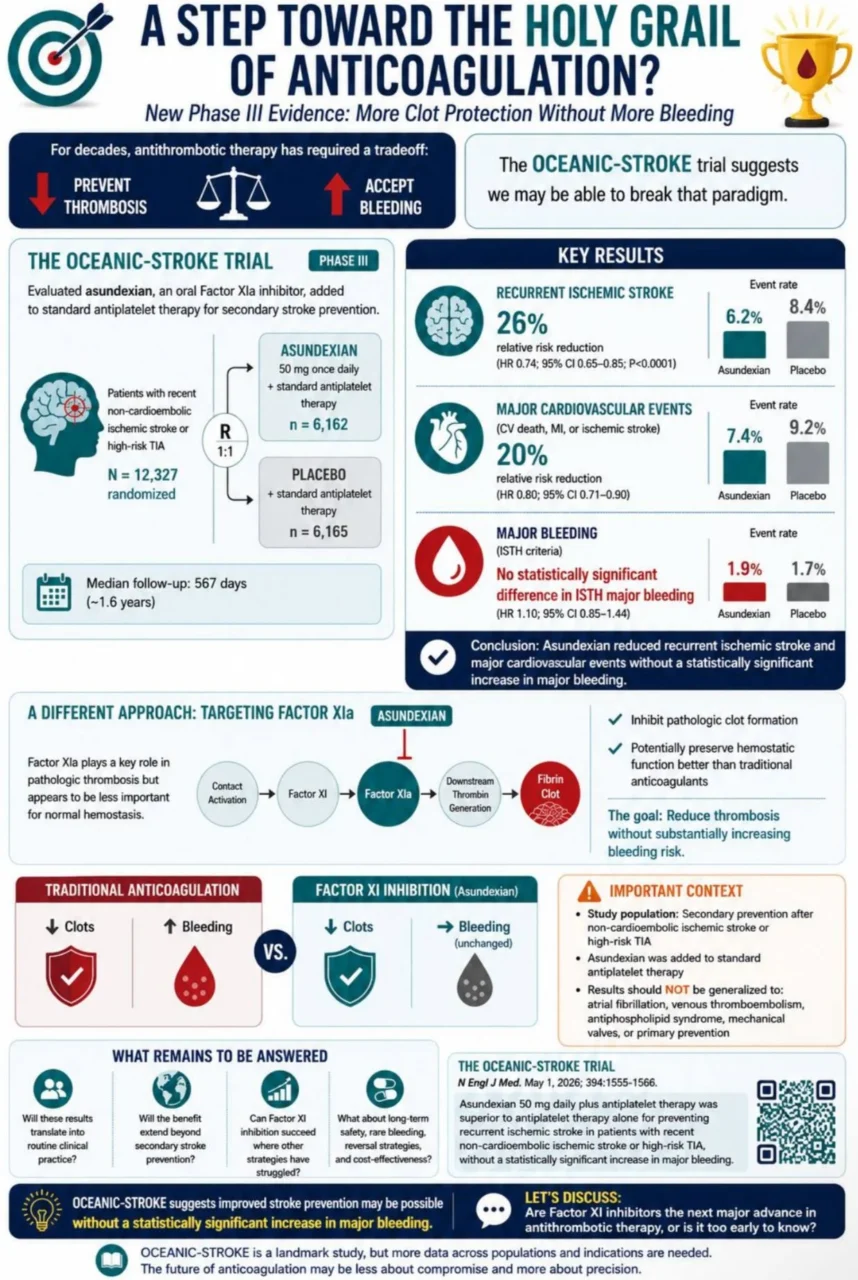
Investigators randomized 12,327 patients with a recent non-cardioembolic ischemic stroke or high-risk TIA to receive:
- Asundexian 50 mg daily plus standard antiplatelet therapy
- Placebo plus standard antiplatelet therapy
The results were notable:
- 26percent relative reduction in recurrent ischemic stroke
- 20percent relative reduction in major cardiovascular events
- No statistically significant increase in ISTH major bleeding
Event rates:
- Recurrent ischemic stroke: 6.2percent vs 8.4percent
- Major cardiovascular events: 7.4percent vs 9.2percent
- ISTH major bleeding: 1.9percent vs 1.7percent
What makes this especially interesting is the target.
Asundexian inhibits Factor XIa, a component of coagulation believed to play a larger role in pathologic thrombosis than in normal hemostasis.
The goal is straightforward:
- Reduce thrombosis
- Preserve hemostatic function
- Improve outcomes without substantially increasing bleeding risk
Important caveats:
- These findings apply to secondary prevention after non-cardioembolic stroke or high-risk TIA.
- They should not be extrapolated to atrial fibrillation, venous thromboembolism, mechanical valves, or antiphospholipid syndrome.
- Additional studies are needed before Factor XI inhibition can be considered a new standard of care.
Still, OCEANIC-STROKE may represent one of the most important developments in thrombosis research since the arrival of DOACs.
Not because it proves we have solved the bleeding problem.
But because it suggests we may finally be asking the right question:
Can we separate thrombosis prevention from bleeding risk more effectively than we ever have before?
If that proves possible, the implications will extend far beyond stroke prevention.
What are your thoughts on Factor XI inhibition? A genuine breakthrough – or promising but still unproven?”
Stay updated with Hemostasis Today.
-
Sep 20, 2026, 03:22The Voices of People Living With Bleeding Disorders – EHC
-
Sep 20, 2026, 01:18Sebastian Mafeld: Has 2026 Changed How We Treat Pulmonary Embolism?
-
Sep 20, 2026, 01:16Pall T. Onundarson: DOACs – Monitoring, Tailoring Dose and Identifying Problems
-
Sep 20, 2026, 01:15Thierry Fumeaux: From Efficacy to Effectiveness – The Value of Real-World Evidence
-
Sep 20, 2026, 01:14Said El Shamieh: VEGFA Genetic Variants and Bleeding Risk During Warfarin Therapy
-
Sep 20, 2026, 01:04Omar Danoun: Levetiracetam May Increase Thromboembolic Risk With DOACs
-
Sep 20, 2026, 01:02Mohamed Abo-Aly: Which Antiseizure Medication is Safest for Patients on DOACs?
-
Sep 20, 2026, 00:58Hamza Rafiq: How Does a Deep Vein Thrombosis Become a PE?
-
Sep 20, 2026, 00:50A Shared Platelet Factor 4–Targeted Immune Mechanism in Adenovirus Infection – NEJM