


Ifeanyichukwu Ifechidere: Which Coagulation Factors Are Not Involved in Bleeding?
Ifeanyichukwu Ifechidere, Specialist Biomedical Scientist at Sheffield Teaching Hospitals NHS Foundation Trust, shared a post on LinkedIn:
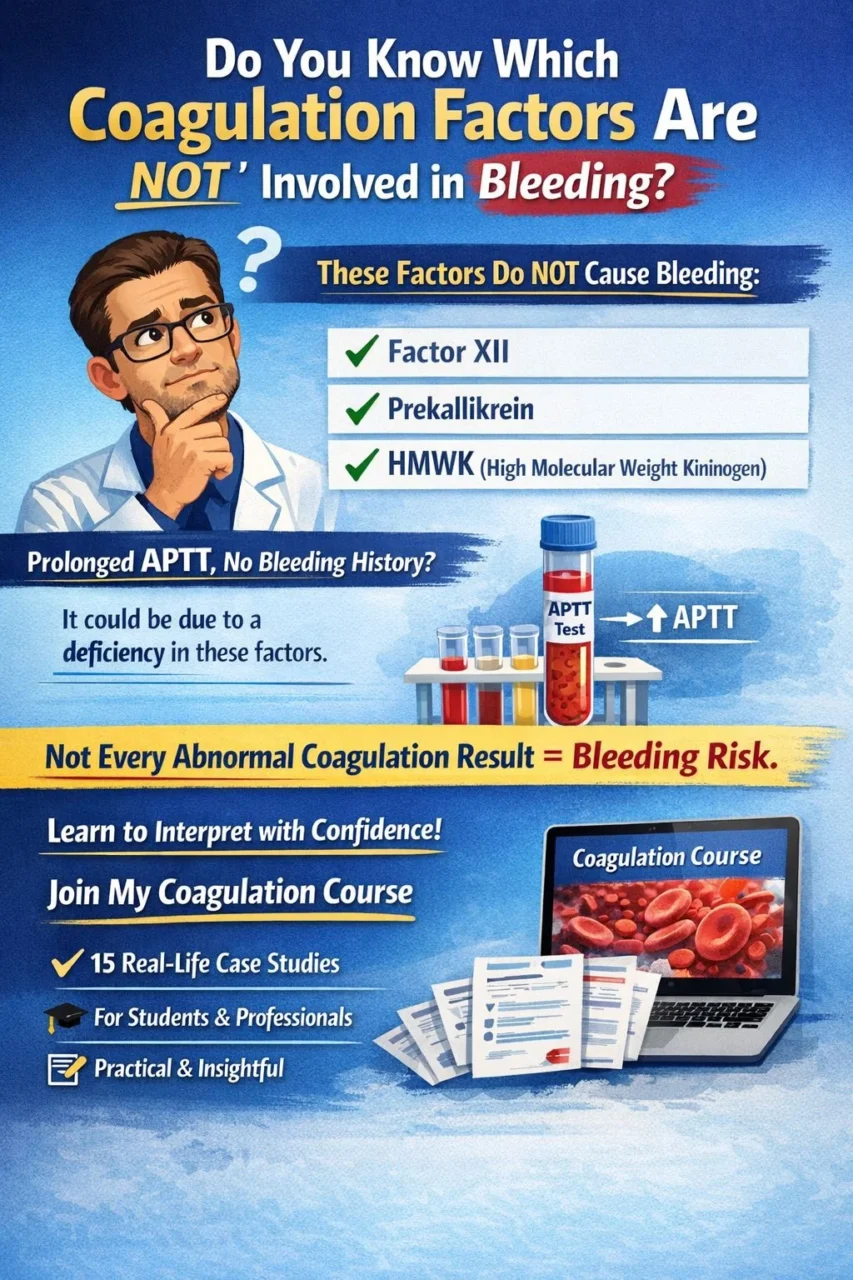
Do You Know Which Coagulation Factors Are Not Involved in Bleeding?
This is one of those questions that separates surface-level understanding from true clinical insight.
Most people assume:
If a coagulation factor is abnormal, bleeding risk must increase.
But that’s not always true.
Let’s break it down:
There are specific factors in the coagulation cascade that, when deficient, do NOT typically cause bleeding:
- Factor XII
- Prekallikrein
- High Molecular Weight Kininogen (HMWK)
Why does this matter?
These factors belong to the contact activation pathway (intrinsic pathway in vitro).
They are essential for laboratory clotting tests (like APTT)
But not essential for in vivo haemostasis
Clinical implication:
A patient may present with:
- Markedly prolonged APTT
- No bleeding history
And the reason could be a deficiency in one of these factors.
This is where many get it wrong:
- Unnecessary delays in procedures
- Incorrect clinical concern
- Misinterpretation of lab results
Key takeaway:
- Not every abnormal coagulation result equals bleeding risk.
- Understanding which factors matter clinically is what transforms you from someone who reports results – to someone who interprets with authority.
Want to build real confidence in coagulation interpretation?
I’ve created a fundamental coagulation course built around 15 real-life case studies – designed for:
- Students
- Interns
- Practicing professionals
This is not theory – heavy learning.
It’s focused on helping you:
- Recognise patterns instantly
- Avoid common interpretation mistakes
- Think like a specialist in real lab scenarios
Because confidence in coagulation doesn’t come from memorising pathways – it comes from seeing and solving real cases.”
More posts featuring Ifeanyichukwu Ifechidere on Hemostasis Today.
-
Sep 30, 2026, 15:58Bernhard Merget: New Frontiers in Thrombosis and Stroke Research
-
Sep 30, 2026, 15:39Ifeanyichukwu Ifechidere: The Molecular Orchestra of Primary Hemostasis
-
Sep 30, 2026, 15:28Reassessing the Benefit–Risk Balance of Extended Anticoagulation in Cancer Patients – ESC Working Group on Cardiovascular Pharmacotherapy
-
Sep 30, 2026, 15:07Chiranjeev Sharma: Targeting Factor XIa with the Synthetic Inhibitor SB-01
-
Sep 30, 2026, 14:41Bruna Gigante: Balancing Thrombosis and Bleeding in Cardiovascular Care
-
Sep 30, 2026, 14:13Ashok Choudhury: Portal Vein Thrombosis and Outcomes in Cirrhosis
-
Sep 30, 2026, 13:57Leslye Conde Bazán: When Conventional Imaging Is Not Enough – The Role of IVUS
-
Sep 30, 2026, 13:41Huda Salah Eldin: The Challenge of Balancing Antithrombotic Therapy After PCI
-
Sep 30, 2026, 13:29Abdus Salam: What Can CT Venography Reveal About the Veins?