


Kalyan Roy: Swirling as a Simple Indicator of Platelet Quality
Kalyan Roy, Transfusion Medicine Specialist at Square Hospitals LTD, shared a post on LinkedIn:
”What if a simple visual check could reliably indicate platelet quality – without complex testing?
Ensuring the quality and viability of platelet concentrates (PCs) remains a fundamental pillar of modern transfusion medicine, directly influencing patient safety and clinical outcomes.
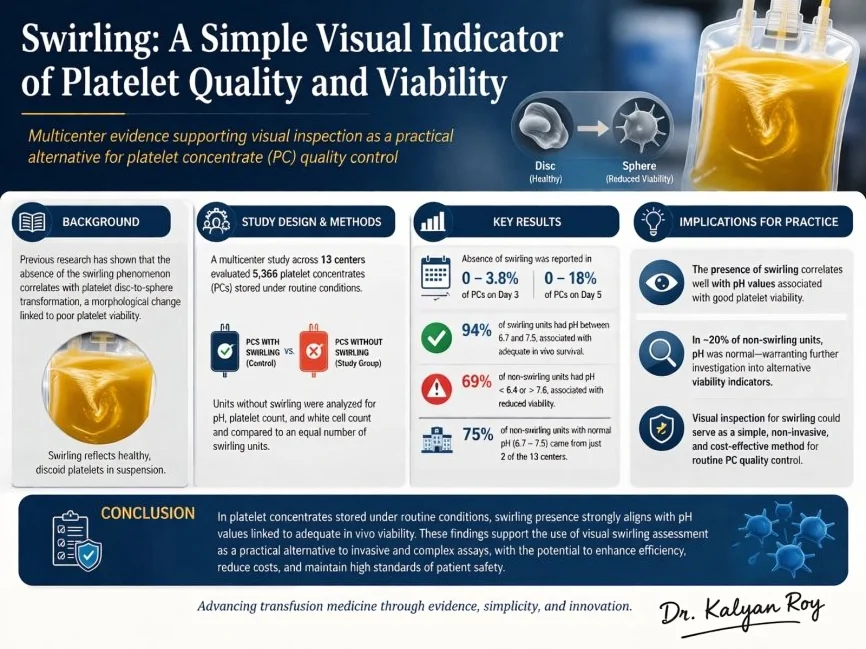
A large multicenter study across 13 centers, evaluating over 5,000 platelet units, highlights a valuable and practical insight: the visual assessment of ‘swirling’ can serve as a reliable, real-time indicator of platelet quality.
Key Observations from the Study
- Strong correlation with optimal pH
Swirling was consistently associated with pH levels between 6.7–7.5, a range linked to effective in vivo platelet survival. - Indicator of compromised platelet integrity
Approximately 69% of units lacking swirling showed pH values outside the acceptable physiological range (<6.4 or >7.6), suggesting reduced viability. - Unexplained subset requiring further research
Nearly 20% of non-swirling units had normal pH values, indicating additional underlying factors influencing platelet quality.
Why This Matters
Swirling reflects the preservation of the platelet’s discoid morphology, essential for optimal hemostatic function.
Its absence often signals transformation into a spherical form-historically associated with diminished viability and clinical performance.
Implications for Clinical Practice
- Enables rapid, bedside-compatible evaluation
- Offers a non-invasive and cost-effective alternative to complex laboratory assays
- Improves operational efficiency in transfusion services
- Maintains high standards of patient safety with minimal resource burden
In an era where healthcare systems must balance efficiency with excellence, adopting validated, low-cost tools like swirling assessment can significantly enhance routine platelet quality monitoring.”
Other posts featuring Kalyan Roy on Hemostasis Today.
-
Oct 19, 2026, 08:20Cory Dugan: The IRONWOMAN Trial Individual Responses to IV Iron Therapy in Active Women
-
Oct 19, 2026, 07:36Johannes Kaesmacher: Cerebral No-Reflow After Thrombectomy Toward a Standardized Definition
-
Oct 19, 2026, 07:33Beth Psaila: Highlights from IACH Annual Meeting and MPN Horizons
-
Oct 19, 2026, 07:29Wolfgang Miesbach: Can Losartan Activate Brown Fat? – Nature Study Explores New Therapeutic Link
-
Oct 19, 2026, 07:22Ruben Mesa: Honored to Speak at the Tandem MPN Meetings of IACH
-
Oct 19, 2026, 07:19Saneha Anjum Shaikh: Parul University Partners with Raktasevak Bike Ride 2026 for Blood Donation Drive
-
Oct 19, 2026, 07:09Alejandro González Veliz: No ST Elevation Does Not Guarantee an Open Coronary Artery
-
Oct 19, 2026, 06:02Thomas Dayspring: Vascular Resilience – What Is It and How Can We Measure It?
-
Oct 19, 2026, 05:53Kevon Dindial: Collaboration for Better Childhood Cancer Outcomes