


Ney Carter Borges: Ticagrelor vs Prasugrel After PCI in Patients With Diabetes and MCAD
Ney Carter Borges, Member Cardiologist of Global Physician Association at Cleveland Clinic Florida, shared a post on LinkedIn:
“Ticagrelor vs Prasugrel After PCI in Patients With Diabetes and Multivessel Coronary Artery Disease
Patients with diabetes mellitus undergoing percutaneous coronary intervention (PCI) represent a particularly high-risk population due to enhanced platelet reactivity, increased thrombotic burden, and a greater incidence of recurrent ischemic events.
Potent P2Y12 inhibitors are therefore recommended as part of dual antiplatelet therapy (DAPT) following PCI. A recent randomized multicenter study evaluated the comparative clinical outcomes of ticagrelor versus prasugrel in patients with diabetes and multivessel coronary artery disease undergoing PCI with drug-eluting stents.
The trial enrolled approximately 1,800 patients across multiple centers between 2020 and 2024. Participants had documented diabetes mellitus and angiographically confirmed multivessel coronary artery disease requiring PCI. Patients were randomized to receive either ticagrelor (90 mg twice daily) or prasugrel (10 mg once daily), both administered in combination with aspirin as standard DAPT.
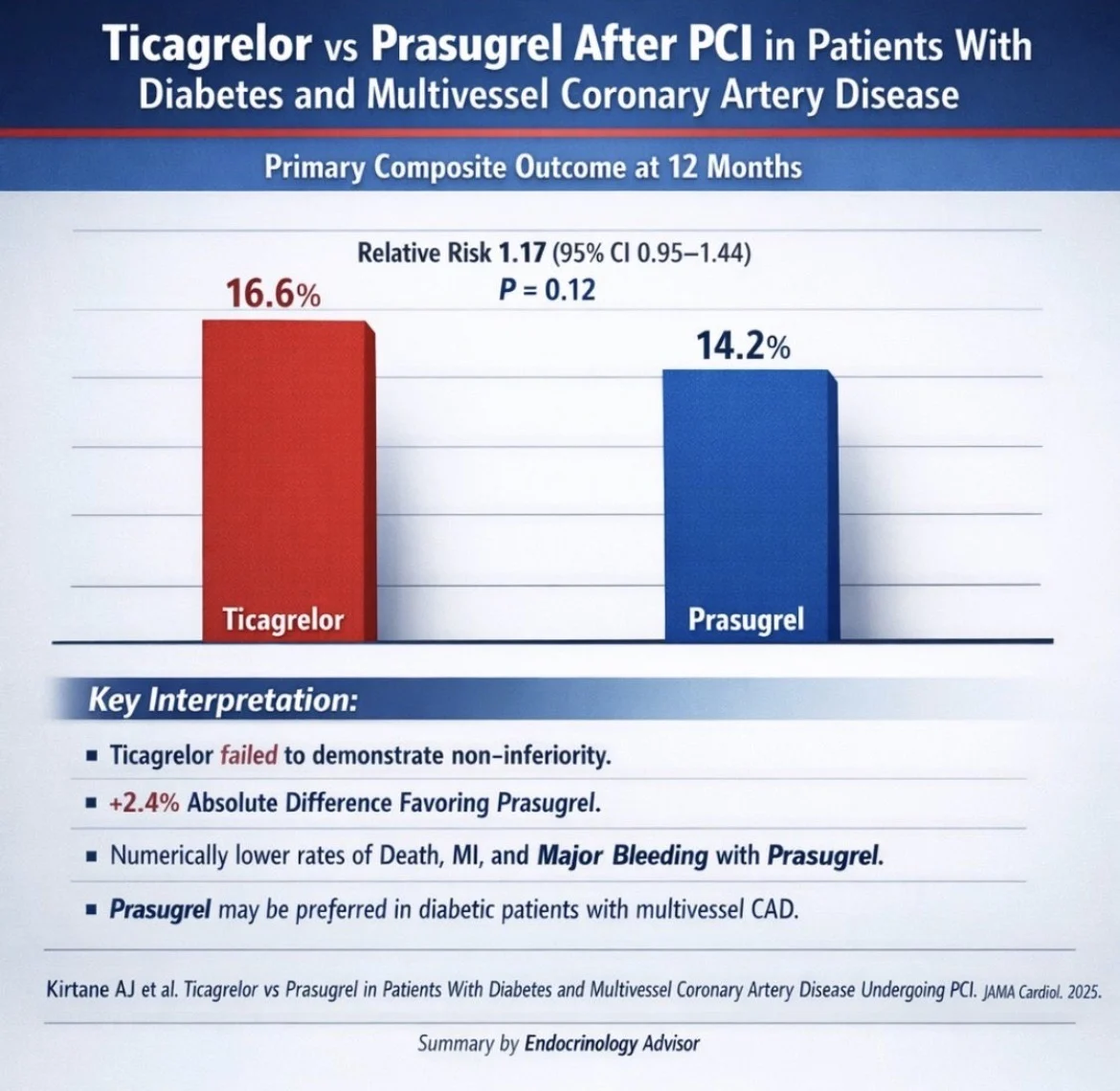
The primary endpoint was a composite of all-cause death, myocardial infarction, stroke, or major bleeding within 12 months after PCI. The composite endpoint occurred in 16.6% of patients treated with ticagrelor compared with 14.2% of those receiving prasugrel, corresponding to a relative risk of 1.17 (95% CI 0.95–1.44; p = 0.12).
Ticagrelor therefore failed to demonstrate non-inferiority compared with prasugrel. Individual clinical events, including death and myocardial infarction, were numerically lower in the prasugrel group, although differences were not statistically significant when analyzed separately.
These findings suggest that prasugrel may provide slightly more favorable outcomes in diabetic patients with complex coronary disease undergoing PCI. The results reinforce the concept that potent platelet inhibition strategies may not be fully interchangeable in high-risk populations. While both agents remain guideline-supported options for DAPT after PCI, this study highlights a potential clinical advantage of prasugrel in patients with diabetes and multivessel coronary artery disease.”
Other posts featuring Ney Carter Borges on Hemostasis Today.
-
Sep 30, 2026, 01:52Javed Anees: DADA2 – When a Young Stroke Is More Than a Stroke
-
Sep 30, 2026, 01:51How a Venous Thrombus Becomes Revascularized – ISTH
-
Sep 29, 2026, 22:45Victor Agunyego: Paracetamol – The Most Common Drug We Underestimate
-
Sep 29, 2026, 22:42Nova Sinclair: Advancing the Future of Hematology – Meet Our 2027 Organizing Committee
-
Sep 29, 2026, 22:41Lorenz Räber: Intracoronary Imaging in PCI – Why, When, How, and Which Modality?
-
Sep 29, 2026, 22:31Selma Turkovic: Pleased to Deliver the Opening Presentation at Kingston Hospital
-
Sep 29, 2026, 22:31Miguel Teran: Ultrasound and Simulation in Arterial Blood Sampling
-
Sep 29, 2026, 22:28Mohammad Refaei: Navigating Your Career in Hematology From Training to Practice
-
Sep 29, 2026, 22:27Matteo Foschi: 10 Clinical Pearls for Antithrombotic Therapy in Secondary Stroke Prevention