


Ney Carter Borges: Endocrine Drivers of Resistant Hypertension – Insights from the MOMENTUM Trial at ACC 26
Ney Carter Borges, Member Cardiologist of Global Physician Association at Cleveland Clinic Florida, shared a post in LinkedIn:
“Endocrine Drivers of Resistant Hypertension: Insights from the MOMENTUM Trial / ACC 26
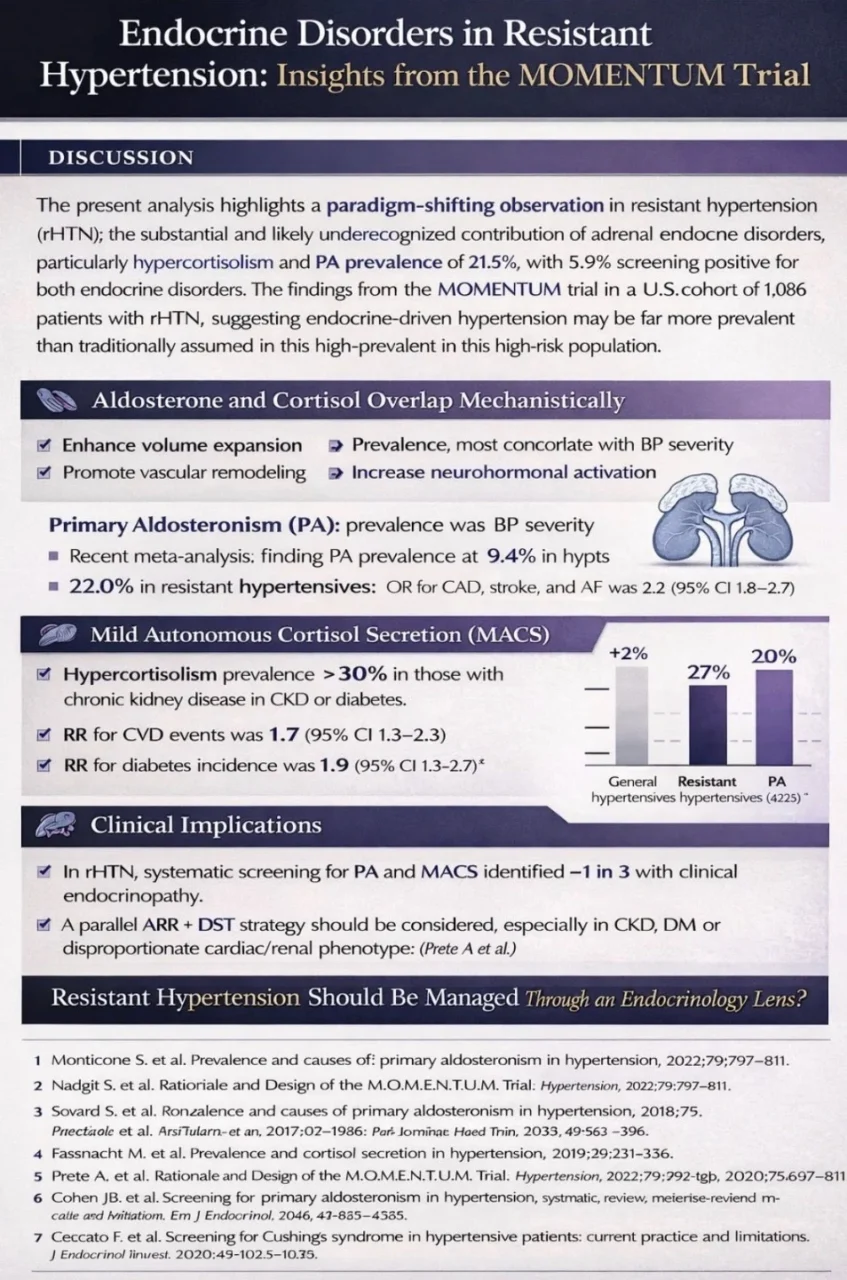
Resistant hypertension (rHTN) represents a high-risk clinical phenotype traditionally attributed to complex hemodynamic and pharmacologic factors. However, emerging evidence—highlighted by the MOMENTUM trial presented at ACC.26—suggests that underlying endocrine disorders, particularly hypercortisolism and primary aldosteronism (PA), may play a substantially larger role than previously recognized.
In the MOMENTUM cohort of 1,086 patients with rHTN, hypercortisolism was identified in 27.3% of individuals, while PA screening was positive in 21.5%. Notably, 5.9% of patients demonstrated biochemical evidence of both conditions. These findings reinforce the concept that endocrine-driven hypertension is not only prevalent but frequently overlapping, challenging the traditional view of isolated hormonal etiologies.
Primary aldosteronism has long been recognized as the most common form of secondary hypertension, with prevalence increasing alongside hypertension severity.
Beyond its effects on sodium retention and volume expansion, aldosterone contributes to vascular remodeling, myocardial fibrosis, and an increased risk of atrial fibrillation, stroke, and heart failure, independent of blood pressure levels. In parallel, mild autonomous cortisol secretion (MACS)—often clinically silent—has gained attention for its association with metabolic dysfunction, insulin resistance, and adverse cardiovascular outcomes.
Mechanistically, aldosterone and cortisol share converging pathways that exacerbate hypertension. Cortisol, particularly in states of chronic mild excess, can activate mineralocorticoid receptors through saturation of 11β-HSD2, thereby mimicking aldosterone-like effects.
This overlap may explain the observed co-secretion phenotype and the persistence of elevated blood pressure despite multidrug therapy.
Importantly, the MOMENTUM data suggest a higher prevalence of hypercortisolism in patients with chronic kidney disease, diabetes, and established cardiovascular disease, supporting a bidirectional relationship between endocrine dysregulation and cardiometabolic burden. These observations underscore the need for a broader diagnostic framework in rHTN.
Despite guideline recommendations, real-world screening for PA remains low, and evaluation for hypercortisolism is even less standardized.
The current evidence supports a dual-hormone screening strategy incorporating both aldosterone-renin ratio (ARR) and overnight dexamethasone suppression testing (DST), particularly in patients with resistant hypertension and high-risk phenotypes.
Although full peer-reviewed data from MOMENTUM are awaited, the consistency of these findings with prior literature strengthens their clinical relevance.
Collectively, these data raise a critical question: should resistant hypertension be routinely approached through an endocrinology lens?”
More posts featuring Ney Carter Borges on Hemostasis Today.
-
Oct 8, 2026, 14:10Rebecca Akpeloo: PE as an Overlooked Threat in Sickle Cell Disease
-
Oct 8, 2026, 14:05Christina Pohlman: World Thrombosis Day – Raising Awareness of DVT
-
Oct 8, 2026, 13:59Patience Nkabe Odey: What Drives Rhesus D Screening Uptake Among Pregnant Women?
-
Oct 8, 2026, 13:50Todd Rice: ECMO at the Intersection of Anticoagulation and Respiratory Failure
-
Oct 8, 2026, 13:35Manuel Monreal: Why IVC Filter Retrieval Matters for VTE Outcomes
-
Oct 8, 2026, 12:53Hellen Ishikawa-Ankerhold: PhD and Postdoctoral Positions in Advanced Microscopy and Immunothrombosis at LMU Munich
-
Oct 8, 2026, 12:45Pedro Perez: World Thrombosis Day 2026 – Raising Awareness of Women’s VTE Risk
-
Oct 8, 2026, 12:20Berrin Gunaydin: Functional Biomarkers of Iron Deficiency in Pregnancy
-
Oct 8, 2026, 11:45Wolfgang Miesbach: Milvexian After Acute Coronary Syndrome – What LIBREXIA ACS Found