


Reza Shojaei: How Rising Neurology Demand Is Reshaping Plasma Markets
Reza Shojaei, Chief Operating Officer at Canadian Plasma Resources, shared on LinkedIn:
”Neurology is rapidly becoming one of the most powerful forces shaping global plasma markets.
From CIDP and Guillain–Barré syndrome to Myasthenia Gravis and other chronic neurological disorders, rising utilization of IVIG and SCIG is transforming plasma demand, supply planning, collection strategies, and manufacturing investment decisions across the industry.
In this latest edition of Blood and Plasma Pulse, we explore:
- Why the neurology demand is accelerating globally
- How chronic Ig utilization is impacting plasma supply economics
- The growing pressure on collection and fractionation capacity
- The emerging role of FcRn therapies
- Why plasma is increasingly viewed as a healthcare security asset
As neurological therapies continue to expand, the plasma industry is entering a new strategic era.
How Rising Neurology Demand Is Reshaping Plasma Markets
The global plasma industry is entering a new strategic era. While immunology and hematology have historically dominated the use of plasma-derived medicinal products (PDMPs), neurology is increasingly a major driver of demand for immunoglobulin (Ig) worldwide.
Chronic neurological disorders requiring intravenous immunoglobulin (IVIG) and subcutaneous immunoglobulin (SCIG) therapies are reshaping plasma collection strategies, manufacturing investments, reimbursement frameworks, and long-term supply planning.
For plasma industry leaders, understanding this shift is no longer optional. Neurology demand is now materially influencing plasma economics, operational scalability, and global supply security.
The Neurology Expansion of Immunoglobulin Therapy
Over the past decade, immunoglobulin therapies have expanded far beyond traditional primary immunodeficiency (PID) indications.
Neurological diseases such as Chronic Inflammatory Demyelinating Polyneuropathy (CIDP), Guillain–Barré syndrome (GBS), multifocal motor neuropathy (MMN), myasthenia gravis (MG), autoimmune encephalitis, and various inflammatory neuropathies are increasingly treated with IVIG or SCIG as standard-of-care options (Klasen, 2026).
Several forces are accelerating this trend:
- Improved neurological diagnostics
- Greater disease awareness among neurologists
- Expanded reimbursement pathways
- Aging populations
- Increased use of chronic maintenance therapy
- Broader acceptance of home-based SCIG treatment models
According to recent market analyses, neurology is projected to become one of the fastest-growing application segments within plasma-derived therapies, with some forecasts estimating annual growth rates approaching 9–10% in neurological indications (Data Bridge Market Research, 2025).
CIDP in particular has emerged as one of the largest contributors to Ig growth globally.
Demand expansion is occurring across North America, Europe, and increasingly Asia-Pacific markets (Klasen, 2026).

Neurology is rapidly emerging as a major driver of global immunoglobulin demand, reshaping plasma collection, manufacturing capacity, and long-term healthcare supply strategies.
Why Neurology Consumes So Much Plasma
Neurological IVIG therapies are uniquely plasma-intensive.
Unlike many acute indications, neurological disorders often require:
- High-dose loading regimens
- Chronic long-term maintenance therapy
- Frequent infusions
- Lifelong treatment in some patients
A single CIDP patient may require 1–2 g/kg every 3–4 weeks indefinitely.
This creates substantial annual recurring plasma demand per patient.
Because immunoglobulin manufacturing yields are inherently limited by the availability of human plasma, rising neurological utilization directly increases pressure on the global plasma supply chain.
This dynamic is strategically important because:
- Immunoglobulins already represent the largest and fastest-growing PDMP category
- Fractionation capacity expansion requires multi-year capital investment
- Plasma collection growth is operationally complex
- Regulatory approvals for new facilities are lengthy and resource-intensive
Consequently, even moderate increases in neurological prescribing can materially affect global plasma market equilibrium.
Neurology Demand vs. Plasma Collection Economics
The growing neurological market is reshaping how plasma companies think about donor recruitment, retention, and collection capacity.
Historically, plasma supply planning was largely tied to immunology and hemophilia forecasting.
Today, many organizations are increasingly modelling demand growth based on chronic neurological utilization patterns.
This shift is influencing several operational priorities:
1. Aggressive Plasma Collection Expansion
North America continues to dominate global plasma collection due to its mature compensated-donor infrastructure.
The United States alone operates more than 1,000 licensed plasma collection centers (DataIntelo, 2025).
Major fractionators are continuing to expand:
- New collection center openings
- Expanded donor recruitment campaigns
- Increased automation technologies
- Digital donor engagement strategies
- Enhanced retention programs
The neurology-driven rise in Ig demand is one of the central justifications behind these investments.
2. Higher Strategic Value of Source Plasma
Neurology demand is reinforcing plasma’s position as a strategically constrained biological resource rather than a conventional raw material.
Unlike many pharmaceutical inputs, plasma cannot be synthetically manufactured at scale.
Every incremental gram of IVIG ultimately depends on human donors.
As neurological indications expand, the value of stable plasma supply networks increases substantially.
3. Greater Interest in Collection Efficiency
Fractionators and plasma operators are increasingly focused on:
- Higher plasma yield technologies
- Reduced donor attrition
- Optimized donor frequency models
- Advanced donor analytics
- Improved operational throughput
Operational efficiency is becoming essential as demand in neurology continues to absorb larger portions of the Ig supply
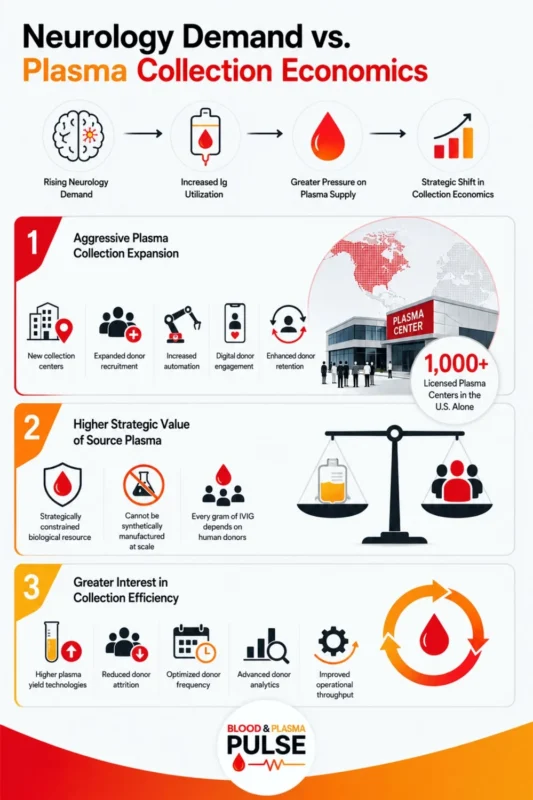
As neurology-driven Ig demand accelerates, plasma collection is evolving from a volume-focused operation into a strategic, infrastructure-driven ecosystem built on donor retention, efficiency, and long-term supply security.
The Emerging Competitive Threat: FcRn Therapies
Although neurology is currently driving Ig growth, the market is simultaneously entering a period of therapeutic disruption.
New FcRn-targeting biologics, including therapies for CIDP and myasthenia gravis, are beginning to compete directly with IVIG in selected neurological populations (Klasen, 2026).
FcRn-targeting biologics are a newer class of advanced therapeutic drugs designed to reduce harmful IgG antibodies in the body by blocking or modulating the neonatal Fc receptor (FcRn).
FcRn is a naturally occurring receptor that protects IgG antibodies from being broken down too quickly.
Under normal physiology, this is beneficial because it helps maintain long-lasting immune protection.
However, in many autoimmune diseases, pathogenic IgG autoantibodies attack the body’s own tissues. FcRn-targeting therapies intentionally interrupt this recycling process so that those harmful IgG antibodies are degraded more rapidly.
In 2024 and 2025, newer FcRn therapies gained increasing traction in the United States for the treatment of CIDP.
Early evidence suggests these therapies may slow future growth of IVIG in neurology (Klasen, 2026).
However, several realities remain important:
- IVIG continues to maintain strong physician familiarity
- Many patients remain clinically stable on IVIG
- Global access to FcRn therapies remains limited
- Reimbursement barriers persist
- Some patients fail newer biologics and return to IVIG
- Polyclonal immunoglobulin mechanisms remain difficult to replicate synthetically
As a result, most analysts expect Ig demand to continue to rise overall despite selective competitive pressures (Klasen, 2026).
Rather than eliminating demand for IVIG, FcRn therapies may eventually moderate growth rates in certain neurological subsegments.
Supply Pressure and the Return of Allocation Concerns
The neurological expansion of IVIG use has also revived industry discussions about supply adequacy and prioritization.
During previous periods of constrained supply, hospitals and patients reported treatment delays, product switching, and allocation concerns associated with rising neurological demand (Reddit user discussions, 2019).
Several structural vulnerabilities remain:
- Long manufacturing lead times
- Plasma collection dependence
- Regulatory complexity
- Geographic concentration of supply
- Limited fractionation redundancy
This has elevated strategic discussions around:
- National plasma self-sufficiency
- Domestic collection expansion
- Strategic plasma reserves
- Diversified manufacturing footprints
- Supply chain resilience
Countries increasingly recognize plasma as a healthcare security asset rather than merely a pharmaceutical commodity.

As neurology-driven IVIG demand accelerates, plasma increasingly recognized as a strategic healthcare security asset requiring resilient supply chains, domestic collection capacity, and long-term infrastructure investment.
Asia-Pacific and Emerging Market Growth
Neurology demand is not limited to North America and Europe.
Asia-Pacific markets are rapidly expanding their neurological diagnostic capabilities and access to immunoglobulin therapies.
Several countries are simultaneously investing in domestic plasma collection and fractionation infrastructure (Mordor Intelligence, 2025).
As diagnosis rates improve globally, previously underdiagnosed neurological populations may significantly expand future Ig demand.
This is particularly relevant because many current demand forecasts may still underestimate latent neurological need worldwide.
Strategic Implications for the Plasma Industry
For plasma collection organizations, fractionators, regulators, and healthcare systems, the implications are substantial.
The neurology market is contributing to:
- Sustained long-term Ig demand growth
- Continued expansion of compensated plasma collection
- Increased manufacturing investment
- Greater donor competition
- More focus on operational scalability
- Intensified reimbursement scrutiny
- Stronger emphasis on supply security
In many ways, neurology is becoming one of the defining demand-side forces shaping the next decade of plasma economics.
The industry is transitioning from a historically reactive supply model toward a more strategic infrastructure-driven model capable of supporting chronic, high-volume neurological utilization.
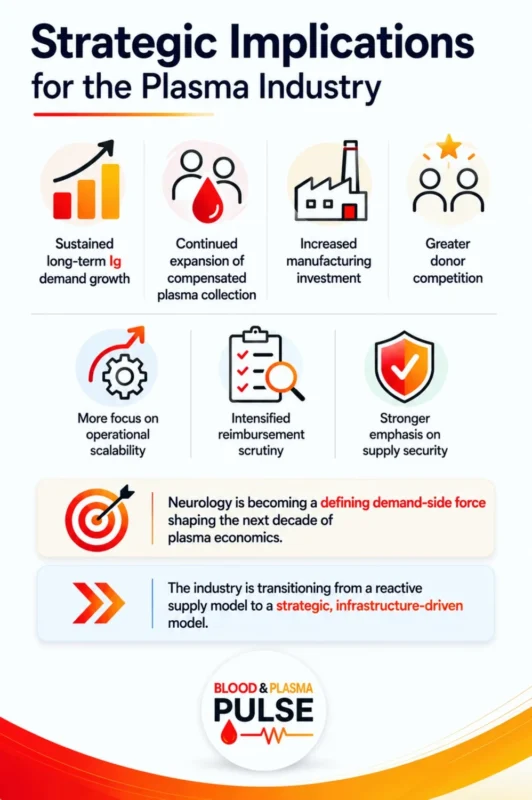
Neurology is no longer a niche driver of immunoglobulin demand; it is rapidly reshaping the future of the global plasma industry’s economics, scalability, and strategic infrastructure.
Final Thoughts
The relationship between neurology and plasma markets is becoming increasingly interconnected.
As neurological diagnoses expand and chronic Ig utilization rises, plasma-derived therapies are moving deeper into the center of modern neurological care.
This evolution is reshaping everything from donor recruitment strategies to global manufacturing investment decisions.
At the same time, the market is entering a more complex competitive landscape with the emergence of FcRn biologics and other targeted immunotherapies.
Yet one reality remains unchanged:
Every immunoglobulin therapy still begins with a plasma donor.
For the plasma industry, rising demand in neurology is not simply another growth trend.
It is a structural market transformation that will likely define plasma economics, operational strategy, and supply security for years to come.
References
- Data Bridge Market Research. (2025). Europe blood plasma and plasma derived medicinal products market size, trends, growth report 2033. https://www.databridgemarketresearch.com/reports/europe-blood-plasma-and-plasma-derived-medicinal-products-market
- DataIntelo. (2025). Plasma-derived medicinal products market research report 2034. https://dataintelo.com/report/global-plasma-derived-medicinal-products-market
- Klasen, J. (2026). Demand forecast for plasma collections. Annals of Blood. https://aob.amegroups.org/article/view/12571/html
- Mordor Intelligence. (2025). Plasma fractionation – Market share analysis, industry trends and statistics, growth forecasts (2025–2030). https://www.marketresearch.com/Mordor-Intelligence-LLP-v4018/Plasma-Fractionation-Share-Trends-Statistics-42577507/
- Precedence Research. (2025). Plasma derived medicine market to reach USD 37.4 billion by 2034. GlobeNewswire. https://www.globenewswire.com/news-release/2025/08/07/3129396/0/en/Plasma-Derived-Medicine-Market-to-Reach-USD-37-4-Billion-by-2034-Growing-at-8-05-CAGR.html.”
Stay updated with Hemostasis Today.
-
Oct 9, 2026, 16:23David Boone: Distinguishing Stroke Prevention from Rhythm Control in Atrial Fibrillation
-
Oct 9, 2026, 15:27Mohamed Hegazi: Geostatistical Modelling Maps Global β-Thalassaemia Carrier Prevalence
-
Oct 9, 2026, 15:15Maha Othman: Uncovering the Consensus on TXA in TBI – Call for Collaboration on a Landmark Umbrella Review
-
Oct 9, 2026, 15:07Daniel D. Han: How Inhalation Product Exposure Impairs Cardiac and Platelet Recovery After MI
-
Oct 9, 2026, 14:58William Toole: How Ultrasound-Guided PRP Therapy Relieves Joint and Tendon Pain
-
Oct 9, 2026, 14:50Shayan Mohammadmoradi: In Corpus Christi for the 20th Midwest Platelet Conference
-
Oct 9, 2026, 14:37Tariq Tramboo: High Platelet Concentrate for Osteoarthritis Knee – Recent Meta-Analyses
-
Oct 9, 2026, 14:26Yousma Khan: Hematology Series – Beyond RBCs, WBCs and Platelets
-
Oct 9, 2026, 14:13Jesus Ardila Novoa: Why the WHO’s Historic Essential Medicines List Decision Is Just the Beginning