


Shamee Shastry: Sharing Perspectives at the AIIMS CME on Therapeutic Apheresis
Shamee Shastry, Professor and Head of the Department of Immunohematology and Blood Transfusion at Kasturba Medical College, Manipal, shared a post on LinkedIn:
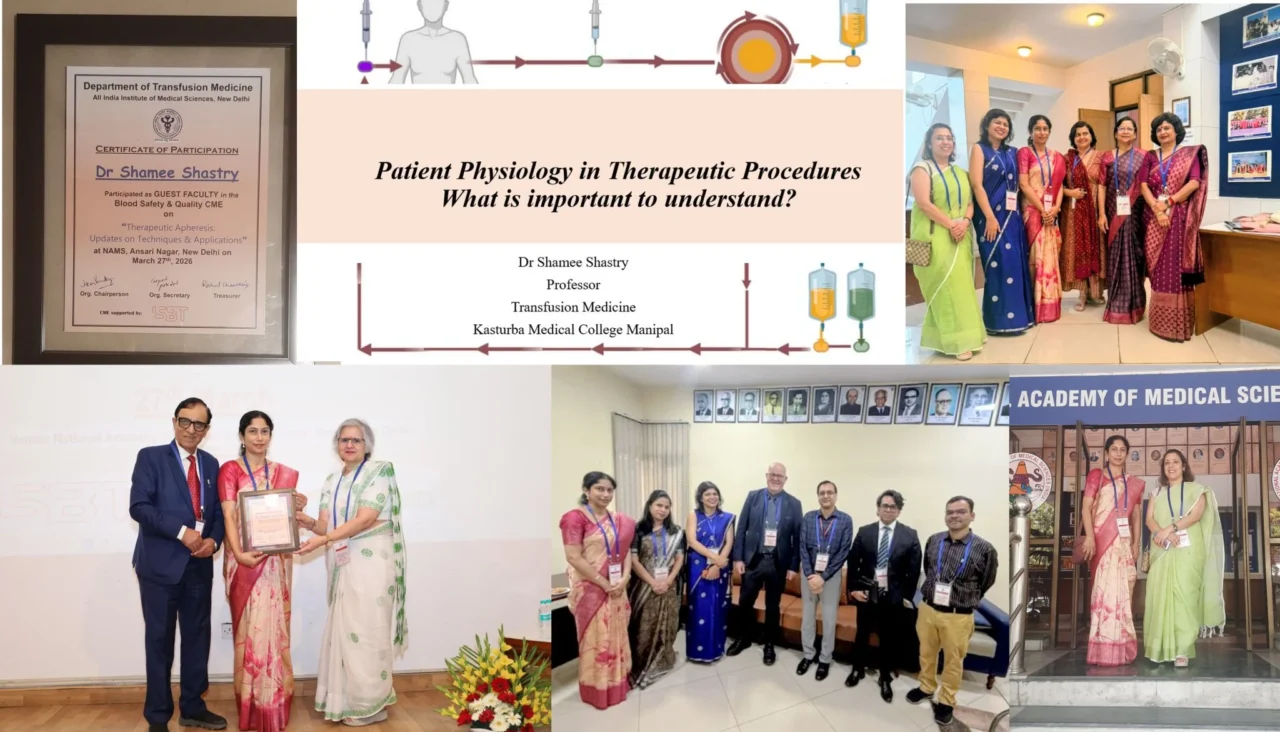
“A clear grasp of patient physiology and disease-specific pathophysiology allows apheresis physicians to deliver truly patient‑centered care.
Apheresis is more than a procedure; Understanding hemodynamics, coagulation balance, cellular integrity, immune activation, and fluid–electrolyte shifts during extracorporeal circulation is central to patient safety and therapeutic success.
It was a privilege to discuss these aspects at the AIIMS CME on Therapeutic Apheresis, organized by the Department of Transfusion Medicine, AIIMS New Delhi, with support from ISBT.
Congratulations to Dr Gopal Patidar, Dr. Hem Chandra Pandey and the entire team team on the successful conduct of the CME.
Great networking and knowledge sharing with Hans Vrielink, Dr R R Sharma, Satyam Arora, Satya Prakash, Dr Vijay Kumawat, Mohit Chowdhry, Deepti Sachan, Rahul Katharia, Sangeeta Pathak, Sangeeta Pahuja Sindhwani, Meenu Bajpai, Aseem Kumar Tiwari, Soumya Das.”
Other posts featuring Shamee Shastry on Hemostasis Today.
-
Sep 30, 2026, 01:52Javed Anees: DADA2 – When a Young Stroke Is More Than a Stroke
-
Sep 30, 2026, 01:51How a Venous Thrombus Becomes Revascularized – ISTH
-
Sep 29, 2026, 22:45Victor Agunyego: Paracetamol – The Most Common Drug We Underestimate
-
Sep 29, 2026, 22:42Nova Sinclair: Advancing the Future of Hematology – Meet Our 2027 Organizing Committee
-
Sep 29, 2026, 22:41Lorenz Räber: Intracoronary Imaging in PCI – Why, When, How, and Which Modality?
-
Sep 29, 2026, 22:31Selma Turkovic: Pleased to Deliver the Opening Presentation at Kingston Hospital
-
Sep 29, 2026, 22:31Miguel Teran: Ultrasound and Simulation in Arterial Blood Sampling
-
Sep 29, 2026, 22:28Mohammad Refaei: Navigating Your Career in Hematology From Training to Practice
-
Sep 29, 2026, 22:27Matteo Foschi: 10 Clinical Pearls for Antithrombotic Therapy in Secondary Stroke Prevention