

Simon Senanu: The Peripheral Blood Smear as an Essential Diagnostic Tool in Modern Medicine
Simon Senanu, Medical Laboratory Scientist at Perkins Medical Centre, shared a post on LinkedIn։
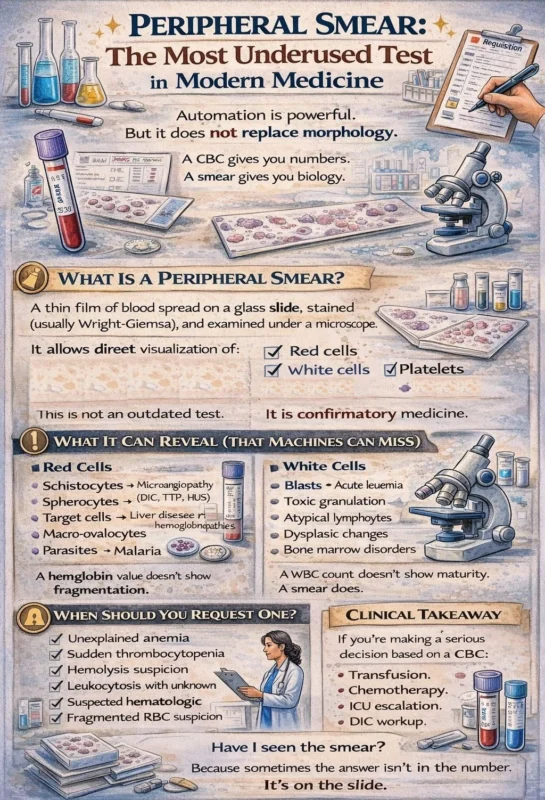
“Peripheral Smear: The Most Underused Test in Modern Medicine
Automation is powerful.
Modern hematology analyzers are fast, precise, and indispensable.
But they do not replace morphology.
A CBC gives you numbers.
A smear gives you biology.
And biology is what determines management.
What Is a Peripheral Smear?
A thin film of blood spread on a glass slide, stained (usually Wright-Giemsa), and examined under a microscope.
It allows direct visualization of:
- Red cells
- White cells
- Platelets
You are not looking at counts.
You are looking at structure, maturity, interaction, and abnormal patterns.
This is not an outdated test.
It is confirmatory medicine.
What It Can Reveal (That Machines Can Miss)
Automated analyzers classify cells using impedance, size, and light scatter patterns.
They do not evaluate morphology with clinical context.
That is where the smear becomes critical.
Red Cells
The CBC can tell you hemoglobin and indices.
It cannot show:
- Schistocytes indicate microangiopathy (DIC, TTP, HUS)
- Spherocytes suggest hemolysis
- Target cells are associated with liver disease or hemoglobinopathies
- Macro-ovalocytes are seen in vitamin B12 or folate deficiency
- Parasites indicate malaria
A hemoglobin value doesn’t show fragmentation.
A smear does.
White Cells
A WBC count tells you quantity.
It does not tell you:
- Cellular maturity
- Nuclear abnormalities
- Cytoplasmic toxicity
- Blast morphology
On a smear, you may see:
- Blasts consistent with acute leukemia
- Toxic granulation suggesting severe infection or systemic inflammation
- Atypical lymphocytes seen in viral illness
- Dysplastic changes suggesting bone marrow disorders
That distinction separates reactive leukocytosis from malignancy.
A WBC count doesn’t show maturation stage.
A smear does.
Platelets
Platelet counts are frequently misleading.
A smear can reveal:
- Clumping causing pseudothrombocytopenia (EDTA artifact)
- Giant platelets indicating increased turnover or marrow response
- True thrombocytopenia vs artifact
Before labeling immune thrombocytopenia or escalating care – confirm what you are actually seeing.
A platelet number can mislead.
A smear clarifies.
When Should You Request One?
- Unexplained anemia
- Sudden thrombocytopenia
- Hemolysis suspicion
- Leukocytosis with unknown cause
- Suspected hematologic malignancy
- Fragmented RBC suspicion
If the pattern doesn’t make sense – look at it.
Why It Matters
Automated analyzers classify by size and light scatter.
They do not understand:
- Cell shape
- Fragmentation
- Parasites
- Subtle dysplasia
Machines count.
Microscopy interprets.
Clinical Takeaway
If you’re making a serious decision based on a CBC:
- Transfusion.
- Chemotherapy.
- ICU escalation.
- DIC workup.
Pause.
And ask yourself:
Have I seen the smear?
Because sometimes the answer isn’t in the number.
It’s on the slide.
When the CBC doesn’t fit the clinical picture, do you trust the number or verify the morphology? What’s the most important finding you’ve ever caught?”
Stay updated with Hemostasis Today.
-
Oct 9, 2026, 13:55Chandler Purser: AABB 2026 Focuses on Transfusion Safety and Audit-Driven Practice Improvement
-
Oct 9, 2026, 13:48Maxime Dely: Raising Awareness for Blood Donation
-
Oct 9, 2026, 13:48Vera Ghali: Anemia in Myelofibrosis and Its Impact on Treatment Outcomes and Overall Survival
-
Oct 9, 2026, 13:32W David Freeman։ The Mechanical Penumbra in Intracerebral Hemorrhage and Its Potential for Tissue Recovery
-
Oct 9, 2026, 13:11Ayshathul Noora։ Carbetocin vs Oxytocin in Preventing Postpartum Hemorrhage
-
Oct 9, 2026, 13:07The Rebalanced Patient: New Therapies and New Thrombotic Risks in Hemophilia
-
Oct 9, 2026, 12:48Santiago Cepeda Chafla: CereBleed Simplifies Brain Hemorrhage Assessment
-
Oct 9, 2026, 12:34Abdul Muqtadir Abbasi: Pancytopenia Is a Finding, Not a Diagnosis
-
Oct 9, 2026, 12:24Mercy Lung’aho: When Diet Quality and Nutritional Biomarkers Tell Different Stories