


Simon Senanu: White Blood Cell Differential Count in Clinical Interpretation
Simon Senanu, Medical Laboratory Scientist at Perkins Medical Centre, shared a post on LinkedIn :
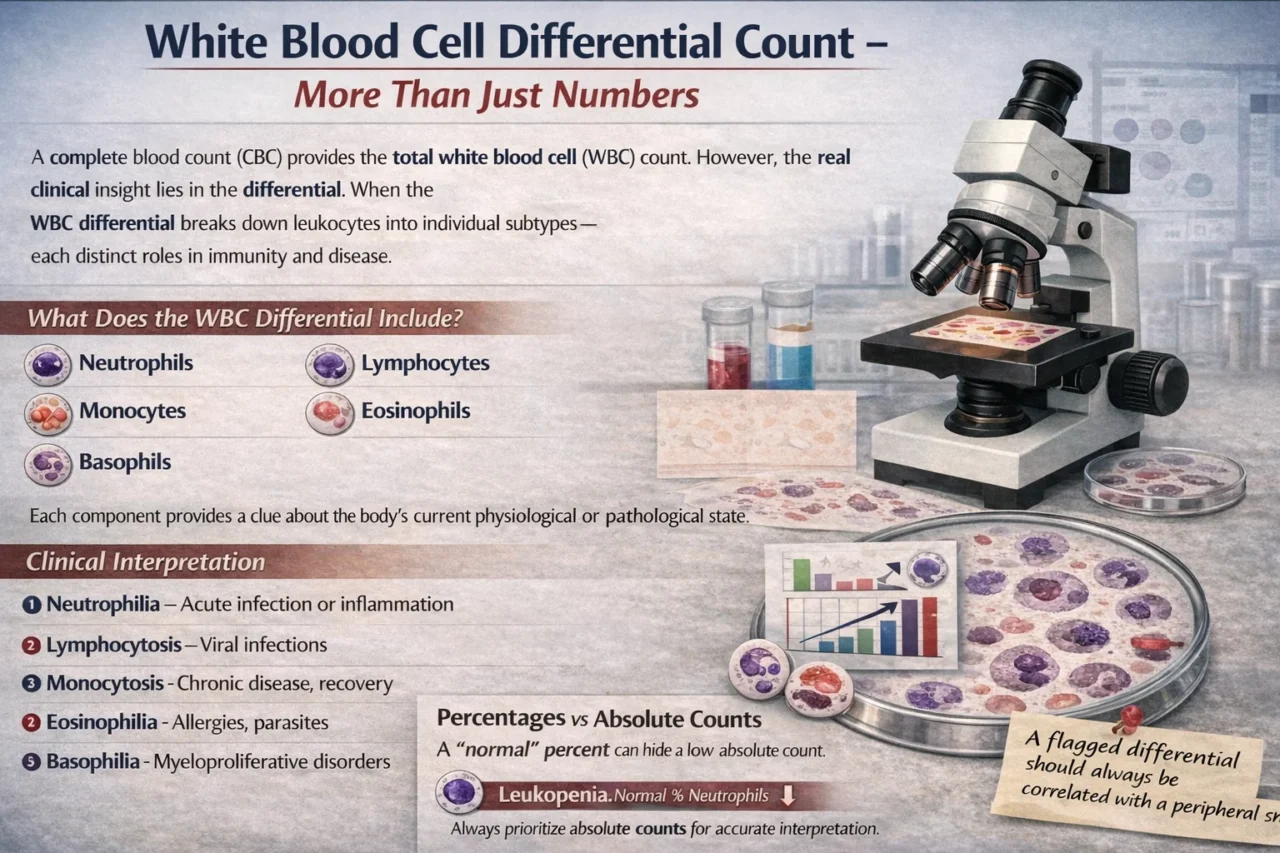
“White Blood Cell Differential Count – More Than Just Numbers
A complete blood count (CBC) provides the total white blood cell (WBC) count.
However, the real clinical insight lies in the differential.
The WBC differential breaks down leukocytes into their individual subtypes – each with distinct roles in immunity and disease.
What Does the WBC Differential Include?
- Neutrophils
- Lymphocytes
- Monocytes
- Eosinophils
- Basophils
Each component provides a clue about the body’s current physiological or pathological state.
Clinical Interpretation
- Neutrophilia indicates acute bacterial infection, inflammation, or physiological stress.
- Lymphocytosis indicates common viral infections (for example, infectious mononucleosis).
- Monocytosis is seen in chronic infections, autoimmune disorders, and recovery phases.
- Eosinophilia is associated with allergic reactions and parasitic infections.
- Basophilia is rare, but may indicate myeloproliferative disorders.
Percentages versus Absolute Counts: A Critical Distinction
One of the most common pitfalls is relying solely on percentages.
A ‘normal’ percentage can mask a clinically significant abnormality in the absolute count.
Example:
A patient with leukopenia may have a normal neutrophil percentage – but a critically low absolute neutrophil count (ANC).
Always prioritize absolute counts for accurate interpretation.
Peripheral Blood Smear – The Missing Link
Automated analyzers provide quantitative data – but morphology provides context.
Smear review can reveal:
- Toxic changes in neutrophils
- Atypical/reactive lymphocytes
- Blast cells (suggestive of leukemia)
- Platelet clumping or artifacts affecting counts
A flagged differential should always be correlated with a peripheral smear.
Laboratory Pitfalls
Even with advanced automation, limitations exist:
- Misclassification of immature or abnormal cells
- Interference from nucleated RBCs
- Cryoglobulins or platelet clumps affecting accuracy
This reinforces the importance of manual differentials in flagged or critical cases.
Takeaway
The WBC differential transforms a routine test into a powerful diagnostic tool.
In hematology, pattern recognition is everything.
When reviewing a differential, what do you prioritize first – the percentage or the absolute count?
Stay updated with Hemostasis Today.
-
Sep 21, 2026, 14:10Aswin K Mohan: Lessons from TRANSCON 2026: Building Resilient Blood Supply Systems Before Crisis Hits
-
Sep 21, 2026, 14:00Vincent Lu: Beyond PT and aPTT – How Hemostasis Evolves Across a Lifetime
-
Sep 21, 2026, 13:56Alex Knapp: Emerging Tech, Space Tow Trucks, and New Advances in Hemophilia Treatment
-
Sep 21, 2026, 13:51Abdalhakim Shubietah: pLAAO Fails Noninferiority to OAC in Landmark Meta-Analysis of 7 RCTs
-
Sep 21, 2026, 13:21In His Last UNGA, António Guterres Delivers a Urgent Call for Global Unity
-
Sep 21, 2026, 13:14Fatih Mehmet Gul: Are We Moving Faster Than Our Ability to Ask ‘Should We?’
-
Sep 21, 2026, 13:08Sangita Reddy: How Does Our Own Healthcare Journey in India Look Through the Same Lens?
-
Sep 21, 2026, 12:53Conan McIlwrath: Strengthening Haemophilia Care Through International Collaboration
-
Sep 21, 2026, 12:41Tinatin Muradashvili: Advancing Hemophilia Care Through Education and Collaboration