


Athma Dias: The Diagnostic Challenge of Inherited Platelet Function Disorders
Athma Dias, Medical Laboratory Scientist at Teaching Hospital Ratnapura, shared a post on LinkedIn about a recent article by Jonas Kaufmann et al. published in TH Open: Companion Journal to Thrombosis and Haemostasis, adding:
“A patient with a lifelong bleeding history.
- Normal PT.
- Normal APTT.
- Normal platelet count.
The haemostasis laboratory has just begun its real work.
Platelet function disorders (PFDs) are among the most common inherited bleeding disorders worldwide yet they remain one of the most diagnostically underserved areas in clinical laboratory medicine.
The core problem? The test most laboratories use to screen them is inadequate.
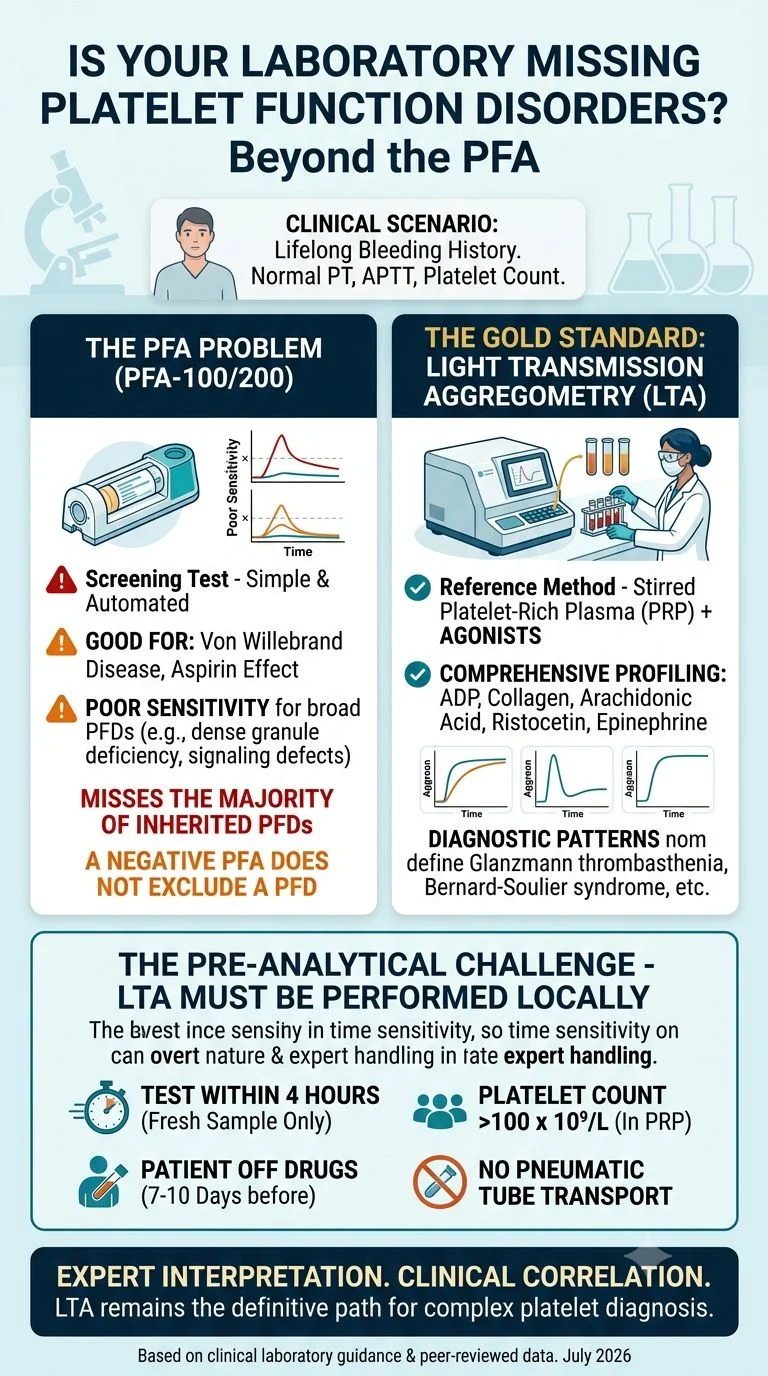
The PFA Problem
The PFA-100/200 measures closure time the time for citrated whole blood under high shear to occlude a collagen/ADP or collagen/epinephrine membrane. It is simple, rapid, and automated.
But a comprehensive diagnostic accuracy study found:
- Sensitivity for confirmed PFD: 19.5% (ADP cartridge) and 44.3% (EPI cartridge)
- Specificity: 86% and 76% respectively
The PFA reliably detects von Willebrand disease and aspirin effect. For the broader spectrum of inherited PFDs dense granule deficiency, signalling pathway defects, glycoprotein abnormalities it misses the majority.
A negative PFA does not exclude a platelet function disorder.
The gold standard: Light Transmission Aggregometry (LTA)
LTA Born aggregometry remains the reference method for PFD diagnosis. Platelet-rich plasma is stirred at 37°C and exposed sequentially to agonists while light transmission is measured:
- ADP — P2Y12 and P2Y1 receptor activation
- Collagen — GPVI and α2β1 receptor pathway
- Arachidonic acid — COX-1/thromboxane pathway; aspirin sensitivity
- Ristocetin — GPIb-IX-V / von Willebrand factor interaction
- Epinephrine — α2A-adrenergic receptor pathway
The pattern of aggregation responses across agonists defines the diagnosis:
- Absent aggregation with all agonists except ristocetin: Glanzmann thrombasthenia (GPIIb/IIIa deficiency)
- Absent ristocetin response only: Bernard-Soulier syndrome (GPIb-IX-V deficiency) or VWD
- Selective ADP hypoaggregation: P2Y12 defect or drug effect
The Pre-Analytical Demands
LTA is one of the most pre-analytically sensitive tests in the laboratory:
- PRP must be tested within 4 hours of collection platelet activation changes rapidly ex vivo
- Patients must discontinue antiplatelet drugs 7–10 days before testing aspirin, NSAIDs, clopidogrel all confound results
- Platelet count must be >100 × 10⁹/L in PRP for reliable light transmission baseline
- Sample agitation during transport activates platelets pneumatic tube systems are contraindicated
LTA cannot be sent to a reference laboratory.
It must be performed by a trained MLS on a fresh sample, in real time.
That constraint is exactly what makes platelet function testing one of the most specialised and scientifically demanding disciplines in haemostasis.”
Title: Utility of the Platelet Function Analyzer in Patients with Suspected Platelet Function Disorders: Diagnostic Accuracy Study
Authors: Jonas Kaufmann, Marcel Adler, Lorenzo Alberio, Michael Nagler
Stay updated with Hemostasis Today.
-
Jul 21, 2026, 03:19Where Does Stroke Treatment Go Next on The Latest ESOC 2026 TV Studio Session – ESO
-
Jul 21, 2026, 03:09Francesca Palandri: New Insights Into Anemia Management in Myelofibrosis
-
Jul 21, 2026, 01:57A New Approach to Understanding Plasmin Generation and Fibrinolysis – RPTH Journal
-
Jul 21, 2026, 01:52Maria Diaz Alonso: Delivering My First International Oral Presentation at ISTH 2026
-
Jul 21, 2026, 01:44Megan Preece: Presenting New Research on Antiphospholipid Syndrome at ISTH 2026
-
Jul 21, 2026, 01:28Dhamirah Nazihah Mohd Nasiruddin: A Milestone in My Haemostasis and Thrombosis Journey at ISTH 2026
-
Jul 21, 2026, 00:55Anita Brikman on PPTA’s First-Half 2026 Achievements
-
Jul 21, 2026, 00:50Caitlin Raymond: Can Therapeutic Plasma Exchange Reduce Microplastics?
-
Jul 21, 2026, 00:46Yohei Hisada: Science, Collaboration, and New Beginnings at ISTH 2026