

Craig Pearce: Hidden Blood Changes May Be Driving Long COVID Fatigue and Brain Fog
Craig Pearce, Director, Sales and Marketing at QCA Systems Ltd, shared on LinkedIn:
”A hidden physical change in the body may be helping to drive the prolonged malaise some people experience after contracting COVID-19.
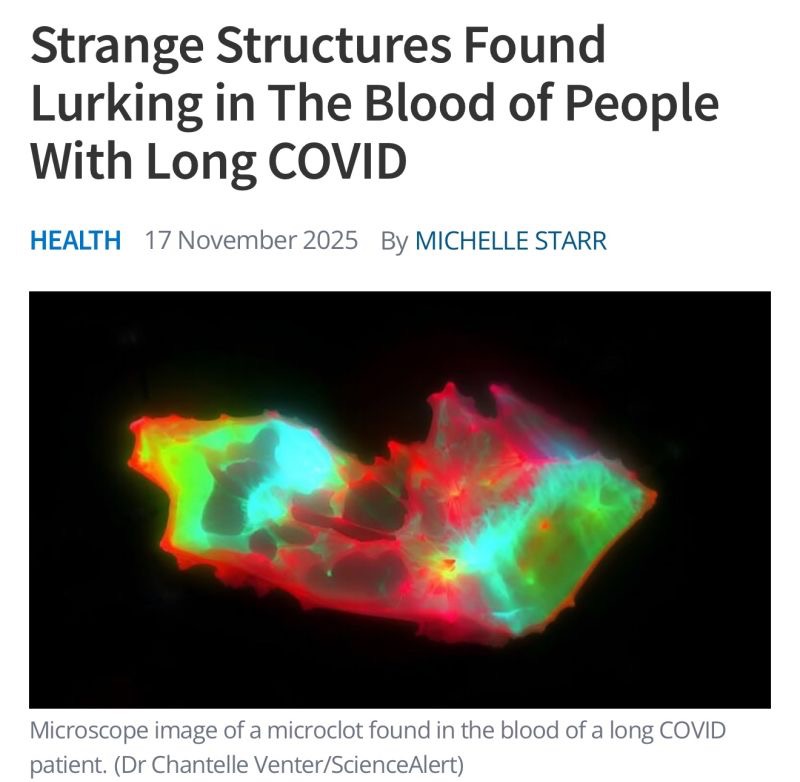
Analyzing blood samples from patients with long COVID, a team of medical researchers has identified unusual microscopic structures that may contribute to symptoms such as brain fog and fatigue.
If this is the case, it offers a hopeful target for future treatment.
The reason why some people experience symptoms for months to years after a SARS-CoV-2 infection is still something of a medical mystery, but multiple mechanisms may be at play.
One possibility first raised by physiologist Resia Pretorius of Stellenbosch University in South Africa in 2021 is microclots.
These are tiny, abnormally persistent blood clots that are smaller than those seen in conditions such as stroke or thrombosis, yet large enough to hinder blood flow through capillaries.
Meanwhile, in 2022, Thierry and his colleagues showed that patients with long COVID have elevated levels of neutrophil extracellular traps, or NETs.
These are sticky webs of DNA and enzymes released by white blood cells to capture and contain pathogens invading the body.
Normally, NETs do their job and then quickly break down, but when they are released in large numbers or persist longer than needed, they can contribute to blood flow problems such as thrombosis and atherosclerosis.
The new research – a collaboration between Pretorius and Thierry – suggests that these two separate markers, NETs and microclots, may interact in the blood of long COVID patients.
Read more here.”
Stay updated with Hemostasis Today.
-
Sep 30, 2026, 01:52Javed Anees: DADA2 – When a Young Stroke Is More Than a Stroke
-
Sep 30, 2026, 01:51How a Venous Thrombus Becomes Revascularized – ISTH
-
Sep 29, 2026, 22:45Victor Agunyego: Paracetamol – The Most Common Drug We Underestimate
-
Sep 29, 2026, 22:42Nova Sinclair: Advancing the Future of Hematology – Meet Our 2027 Organizing Committee
-
Sep 29, 2026, 22:41Lorenz Räber: Intracoronary Imaging in PCI – Why, When, How, and Which Modality?
-
Sep 29, 2026, 22:31Selma Turkovic: Pleased to Deliver the Opening Presentation at Kingston Hospital
-
Sep 29, 2026, 22:31Miguel Teran: Ultrasound and Simulation in Arterial Blood Sampling
-
Sep 29, 2026, 22:28Mohammad Refaei: Navigating Your Career in Hematology From Training to Practice
-
Sep 29, 2026, 22:27Matteo Foschi: 10 Clinical Pearls for Antithrombotic Therapy in Secondary Stroke Prevention