


Wolfgang Miesbach: How a Single Mutation Can Flip Immunity into VITT
Wolfgang Miesbach, Professor of Medicine at Frankfurt University Hospital, shared a post on LinkedIn, about a recent article by Jing Jing Wang et al, published in The New England Journal of Medicine։
”How a single mutation can flip a normal anti‑adenovirus response into a rare autoimmune clotting syndrome.
New NEJM paper on VITT after adenoviral COVID‑19 vaccines:
Genetics + somatic ‘hit’
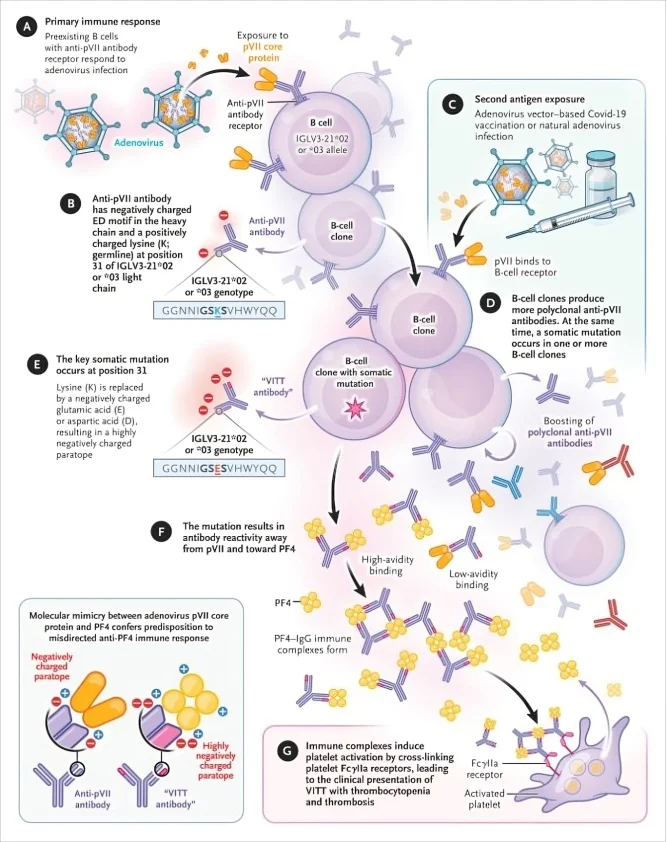
Using antibody proteomics and germline sequencing in 100 VITT patients, the authors show that essentially all pathogenic anti‑PF4 antibodies come from B cells with the light‑chain allele IGLV3‑21*02/*03 and a stereotyped mutation at position 31 (lysine → glutamic acid, K31E) in the light‑chain CDR1. This charge flip, together with acidic motifs in LCDR2 (DDSD) and HCDR3 (ED), creates a strongly negatively charged paratope that binds tightly to positively charged PF4.
The adenoviral trigger
They identify molecular mimicry between PF4 and a highly basic epitope on adenoviral core protein VII (pVII). Only pVII‑purified antibodies carried the “VITT fingerprint”, and recombinant VITT antibodies bound both PF4 and this pVII peptide. When K31E was back‑mutated to germline K31, binding shifted back to pVII, PF4 binding dropped, and thrombosis in a human PF4/FcγRIIa mouse model was almost abolished.
Mechanistic model and implications
In IGLV3‑21*02/*03 carriers, prior adenovirus exposure seeds anti‑pVII memory B cells; on re‑exposure (ChAdOx1‑S, Ad26.COV2.S, or natural infection), rare clones acquire K31E, switch specificity from pVII to PF4, expand mono/oligoclonally, and produce high‑avidity anti‑PF4 IgG that form platelet‑activating PF4–IgG immune complexes.
This nicely explains: rapid ‘secondary’ onset (from day 5), stereotyped antibodies, and restriction to adenoviral vectors.
For future adenoviral platforms: engineer or replace pVII to remove this mimicking epitope, preserving vector function while further reducing an already extremely rare VITT risk — and providing a roadmap for dissecting other boosted autoimmune complications.”
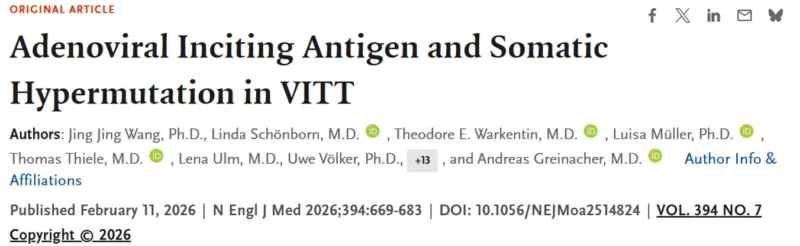
Title: Adenoviral Inciting Antigen and Somatic Hypermutation in VITT
Authors: Jing Jing Wang, Linda Schönborn, Theodore E. Warkentin, Luisa Müller, Thomas Thiele, Lena Ulm, Uwe Völker, Andreas Greinacher
Read the Full Article on The New England Journal of Medicine․
Find more posts featuring Wolfgang Miesbach on Hemostasis Today.
-
Sep 30, 2026, 15:39Ifeanyichukwu Ifechidere: The Molecular Orchestra of Primary Hemostasis
-
Sep 30, 2026, 15:28Reassessing the Benefit–Risk Balance of Extended Anticoagulation in Cancer Patients – ESC Working Group on Cardiovascular Pharmacotherapy
-
Sep 30, 2026, 15:07Chiranjeev Sharma: Targeting Factor XIa with the Synthetic Inhibitor SB-01
-
Sep 30, 2026, 14:41Bruna Gigante: Balancing Thrombosis and Bleeding in Cardiovascular Care
-
Sep 30, 2026, 14:13Ashok Choudhury: Portal Vein Thrombosis and Outcomes in Cirrhosis
-
Sep 30, 2026, 13:57Leslye Conde Bazán: When Conventional Imaging Is Not Enough – The Role of IVUS
-
Sep 30, 2026, 13:41Huda Salah Eldin: The Challenge of Balancing Antithrombotic Therapy After PCI
-
Sep 30, 2026, 13:29Abdus Salam: What Can CT Venography Reveal About the Veins?
-
Sep 30, 2026, 13:03Amira Mohy: Diagnostic Flow Cytometry Panels for Hematological Malignancies